
Have you ever noticed that some wounds heal but leave a noticeable scar?
What is a keloid scar?
Keloid scar is a type of scar that grows excessively and abnormally after the skin heals from a wound or injury. However, unlike a normal scar, keloid scars do not stop growing when the wound heals, but rather continue to expand and exceed the area of the original wound.
Causes of the appearance of keloid scars
Keloid scars appear as a result of the body's excessive response during the wound healing process. Instead of the body stopping producing collagen when healing is complete, it continues to produce it in abundance, leading to the formation of thick, raised tissue that causes the scar. Accordingly, the common reasons for the appearance of keloid scars are as follows:
- Ordinary cuts or scratches: Even minor wounds may turn into keloid scars in some people.
- Skin infections: Such as acne or smallpox may leave keloids, especially if the pimples are tampered with.
- Holes: Such as ear, nose, or body piercings, are among the common causes of keloid scars.
- Surgeries: Such as caesarean section surgeries, appendectomy, or any other operation.
- Burns: Especially deep burns, as they increase the likelihood of keloids appearing.
- Insect bites: In some people, small bites result in a keloid scar.
- عوامل وراثية: People who have family members with keloids are at greater risk.
- Skin color: People with dark skin are more susceptible to keloid formation.
Why does keloid scar form after wounds?
Keloid scars form after wounds due to a defect in the skin’s healing mechanism, as the body secretes excessive amounts of collagen, which is the protein responsible for skin healing. Therefore, it can be said that when a wound occurs in the skin, the body enters three stages until healing, which are as follows:
- Inflammation: where immune cells gather to fight infection.
- Collagen production: The body begins to produce collagen to build new tissue that closes the wound.
- Reconstruction: Collagen is rearranged so the tissue becomes smooth and similar to normal skin.
But in the case of keloids, the collagen production stage does not stop as it should, and thus the body secretes type III collagen in very large quantities, then it turns into type I and accumulates in an unorganized manner, and the result is a thick, raised scar that extends beyond the boundaries of the wound, which is the keloid scar.
Learn about: أسباب مرض الذئبة الحمراء وخيارات العلاج
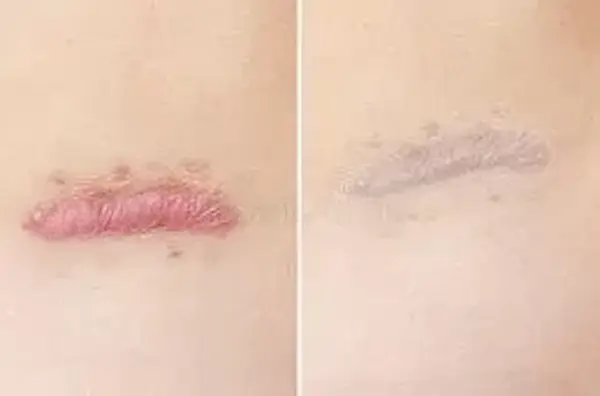
Symptoms of keloid scar
The symptoms of a keloid scar are distinct compared to the symptoms of a normal scar, and can be clearly observed as it develops. Here are the most important symptoms:
- Raised bump: The scar is clearly thick and prominent, and is often larger than the size of the original wound.
- Extending outwards: unlike a normal scar;
- Different color: The color may be red or pink at first, then turns to dark brown or purple, especially in people with dark skin.
- Different texture: It may be soft, chewy, or hard to the touch.
- Feeling itchy: Many people feel constant itching in the keloid area, especially when they begin to form.
- Pain or sensitivity: It may be painful, especially when pressed or rubbed against clothing.
- Slow growth: It does not appear suddenly, but starts small, then gradually grows over weeks or months.
- Persistent and does not go away on its own: Unlike some scars that fade over time, keloids remain persistent and increase in size.
Who is most at risk of developing keloids?
Keloid scar is an annoying skin problem that appears in some people, but there are certain groups that are more susceptible to it, and they are as follows:
- People with dark skin: such as people of African descent, as high melanin is associated with an increased possibility of excessive collagen production after wounds.
- Those with a family history: The presence of keloids in a family member increases the risk of developing it, which indicates the presence of a strong hereditary factor.
- Age group between 10 and 30 years: This group is most vulnerable, especially during puberty, when the skin's healing response is most active.
- Those who have had surgeries or piercings: such as ear piercing, plastic surgery, caesarean sections, or even minor wounds that were not treated well.
- Those who have frequent skin infections: such as acne or chicken pox, especially if the pimples are treated naturally.
How can a keloid scar be diagnosed?
The keloid scar is usually diagnosed through clinical examination only, as the doctor can easily identify it due to its distinctive shape, and the steps for diagnosis are as follows:
- Visual examination: The doctor notes the shape of the scar, its size, height above the skin, and color, then checks whether it exceeds the boundaries of the original wound.
- Medical history: The doctor asks about when the scar appeared, the type of previous wound or injury, and whether there is a similar family history.
- Excluding cases: In some rare cases, the doctor may request a biopsy of any skin sample;
Methods of treating keloid scar
Methods of treating a keloid scar vary depending on its size, location, and extent of development, and may include both traditional and modern methods to achieve the best results. Here are the most prominent methods available for treatment.
أولًا: الطرق التقليدية
- Cortisone injections (topical steroids): injected directly into the keloid;
- Silicone compresses or silicone patches: Applied to the scar daily for several hours, they help soften the scar and reduce its growth.
- Cryotherapy: It is used to freeze keloids using liquid nitrogen, and it reduces their size, but it is only suitable for small keloid scars.
- Compressive bandages: or local pressure, used after surgeries or punctures.
Second: Modern and advanced treatments
- Laser treatment: It is used to reduce the redness of keloids and improve their texture, but it does not remove them completely, and is often used alongside cortisone.
- Brachytherapy: It is used after surgical removal of keloids to prevent their recurrence, and gives good results in severe cases.
- Microneedling: Stimulates the production of structured collagen and is sometimes used with topical agents to reduce scar thickness.
- Platelet-rich plasma (PRP) therapy: Sometimes done with microneedling or laser;
- Surgery to remove keloids: Used only in difficult cases, but keloids often return unless surgery is followed by preventive treatment such as radiation or injections.
Despite the many methods of treating keloid scars, there is no single treatment that suits all cases, as the patient may need a specific method or a combination of several methods to get the best result. This is why we at the Dermatology and Cosmetic Center at Al Mousa Specialist Hospital provide various methods of treating keloid scars to suit each case. If you suffer from them, book your consultation with the Dermatology and Cosmetic Center.
Book your consultation now at مركز الجلدية والتجميل At Al Mousa Specialist Hospital.
Ways to prevent keloid scars
Although keloid scar may be caused by a genetic predisposition;
- Avoid playing with wounds or pimples, and be careful not to press or scratch the acne;
- Take good care of the wound by cleaning it and covering it with a clean bandage, while using topical antibiotics if necessary to avoid infection.
- Use silicone plasters or gel after operations or piercings. Applying medical silicone plasters helps reduce the risk of keloid formation.
- Stay away from body piercing in sensitive places such as the earlobe, chest, or shoulder, especially if you have a family history of keloids.
- Consult a doctor before any cosmetic or laser surgery;
- Use local pressure or compression bandages, especially after surgery;
- Avoid exposure to the sun on areas of recent wounds;
Frequently asked questions about keloid scar
Is keloid hereditary?
Yes, keloids can be hereditary, as people with a family history of keloid scars are more likely to develop them, especially those with dark skin.
Is it possible to get rid of keloids permanently?
Yes, it is possible to reduce the size of keloids and improve their appearance with various treatment methods, but it is difficult to remove them permanently without the possibility of them returning, so preventive treatment is important after any intervention.
Is keloid contagious?
No, keloid is not contagious at all;
If you suffer from a keloid scar and it causes you inconvenience, do not hesitate to request a consultation now from the Dermatology and Cosmetic Center at Al Mousa Specialist Hospital, as it offers you the latest treatment techniques under the supervision of a team of doctors specialized in dermatology and plastic surgery.
المصادر:
Keloid – nhs
keloid scars – my.clevelandclinic
