Cardiac rehabilitation is one of the basic branches of rehabilitative medicine, as it aims to improve the quality of life of the individual and the physical performance of cardiovascular patients, whether they suffer from various heart diseases, or from recent heart surgeries, by providing all CR services during periods of hospitalization, or in designated outpatient clinics. In addition, cardiac rehabilitation programs are developed to become several comprehensive preventive centers through which all aspects of care that prevent heart disease are provided, which include programs for losing excess weight, nutritional treatments, monitoring blood pressure, stress management, diabetes management, and management of excess body fat.
What is cardiac rehabilitation?
Cardiac rehabilitation, also known as cardiac rehabilitation, is a method that is organized with the aim of continuously improving the quality of life and quality of life while reducing the recurrence of heart disease for those who suffer from continuous recurrence and always need to go to the hospital. It also has several other characteristics as follows:
- Cardiac rehabilitation programs improve the emotional, physical, psychological, and functional lifestyle significantly for all heart patients, as all necessary steps are provided to recover from all heart diseases early, while prevention programs and modern strategies are provided to reduce their recurrence or first-time infection for those who are susceptible to it.
- The cardiac rehabilitation process is carried out by an integrated, multidisciplinary team of all specialized professionals. This team consists of a cardiologist, general physicians, and many specialized professionals, including a trained nurse and a specialist. Physical therapy, psychiatrist, occupational therapist, nutritional counselor, and pharmacist all work with the goal of a person's well-being.
- The cardiac rehabilitation program is designed to suit and meet the needs of the individual, as it combines reducing vascular and cardiovascular risks and health education for the heart, in addition to managing all cardiac exercises that achieve optimal health for the individual.
- Cardiac rehabilitation programs have been recommended by many international medical associations, the most famous of which are the Indian Cardiology Society, the American College of Cardiology, and the American Health Association.
When does a patient need cardiac rehabilitation?
Cardiac rehabilitation contributes greatly to the individual's restoration to his normal lifestyle and living a good life by reducing the risk of heart disease and exposure to it by reducing the rate of its recurrence. There are some people who need cardiac rehabilitation more than others, and they are those suffering from some diseases represented in the following:
- Heart transplant.
- Heart failure.
- Heart attack.
- Revascularization procedures.
- Cases of replacement or repair of heart valves.
- Peripheral artery disease.
- Coronary artery disease.
- Cardiomyopathy.
- Congenital heart disease.
- angina.
- Angioplasty.
- Myocardial infarction.
- Bypass surgeries.
There are no caveats to conducting cardiac rehabilitation programs up to age, which constitutes an obstacle to many medical procedures, as all cardiac rehabilitation programs are designed taking all precautions for all factors specific to the individual, including age as well.
Book your consultation now at Cardiovascular Center At Almoosa Specialist Hospital
Stages of the cardiac rehabilitation program
There are several different stages that take place during the cardiac rehabilitation program, and these stages are classified into three sections based on the length of time that the individual takes after each of these stages. Here is each stage and what it includes as follows:
The first stage: the stage of the patient’s presence in the hospital
This stage of cardiac rehabilitation begins when the patient begins the recovery stage after the end of treatment for one of his heart diseases. It begins with the rehabilitation medical team providing all information about the symptoms of heart disease, risk factors for cardiovascular disease, and signs of infection.
In addition to providing patients with all information regarding the necessary routine weight checks, and information about the health regime that is followed, through follow-up at the rehabilitation center at Almoosa Specialist Hospital.
The second stage: the early post-discharge stage
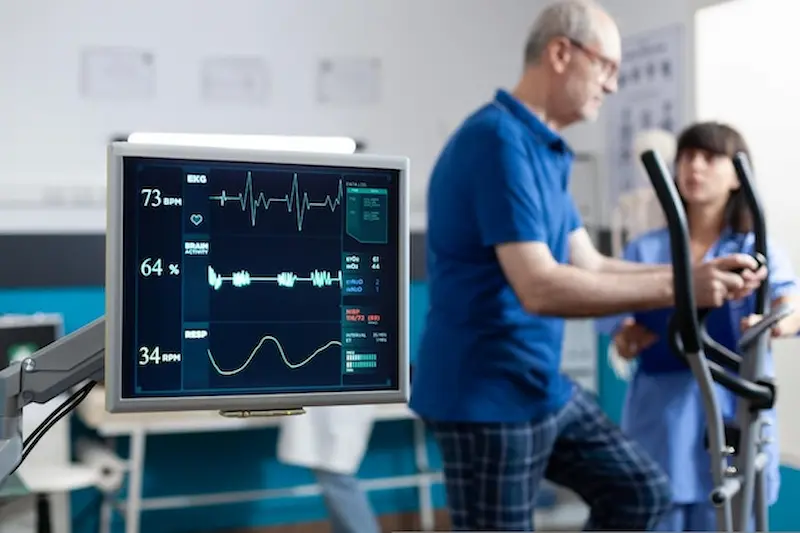
This stage of cardiac rehabilitation begins with continuous monitoring of the person’s response to the cardiac rehabilitation exercises that he follows, where the heart rate, cardiovascular indicators, and blood pressure are checked, and all required changes are made in the exercise regimen that is followed at that stage when needed.
The third stage: the late post-discharge stage
The definition of the maintenance phase is that last phase of cardiac rehabilitation in which the exercise that the patients follow is supervised and this supervision is carried out by all qualified and competent personnel while the patient remains in Rehabilitation center Until the last stages of the cardiac rehabilitation program are completed according to the recommendations of cardiologists. After completion, patients return to their home while following all exercise instructions provided by the medical supervision staff.
The role of exercise in cardiac rehabilitation
In cardiac rehabilitation programs, the exercises are planned according to the needs of the individual and his health condition. These exercises are divided into three main sections, each of which is followed according to the stage in which the individual is, and they are as follows:
Warm-up exercises
The goal of practicing warm-up exercises is to gradually increase the heart rate and blood circulation in the heart so that the heart gradually adapts to this system of exercises. In addition, warm-up exercises reduce the incidence of angina pectoris, as well as the occurrence of a disorder in the regulated heart rhythm to a large extent.
It also helps to stretch the various muscles of the body, which results in reducing the risk of injury.
Warm-up exercises usually take a short period of time, up to 15 minutes, which are divided into movement activities, stretching activities, and pulse-lifting activities.
Warm-up exercises include low-level bike riding, walking, hamstring stretches, leg extensions, and upper back stretches.
Main exercises
The main exercise takes longer than the warm-up exercises, ranging from 15 to 40 minutes. The main exercise is designed for each case as it suits it, as it varies from one case to another.
The main exercise includes swimming, walking, aerobics, and some other exercises, including steps, walking on the spot, shadow boxing, and extending the arm forward.
Cooling exercises
It is also called calming down exercises, as it helps the patient's body regain a state of rest, because suddenly stopping exercise in general can cause a drop in blood pressure, which leads to the emergence of disease symptoms, including dizziness, in addition to its contribution to maintaining the rhythmic contractions of the heart, and a continuous slowdown in the heartbeat.
During cool-down exercises, the speed of the exercises is kept gradually reduced until the body can reach the relaxation stage and resting state it was in before.
Cool-down exercises never take long and are the least time consuming of the three exercise phases, lasting only 10 to 15 minutes.
Cool-down and warm-up exercises are very necessary stages of exercise that can never be dispensed with or strengthened in the exercise regime that is followed.
Where to find the best cardiac rehabilitation centers?
There are many cardiac rehabilitation centers throughout the Arab world, especially in the Kingdom of Saudi Arabia, but you can get the best service and the most distinguished experiences at Almoosa Specialized Center for Cardiac Rehabilitation, where:
- During which a special program is designed for each case, due to the differences in health conditions from one patient to another and from one individual to another.
- The rehabilitation program includes exercises appropriate to the individual and educational guidance. This customized program aims to quickly improve the health of patients with various heart diseases, especially after suffering from heart attacks, or after cardiac surgery procedures, at the hands of a group of the best specialists and under the supervision of hospital doctors.
- The cardiac rehabilitation program consists of providing moral support and guidance for a healthy and safe lifestyle that benefits heart health, along with some exercises that take place in several different stages.
- Healthy lifestyle habits include following a healthy and nutritious diet, quitting smoking, and controlling body weight.
- The cardiac rehabilitation program includes a medical examination and then exercises, which include light activities to help reduce the possibility of heart disease. These activities include walking, light jogging, and cycling.
- In addition to some exercises that help strengthen the body's muscles, such as lifting weights, as well as practicing resistance exercises two to three times a week, which helps increase the fitness of the body's muscles.
Modern technologies used in cardiac rehabilitation programs
Cardiac rehabilitation is an integrated, multidisciplinary approach that requires coordinated efforts between multiple specialists and health care programs to result in optimal benefit for patients.
Centers specialized in providing cardiac rehabilitation programs are essential because they need advanced equipment for monitoring cardiovascular indicators and exercise, and they also need special facilities to deal with sudden cardiac complications.
Almoosa Specialized Center offers several comprehensive programs specialized in providing several preventive specializations and specializations for treatment and diagnosis for all Heart disease The center follows all scientifically proven surgical, non-surgical, and interventional practices in addition to providing comprehensive emergency services through first-class hospital facilities, which are as follows:
- Several furnished intensive care units, which are operated by a group of intensive care specialists and critical care experts.
- An intensive care unit equipped with a large number of nurses and several patient beds.
- The modern electrophysiology laboratory is equipped with 3D mapping capabilities.
- Advanced patented HDBit CT.
- Minimally Interventional Cardiology Laboratory.
- Several laboratories for cardiac flat catheterization or T.
- Non-invasive cardiac laboratory.
- A 64-slice computed tomography machine performs a non-invasive heart examination.
Top frequently asked questions about cardiac rehabilitation
Is cardiac rehabilitation effective?
Many people, especially those with heart disease, need to undergo cardiac rehabilitation, but they hesitate and wonder about the effectiveness of this rehabilitation, so we provide you with a clear answer about this matter in detail.
Many researchers on cardiac rehabilitation have found that it is very effective for all people, and its effectiveness and great benefit are not limited to patients only, as it significantly reduces heart diseases that often lead to death, as well as vascular diseases, by 58%.
In addition to reducing the incidence of sudden heart attacks by a significant percentage of up to 30% when continuing with cardiac rehabilitation in its various ways, it also reduces the chances of suffering a stroke by a very large percentage of up to 60%.
Can heart health be restored?
Rehabilitation programs to restore heart health aim to provide many programs that include intense exercise and educational information in several sessions to achieve the desired recovery and regain activity for a healthy daily life as much as possible.
Cardiac rehabilitation programs have proven to be very effective in reducing re-admission to the hospital after various cardiovascular diseases, in addition to raising the level of physical fitness and improving the level and quality of life.
Therefore, when suffering from a heart disease, such as heart surgery, a heart attack, a heart transplant, or an angioplasty, one can obtain a cardiac rehabilitation program that combines special exercises and educational sessions that are specifically designed with the aim of improving mental, physical, and emotional health together by changing and managing all risk factors.
Does the heart muscle recover after it becomes weak?
So far, no specific treatment has been discovered to fully recover from weak heart muscles, but there are several different treatment methods, the primary goal of which is to control the disease and its symptoms, not to worsen the patient’s health condition, and to reduce the risk of complications from the disease, as doctors prescribe several methods, including surgery, or using medications to achieve the following:
- Eliminate all fluids in the body by getting rid of them completely.
- Preventing blood clots.
- Reducing the speed of the heart rate and working to slow it down.
- Reducing blood pressure.
- Improve blood flow.
- Improving the heart's ability to pump blood.
It is worth noting that it is not necessary to take treatments for heart weakness, as there are some cases that only require some changes in their lifestyle, as the doctor specializing in the health condition explains to them.
Almoosa Specialized Center offers all the modern methods and techniques in treating heart diseases using cardiac rehabilitation, whether for patients or others who are at risk of heart disease. These services are provided by a group of the best physical therapists specialized in this field with accredited certificates.
Sources and references