
Studies and research around the world have recorded that the estimated incidence of congenital hip dislocation ranges between 1 to 3 per 1,000 live births, making it one of the conditions that urgently need to understand the causes and symptoms in order to deal with the problem and treat it quickly. This is exactly what we find in this article, which carries between its lines detailed information about the problem of congenital hip dislocation and how to treat it.
What is congenital hip dislocation?
Developmental Dysplasia of the Hip DDH, or congenital dislocation of the hip joint as doctors call it, is a congenital condition in which the infant is born due to the hip joint not forming normally during the growth of the fetus in the mother’s womb, so the head of the femur is unstable in the socket designated for it in the pelvic bone, which causes problems with walking and later motor development in the child.
Degrees of congenital dislocation of the hip joint
There are 3 different degrees of congenital dislocation of the hip joint, and the degree is determined through accurate medical diagnosis, and they are as follows:
- Incomplete formation: It is the lowest degree of hip dislocation, where the socket is incompletely formed, which leads to the head of the femur not being securely fixed inside it without a dislocation.
- Partial dislocation: At this degree, the head of the femur becomes partially inside the socket, but is unstable, and may easily move out of the socket. This type is the most common among the degrees of dislocation.
- Complete dislocation: This type is the most dangerous degree of dislocation, as the head becomes completely outside the pelvic cavity and there is no meeting between them, which requires urgent medical intervention.
Causes of congenital hip dislocation
The causes of congenital hip dislocation vary between causes before birth and others that occur due to wrong actions after the birth of the child, and are summarized as follows:
- Genetic or genetic factors if there is a family history of infection, which increases the possibility of infection in the newborn.
- The breech position of the fetus inside the uterus is such that the fetus’s buttocks face downward, which puts pressure on the hips.
- Females are more likely to suffer from hip dislocation due to the influence of maternal hormones that make the ligaments more flexible.
- Due to the lack of amniotic fluid surrounding the fetus inside the uterus, which reduces its movement and affects the health of joint development.
- After birth, if the baby’s legs are wrapped tightly inward, or he is carried in a position that restricts the movement of the hips, which is unfortunately one of the wrong customs widespread in Arab societies.
- You can read What are the most dangerous bone diseases?
Symptoms of congenital hip dislocation
Symptoms of congenital hip dislocation vary depending on the age of the child and are often not apparent in the first months after birth, but we will learn about some of what the mother may notice in her infant:
Symptoms in newborns
The most important symptoms that appear in newborns and require careful observation and follow-up by the mother:
- A difference in the length of the legs, where one appears shorter than the other.
- Uneven skin folds between the thighs, as there appears to be a difference between the number and shape of the folds
- Difficulty moving the legs, and the mother may find resistance from the infant with crying when trying to open the legs.
- A visible cracking sound in the joint. This symptom may be noticed by the doctor while examining and moving the hip.
Symptoms in older children
As for the symptoms that appear in older children, i.e. older than 6 months, they include the following:
- Delayed sitting, crawling, and later walking.
- Notice a protrusion in the buttocks with a curvature in the lower back in the child.
- Noticing lameness and staggering in the child when he starts walking, which causes him to lean to one side.
Diagnosis of congenital hip dislocation
Methods for diagnosing congenital hip dislocation help identify the condition early if symptoms or signs do not appear clearly in the infant. The most important diagnostic methods followed by doctors are:
First: clinical examination
The doctor usually performs a clinical examination of the newborn at each follow-up visit during the first year of birth, and the most important ways in which he diagnoses the infection are:
- Observing external signs: The doctor examines the hip and notes the difference between the length of the legs and other signs.
- Ortolani test: In which the doctor gently moves the child’s legs outward. In the event of a dislocation, the doctor hears a cracking sound.
- Barlow test: The doctor presses the legs inward to examine the head of the femur and detect an unstable hip.
Second: Imaging tests
The doctor orders some imaging tests to confirm congenital hip dislocation, including:
- X-ray: used for children over 6 months, and helps evaluate the shape and stability of the joint.
- Ultrasound: It is used for children younger than 6 months and shows the position of the head of the femur within the socket, which helps the doctor detect abnormalities in the hip joint.
Treatment of congenital hip dislocation
Congenital hip dislocation is treated in 3 different ways, depending on the age group in which the doctor intervenes, including the following:
- From birth to 6 months:
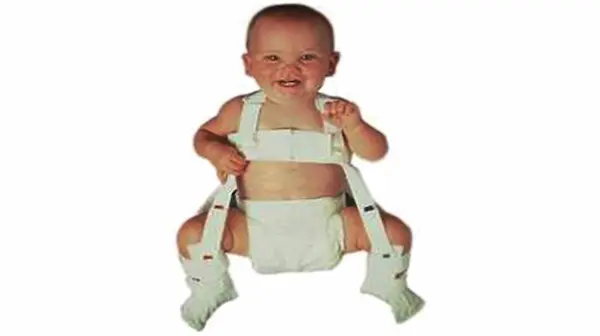
Here the doctor chooses to use the Pavlik Harness device to treat congenital hip dislocation in infants. It is a belt that fixes the legs in a specific position so that the head of the bone is in the socket. The doctor recommends wearing it for a period of 3 months under complete medical supervision. At first, the child wears it all day, then the hours are gradually reduced. - Treatment from 6 months to a year:
If the dislocation is discovered late or the Pavlik belt is not successful, the doctor chooses to expand the joint under general anesthesia. He fixes the head of the femur inside the socket without surgical intervention. The child is then placed in a splint to stabilize the joint for a period of 6 months and is changed every 6 weeks. - Treatment for a year or more:
The option here is surgery if the first methods are not successful or the dislocation is discovered at a late age. In this surgery, any tissue that prevents the femoral head from entering the socket is removed, and then the joint is immobilized with a splint for a period determined by the doctor. In some cases, the doctor makes adjustments to the pelvic bones to stabilize the joint.
The importance of rehabilitation therapy after treating congenital hip dislocation
Rehabilitation therapy is one of the most important steps that complete the basic treatment journey and help its success because it helps the child return to movement naturally, and reduces the possibility of complications by strengthening the muscles surrounding the joint, restoring the range of motion of the joint, correcting the way of walking, and preventing recurrent dislocation through appropriate exercises and devices.
Doctors specializing in Children's rehabilitation center Almoosa Specialist Hospital provides distinguished medical service and care for the child. Book your consultation now, and complete the journey of treating congenital hip dislocation, through the latest medical devices and exercises that help the child regain movement and prepare him to return to his normal life again.
Complications of congenital hip dislocation
The child is exposed to complications of congenital hip dislocation if treatment is neglected, or treatment is not started early in the child’s life. These complications include the following:
- Delayed walking, which is the least common complication that occurs to the child.
- Walking in an abnormal way, such as limping in the case of a dislocation in one side, and staggering in the case of a dislocation in both sides.
- Uneven length of the legs, which causes a problem in maintaining balance while walking and results in difficulty moving.
- Chronic pain in the lower back and hip joint with age as a result of pressure on the spine and joints.
- Permanent deformities in the shape of the pelvis and hip, such as one-sided short stature or complete body deformity.
- Due to the lack of normal use of the joint, the patient may experience premature osteoarthritis at the age of twenty or thirty.
If you have a child suffering from congenital hip dislocation and want to start a safe and effective treatment journey, contact the specialized doctors at Almoosa Specialist Hospital in Al-Ahsa to begin the treatment that suits your child’s age after making an accurate diagnosis, in addition to continuing the treatment journey with Al-Moussa Center for Physiotherapy and Rehabilitation... With us, you are safe.
FAQs
Below we answer the most important questions we receive about congenital dislocation of the hip joint:
Is congenital hip dislocation dangerous?
Yes, but if early treatment is neglected and the child is not followed up with a specialist doctor, then the child is exposed to many complications, including severe pain, inability to walk, and unequal length of the legs.
How do I know if my child has a hip dislocation?
You can detect hip dislocation in your child if the length of the legs is unequal and the child finds difficulty and resistance when changing diapers, in addition to a severe crackling sound when moving the hip joint.
Can congenital hip dislocation be cured?
Yes, congenital hip dislocation can be cured, especially if it is detected and treated early. Doctors tell us that the cure rate may exceed 90% in some cases, especially in newborns to 6 months old.
What is the treatment for hip dislocation in newborns?
Treatment of hip dislocation in newborns aims to return the head of the femur to its place inside the socket using a Pavlik belt, as we mentioned before. In most cases, this device returns the joint to its place without surgical intervention.
Sources and references
Developmental Dysplasia of the Hip – kidshealth
Developmental dysplasia of the hip – kidshealth
