
Demyelinating disease refers to a group of conditions that affect the nervous system, in which the layer of the myelin sheath that acts as an insulator is damaged, leading to a wide range of neurological symptoms. These diseases may appear in different forms, most notably multiple sclerosis, but they also include other conditions such as myelitis and optic neuritis. This article presented by Almoosa Specialist Hospital aims to provide a comprehensive overview of these diseases, starting with understanding the common symptoms that may indicate their presence, passing through the advanced diagnostic methods that doctors at the hospital use to confirm
What is demyelinating disease?
It is a group of medical conditions that cause damage to the myelin sheath, which is the protective covering that surrounds nerve fibers in the nervous system, meaning that it acts as an insulator covering electrical wires, which helps transmit nerve signals quickly and efficiently between the brain and the rest of the body.
When this sheath is damaged, nerve signals slow or stop completely, resulting in a wide range of neurological symptoms.
What are the different types of demyelinating disease?
The classification of types of demyelinating disease depends on the affected organ or the mechanism causing the disease. The most prominent types of the disease include the following:
- Multiple sclerosis, which is the most famous type of demyelinating disease, where the body's immune system attacks the myelin sheath in the central nervous system of the brain, spinal cord, and optic nerve, causing inflammation and damage that leads to sclerosis in several areas.
- Neuromyelitis optica, which was previously considered a form of multiple sclerosis, but is now classified as a separate disease, is characterized by the presence of antibodies that attack a specific protein in the central nervous system, causing severe attacks of inflammation of the optic nerve and spinal cord, often leading to loss of vision and weakness or paralysis of the limbs.
- Optic neuritis may be an isolated symptom, or the first sign of another demyelinating disease such as multiple sclerosis, as it usually causes pain with eye movement, and weakness or temporary loss of vision.
- Transverse myelitis, an acute inflammation of the spinal cord, leading to damage to the myelin sheath. Symptoms include severe weakness or paralysis of the lower extremities, loss of sensation, and bladder and bowel problems.
- Acute disseminated encephalomyelopathy, a rare disease that often occurs after a viral infection or receipt of a vaccine, causes widespread inflammation of the brain and spinal cord, resulting in sudden and severe neurological symptoms and usually a single attack, unlike multiple sclerosis.
- Chronic inflammatory demyelinating polyneuropathy. This disease differs from previous types in that it affects the peripheral nerves and not the central nervous system, causing gradual muscle weakness and loss of sensation. It usually begins in the lower extremities and then extends to the upper extremities.
Learn about: Everything you need to know about neurological communication disorders
Causes of demyelinating disease
In general, there is no single, specific cause of demyelination, but rather it is the result of a complex interaction between several factors, with researchers focusing on the fact that these diseases, the most famous of which is multiple sclerosis, are considered autoimmune diseases, where the body’s immune system attacks the myelin sheath by mistake.
The most prominent factors that are believed to contribute to the development of these diseases include the following:
- Genetic factors: Genes play a role in increasing the probability of infection, but the disease is not directly hereditary, as having a family history of autoimmune diseases or multiple sclerosis increases the risk of infection, but this does not necessarily mean that the person will develop the disease.
- Viral infection. Many researches indicate that some viruses may increase the risk of infection, especially the Epstein-Barr virus, which causes infectious mononucleosis. It is believed that the virus may stimulate an incorrect immune response that leads to attacking the myelin sheath.
- Vitamin D deficiency: There is a clear link between low levels of vitamin D and an increased risk of infection, especially in areas far from the equator where sunlight is less.
- Smoking: Smoking is a proven risk factor that increases the probability of infection and accelerates the development of the disease.
- Immune factors are the basic mechanism of the disease, as it is an incorrect response of the immune system.
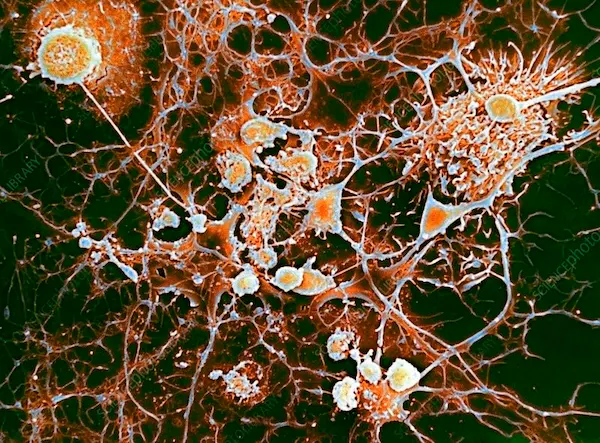
Symptoms of demyelinating disease
Symptoms of demyelinating disease vary widely from person to person.
- Muscle weakness in one or more limbs, making it difficult to walk or lift objects.
- Difficulty with balance and coordination, causing an unsteady gait, ataxia, or dizziness.
- Muscle spasms and a feeling of muscle stiffness or painful spasms, especially in the legs.
- Feeling numb or tingling like pins and needles in different parts of the body.
- Suffering from acute or chronic nerve pain, such as facial pain or nerve pain in the extremities.
- Excessive sensitivity to touch, and feeling pain upon light touch that does not usually cause pain.
- Blurred vision and blurred vision, usually in one eye.
- Feeling pain when moving the eye.
- Partial or complete loss of vision in one eye, which may be temporary.
- Double vision, meaning seeing two images of the same thing.
- Fatigue and general exhaustion, which is the most common symptom, is not just a normal feeling of fatigue, but rather an exhaustion that prevents the patient from completing daily tasks, and does not improve with rest.
- Difficulty concentrating or remembering information.
- Mood changes and fluctuations, depression or anxiety.
- Bladder and intestine problems, manifested in frequent or urgent need to urinate, urinary incontinence, and chronic constipation.
How is demyelinating disease diagnosed?
Demyelinating disease is diagnosed at Almoosa Specialist Hospital through a comprehensive process that includes several steps, including:
- Clinical examination and medical history
The doctor examines the symptoms that the patient suffers from, the date of their appearance, and the extent of their impact on his life. This includes examining eye movement and visual acuity, testing muscle strength in the extremities, monitoring walking and the ability to perform fine movements, and examining the sensation of touch, pain, and temperature. The doctor also asks about a family history of autoimmune diseases or neurological diseases.
-
Magnetic resonance imaging
It is the most important diagnostic tool for demyelinating disease, as MRI uses radio waves and a strong magnetic field to create detailed images of the brain and spinal cord, so that areas of damage that have occurred due to the erosion of the myelin sheath appear as white spots in the images, and a special dye may be injected to determine whether there are areas of active inflammation, which indicates a new attack of the disease.
-
Lumbar puncture
The doctor withdraws a sample of the cerebrospinal fluid surrounding the brain and spinal cord, and then it is analyzed in the laboratory to look for certain antibodies that are a strong indicator of demyelinating diseases, especially multiple sclerosis, or certain levels of proteins that indicate the presence of inflammation in the nervous system.
-
Excitation voltage tests
To measure how quickly nerve signals are transmitted in certain paths;
Book your consultation now at Neuroscience Center At Almoosa Specialist Hospital.
Treatment of demyelinating diseases
Treatments for demyelinating diseases mainly aim to manage symptoms, slow the progression of the disease, and improve the patient’s quality of life. There is currently no definitive treatment that completely cures these diseases, but available treatments greatly help control the condition, and include:
Treatment of acute attacks (relapses)
In cases of relapses in which symptoms appear suddenly and severely, the following treatment is used:
- Corticosteroids, given intravenously for a short time, are primarily aimed at reducing inflammation and reducing the severity of the attack, which helps you recover faster.
- Plasma exchange, used in severe cases that do not respond to corticosteroids, where the patient's blood is drawn and the plasma containing the antibodies causing the disease is separated, then the blood is returned to the body with a replacement fluid.
Disease-modifying therapies
It is an essential part of the management of demyelinating diseases such as multiple sclerosis, as it aims to reduce the number of acute attacks, prevent the formation of new lesions in the nervous system, and slow the progression of the disease in the long term. It includes:
- Medications by injection under the skin or into the muscle: such as interferon beta and glatiramer acetate.
- Oral medications: such as fingolimod, teriflunomide, and dimethyl fumarate.
- Intravenous medications, such as natalizumab and ocrelizumab, are given at intervals in the hospital, and are very effective in active cases of the disease.
Supportive treatments and symptom management
In addition to medications that treat the disease itself, there are other treatments that are used to control symptoms and improve the patient's quality of life, including:
- Medications to control muscle spasms: such as baclofen or tizanidine.
- Anti-fatigue medications: such as amphetamines.
- To improve bladder and bowel function: special medications or lifestyle changes.
- Certain medications to calm the nerves.
- Physical therapy: helps maintain muscle strength and improve balance and flexibility.
- Occupational Therapy: Provides tips and techniques to help patients complete daily tasks more easily.
- Psychotherapy: to deal with depression, anxiety, and mood changes associated with the disease.
Learn about: The best ways to treat peripheral neuritis Causes and symptoms
What precautions can help prevent demyelinating disease?
In fact, there is no surefire way to prevent demyelinating disease, because its causes are still not fully understood and depend on a complex combination of genetic and environmental factors.
However, research suggests that there are some precautions that may help reduce your risk or delay the onset of symptoms, especially in the case of multiple sclerosis, including:
- Maintain adequate vitamin D levels through sun exposure: moderate exposure to direct sunlight, eating foods rich in vitamin D, and taking vitamin D supplements.
- Quit smoking.
- Avoid viral infections, maintain good personal hygiene and strengthen immunity in general.
- A healthy, balanced diet to support nervous system health and reduce inflammation may have a protective effect.
Frequently asked questions
Is demyelinating disease dangerous?
Yes, demyelinating disease can be serious depending on its type, severity, and the area of the nervous system affected. Some cases are mild and can be improved, while others may cause permanent disability. Early diagnosis and adherence to treatment play a major role in improving results.
What causes demyelinating diseases?
Demyelinating disease does not have a single, specific cause. Rather, it is the result of a complex interaction between several factors as we mentioned previously. In general, it is classified as an autoimmune disease in which the body's immune system mistakenly attacks the myelin sheath, leading to its damage.
Does the myelin layer regenerate?
Yes, the myelin layer has the ability to regenerate naturally in the body, and this process is known as remyelination. However, there are factors that affect the efficiency of this process, especially in cases of demyelinating diseases.
In the early stages of some diseases, such as multiple sclerosis, the remyelination process is relatively effective, which contributes to the periods of calm and improvement that the patient experiences, but as the disease progresses, this process becomes less efficient and gradually stops due to damage to the myelin-producing cells and the effects of chronic inflammation hinder the repair process, and scars may form in the areas of damage, making it difficult for the new myelin to adhere to the nerve fibers.
In conclusion, of course, demyelinating diseases represent a medical challenge that requires deep understanding and rapid intervention, and although the diagnosis may be confusing at first, advances in medical research have opened broad horizons in the field of diagnosis and treatment.
Almoosa Specialist Hospital effectively contributes to providing comprehensive care for demyelination patients, thanks to its specialized medical team and advanced technologies.
Do not hesitate to contact us on our numbers listed on the website for more details, reservations and inquiries.
Medical references
Causes of demyelination and demyelinating diseases – healthline
Overview of Demyelinating Disorders – msdmanuals
