
Otoplasty surgeries are among the surgical procedures that aim to improve the shape of the outer ear, whether in terms of protrusion, size, or symmetry with facial features. Many people resort to them who suffer from congenital or acquired deformities that have affected their appearance and self-confidence. These surgeries are also distinguished by their effective results and their ability to achieve aesthetic balance in the face, making them a popular choice for children and adults alike. In the following lines with Al Mousa Specialist Hospital, we will review together everything you need to know about ear plastic surgery, starting with the reasons.
What are ear plastic surgery?
Otoplasty is a group of surgical procedures that help modify the shape of the outer ear to improve its appearance or correct congenital or acquired deformities. Otoplasty includes what is known as otoplasty, which is a process to correct the protrusion of the ear, reduce its size, or reshape the outer edge or earlobe. It is usually performed under local or general anesthesia, depending on the case, and the results are often permanent. It can also be performed on children after the age of five, when the ear has fully developed, and adults can also resort to it at any time, especially
Reasons for resorting to ear plastic surgery
People's motivations for undergoing otoplasty vary between medical and cosmetic reasons. Some patients are born with congenital deformities such as a protruding, folded, or deformed ear as a result of defects in the cartilage. Deformities can also occur as a result of accidents, injuries, or even burns that change the shape of the outer ear. From a psychological standpoint, many people suffer from low self-confidence and a feeling of embarrassment, especially when interacting socially, taking pictures, or choosing certain hairstyles that leave the ears exposed. Parents may also resort to the procedure.
1. Congenital deformities in the shape of the ear
Some people are born with deformities in the structure of the ear, such as excessive protrusion, folded or asymmetric ears, which affects the general symmetry of facial features. These conditions usually appear in the early stages of childhood, and parents may notice them immediately after birth or when the child grows. The most common of these deformities are:
- Protruding ears.
- Cup ear.
- Absence of parts of the ear (such as microtia)
2. Accidents and injuries
Accidents can cause damage or deformity of the outer ear, such as:
- الحروق.
- Deep wounds or cuts.
- Traffic or sports accidents.
- Animal bites.
These cases may require surgical intervention to repair or reconstruct the ear, which is considered plastic or reconstructive surgery.
3. Psychological and social effects
The psychological aspect plays an important role in the decision to undergo the operation, as some people, especially children and teenagers, suffer from bullying or negative comments because of the unusual shape of their ears, which may lead to:
- Lack of self-confidence.
- Weakness in social relationships.
- Refusing to participate in school activities or appear in photos.
4. Aging and changing ear shape
As we age, the ear may undergo some cosmetic changes, such as:
- Sagging earlobes.
- Looseness of the ear skin.
- The appearance of wrinkles or stretching as a result of wearing the earring for long periods.
Some resort to simple surgery to tighten and reduce the earlobe or restore its original shape.
5. Cosmetic desire
Even without an obvious deformity or injury, some may simply want to improve the appearance of the ear to achieve better symmetry between the ear and the face, or to bring the ear closer to the head if it protrudes slightly and is uncomfortable to the eye. This motivation is common among adults who seek to improve their features, in accordance with their own standards of beauty.
6. Correction of previous unsuccessful surgeries
Some patients resort to otoplasty due to unsatisfactory results of previous operations, whether the reason is poor surgical planning, poor wound healing, or imbalance between the ears, which requires corrective intervention to restore the desired symmetry.
Learn about: كل ما تحتاج معرفته عن عملية تجميل الانف
What are the types of ear plastic surgery?
Types of ear plastic surgery include several options that vary according to need and medical condition, the most prominent of which are the following:
1. Ear reduction surgery
This operation is used to reduce the size of the auricle when it is larger than normal compared to the size of the head or face. Part of the cartilage and skin is removed from the ear and reshaped in a way that makes it appear smaller and more symmetrical. This surgery is often performed for purely aesthetic reasons, and may be requested by adult patients who feel that their ear is prominent or asymmetrical.
2. Prominent ear plastic surgery
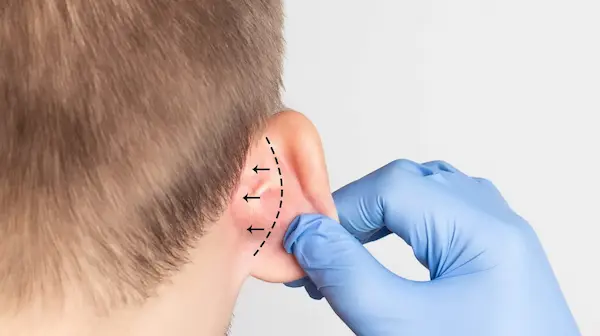
This operation is very common and aims to reshape the ear that protrudes or is far from the head. The surgeon reattaches the ear close to the scalp using permanent cosmetic threads, or by reshaping the cartilage. This surgery is preferred for children between the ages of 5 and 14 years, but it can be performed for adults as well.
3. Ear reconstruction
This surgery is used in cases of congenital deformities such as microtia syndrome or loss of the ear as a result of an accident or injury. Usually, cartilage taken from the patient’s ribs or safe synthetic materials is used to reshape the entire ear. These operations are performed in several stages, and often require a medical team specialized in reconstructive surgery.
4. Earlobe beautification
This procedure is considered one of the simplest types of ear plastic surgery and is used to treat the following:
- Drooping or sagging earlobes.
- Tears caused by heavy earrings or accidents.
- Having an old hole is not desirable.
The procedure includes getting rid of excess skin and suturing the earlobe, to restore its harmonious shape. The procedure is also performed under local anesthesia and is a simple and quick operation.
5. Correction of previous operations
Some patients need re-surgery to correct unsatisfactory results from previous otoplasty. The modifications may include adjusting the angle of protrusion of the ear, correcting asymmetry, or treating a prominent scar. This surgery requires great experience, as it is performed in an area that has undergone previous surgical intervention, so it requires precision.
6. Laser ear beautification
Laser techniques are used in some cases to reduce bleeding and speed up wound healing during traditional surgery.
But it is not a complete alternative to surgery, but rather an adjunct to certain types of operations such as earlobe reduction or improving the skin around the ear.
7. Ear plastic surgery for infants
Otoplasty for infants is not considered surgery in the traditional sense, but it is a non-surgical method that is used during the first weeks after birth, to correct the shape of the deformed ear using special splints. Its results are also very effective, but if intervention is done early, this process often eliminates the need for surgery in the future.
It should be noted that the types of ear plastic surgery vary depending on the medical condition, the existing deformity, and the extent of the patient’s need for surgical or cosmetic intervention. The specialist doctor determines the appropriate type after a detailed examination and discussing the objectives of the operation with the patient or his guardian.
Book your consultation now at مركز الجلدية والتجميل At Al Mousa Specialist Hospital.
Basic steps of ear plastic surgery
Below we will review a detailed explanation of the basic steps involved in ear plastic surgery, which differ slightly depending on the type of operation and its purpose, but the general structure of the procedure includes the following stages:
1. Medical evaluation and pre-operative planning
Before undergoing surgery, the doctor begins the stage of diagnosis and clinical examination, and the shape, size, and position of the ear in relation to the head is evaluated. The doctor discusses with the patient or his guardian if the patient is a child, and discusses the desired goals of the operation. The doctor also asks the patient to perform some medical tests to ensure that there are no health problems that would prevent surgery. At this stage, the doctor also explains to the patient the steps of the operation and the expected risks, as well as the recovery period.
2. Choose the type of anesthesia
For children, general anesthesia is used to ensure complete comfort during surgery. For adults, local anesthesia can be used with simple sedatives depending on the type and duration of the operation. The type of anesthesia is chosen in coordination with the anesthesiologist based on the patient’s health condition.
3. Making a surgical incision
The surgical incision is usually made behind the ear in the natural fold between the ear and the head, to reduce the visibility of the scar after surgery. In some special cases, the incision may be made from the front within the natural wrinkles of the ear. The purpose of the incision is to reach the ear cartilage to reshape it or reduce its size as needed.
4. Cartilage modification and ear reshaping
The ear cartilage is sculpted and modified according to the desired shape, whether to reduce protrusion, reduce size, or correct a deformity. The ear can be fixed backwards using permanent stitches to make it closer to the head. In some cases, part of the cartilage or skin is removed to achieve the desired symmetry. This step requires high precision to maintain symmetry between the ears.
5. Close the wound and bandage the ear
After completing the adjustment to the shape of the ear, the wound is closed using fine cosmetic stitches, and special bandages are placed around the head to hold the ear in its new position and protect it from any shocks. The doctor may also recommend wearing a compression headband within the first week or more of the operation, especially while sleeping.
6. Follow-up after the operation
The patient is monitored for a short period after the operation, ranging from several hours or one night in some cases. The patient is given precise instructions regarding cleaning the wound, taking medications, and avoiding strenuous activities. The stitches are also removed in the clinic after about a week if they are not dissolvable. It is best for a follow-up visit to monitor the results of the operation and ensure that the ear is healing well.
Who are the ideal candidates for ear plastic surgery?
The ideal candidate for ear plastic surgery is a person who suffers from a clear problem in the shape of his ear that affects his appearance or psychology. He must be in good general health and not suffer from chronic diseases that may affect wound healing. For children, it is preferable that the child be five years old or older because the ear is mature enough to undergo surgery. It is also necessary for the person to have realistic expectations about the results and understand the procedures and medical recommendations included in the operation. Likewise, people who are non-smokers or who can stop smoking for a period before and after the operation are considered
Learn about: 7 ممنوعات بعد عملية تجميل الأنف تعرف عليها الآن
Complications of ear plastic surgery
Otoplasty surgeries are relatively safe surgeries when performed by a specialist doctor, but like any surgical procedure, they are not without some potential risks, whether in the short or long term, including the following:
-
Infection after surgery
One of the most common complications in any surgical operation, infection can occur at the site of the surgical incision or in internal tissues. It appears in the form of severe redness, abnormal swelling, increasing pain, or abnormal discharge from the wound. Severe infection may require treatment with antibiotics, and sometimes reopening the wound to clean it.
-
Swelling and bruising
It is normal for slight swelling to occur after the operation, but it may increase in some cases and last longer than expected. Bruising around the ear or face usually disappears within two weeks, but it may bother the patient temporarily. Using cold compresses and raising the head while sleeping reduces the severity of the swelling.
-
Visible or asymmetric scars
Surgical incisions are often made behind the ear to reduce the appearance of the scar. In some cases, surgery may leave a scar that is thicker or more prominent than expected. It is possible to use specialized creams or perform cosmetic laser treatment to improve the appearance of the scar later.
-
Asymmetry of the ears
A slight difference in the position or shape of the ears may occur after the operation, due to factors such as: asymmetric healing, movement of the ear during healing, or an error in surgical planning. In striking cases, a simple adjustment can be made after several months.
-
Problems with sensation or numbness
The patient may feel numbness or numbness in the ear area or behind it, due to the impact of small nerves during surgery. This condition is often temporary and improves with time, but in rare cases it may be permanent.
-
Fluid buildup (seroma)
Some fluid may accumulate under the skin after surgery, which is known as a seroma. This sometimes requires manual drainage using a medical needle, and this can be prevented by wearing a compression headband after the operation.
-
Adverse reaction to anesthesia
Some patients may experience nausea, dizziness or sensitivity after anesthesia, and in very rare cases, a severe allergic reaction can occur that requires prompt medical intervention.
-
Dissatisfaction with the final result
The patient may feel that the ears do not look as expected or hoped for, and sometimes the reason is unrealistic expectations before the operation, and in some cases, a simple corrective operation can be used.
-
Loose stitches or open wound
The stitches may come loose if the patient does not follow the doctor's instructions or is exposed to direct pressure on the ear, and opening the wound may require re-stitching and repeating the healing period.
-
Skin irritation or itching
Some people may suffer from an allergy to bandages or materials used in sutures, and this condition appears in the form of redness or annoying itching, and is treated using soothing creams.
Frequently asked questions
How long does the recovery period from ear plastic surgery take?
The recovery period for ear plastic surgery ranges between one to two weeks initially, and the patient can return to his daily activities after about a week, while full recovery is completed within about a month.
What is the success rate of ear surgery?
The success rate of ear plastic surgery reaches between 90 and 95 percent, especially when performed by a specialized doctor who adheres to modern medical standards.
Is ear surgery dangerous?
Ear plastic surgery is not dangerous in general. It is considered a simple cosmetic procedure, but like other surgical procedures, it may carry some risks that can be avoided with good planning and choosing the appropriate doctor.
If you are thinking about improving the shape of the ear or correcting any defects that affect your appearance and self-confidence, Al Mousa Specialist Hospital is the ideal choice. Book your appointment now and prepare for a safe experience that enhances your self-confidence.
المصادر:
Ear Surgery – plasticsurgery