
Hearing the fetal heartbeat is one of the most important moments that any mother experiences during pregnancy. When a mother hears her child’s heartbeat for the first time, all sounds around her stop, and the feeling of fear and hope is mixed with overwhelming, indescribable joy.
The fetal heartbeat begins as a faint sound similar to the crackling of a small drum, then gradually accelerates as pregnancy progresses.
So if you want to know all the details about the fetal heartbeat, and what are the reasons for its absence, follow this article with me.
When does the fetal heartbeat start?
The beginning of the fetus's heartbeat is one of the most important stages of its development.
Normal fetal heart rate at each stage of pregnancy
The doctor measures the fetus's heart rate through the number of beats per minute during pregnancy, and this measurement helps evaluate the fetus's condition during prenatal visits or labor.
The normal fetal heart rate ranges from 110 to 160 beats per minute.
The fetus's heart rate may increase to 170 beats per minute around week 9, then slow to about 110 beats per minute after that.
The average fetal heart rate varies depending on the stages of pregnancy, e.g
| weeks | Heart rate |
| From the fifth to seventh week. | The fetal heart begins to grow around the fifth week, and the fetal pulse rate ranges between 90 beats to 110 beats per minute. |
| The eighth to twelfth week. | The heart rate increases to an average of 140 to 170 beats per minute by the ninth week. |
| Week thirteen to twenty-six. | The average heart rate ranges from 110 to 160 beats per minute. |
| Week twenty-seven to forty. | The fetal heart rate increases from 110 beats per minute to 160 beats per minute. |
The fetal heart rate may also vary throughout the day and night, and may reach from five to 25 beats per minute, due to the level of fetal activity.
The heart rate increases during movement and decreases during sleep.
Learn about: متى تبدا حركة الجنين والفرق بين حركة الذكر والأنثى
Methods for detecting fetal heartbeat
The doctor can detect the fetal heartbeat in many ways, including:
1- Ultrasound
A pregnant woman may undergo an ultrasound examination;
The doctor conducts an ultrasound examination in the first three months of pregnancy, for the following
- Confirm the pregnancy, and check the age of the fetus.
- Checking the possibility of an ectopic pregnancy.
- Evaluate bleeding, or pain.
- Detection of fetal heartbeat.
- Look for any fetal or uterine abnormalities.
- Check the number of embryos.
The ultrasound examination can be divided into the following:
-
Transvaginal ultrasound examination
A transvaginal ultrasound may help detect a fetal heartbeat early in pregnancy (usually before the 11th week).
This test is done internally, where the doctor inserts a device into the vagina.
This examination may also be useful after the 11th week, if the abdominal examination does not provide clear images of the fetus.
-
Abdominal examination
Abdominal examination may help evaluate the condition of the fetus during the second and third trimesters of pregnancy.
The doctor uses this examination for the following purposes
- Determine the age and growth of the fetus.
- Cervical evaluation.
- Check for any previous problems.
- Detecting the fetal heartbeat.
- Confirmation of suspected ectopic pregnancy.
- Examination of amniotic fluid and placenta.
- Check for any fetal abnormalities.
- Look for signs of premature birth.
2- Monitoring the fetal heart rate
The doctor uses a fetal heart rate monitor during labor to check for any changes.
- Hearing the fetus's heartbeat by placing a special stethoscope on the pregnant woman's abdomen.
- Electronic fetal monitoring involves the use of specialized internal or external devices;
-
Doppler
The Doppler probe is placed on the pregnant woman's abdomen to hear the fetal heartbeat, and it can be used from the tenth to 12th week of pregnancy.
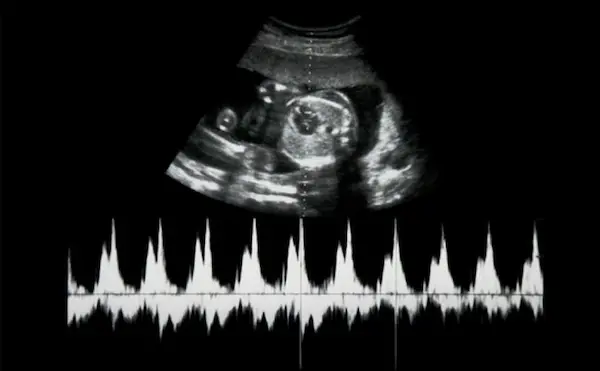
The difference between the fetal heartbeat and the mother’s heartbeat
Distinguishing between maternal and fetal heart rates is essential for making appropriate care decisions.
The fetus's heart rate also increases from 140 to 170 beats per minute by the ninth week.
Reasons for the absence of a fetal heartbeat in the early stages
If the fetus's development is complete, and the fetal heartbeat begins to appear in the sixth week of pregnancy, this is a good sign of the baby's healthy development.
-
Miscarriage
Most cases of missing fetal heartbeat on ultrasound are caused by miscarriage, the causes of which include:
-
Natural miscarriage
The cause of fetal cardiac arrest remains unclear, even if the mother's health is normal.
-
Chromosomal abnormalities
A damaged egg, weak sperm, or abnormal cell division account for 50% of miscarriages.
-
Maternal health problems
Some maternal health conditions may increase the problem of miscarriage, such as:
- داء السكري.
- Syndrome Polycystic ovary syndrome.
- Thyroid problems.
- Immune disorders.
- Uterine abnormalities.
- Cervical insufficiency.
-
التأثيرات الخارجية
Fetal cardiac arrest may result from some external factors, such as the mother's exposure to toxic environments, smoking, or long-term psychological stress.
-
Irregular heartbeat of the fetus
Fetal arrhythmia is a rare condition that may occur at some point in pregnancy and does not continue throughout the pregnancy.
-
Ultrasound device malfunction
One of the important factors that may help you hear the fetal heartbeat clearly and accurately is the use of a modern ultrasound device, but when a malfunction occurs in that device, you may mistakenly believe that there is no fetal heartbeat.
This may be due to the device not being sensitive enough to detect fetal heart weakness, especially in the sixth to eighth weeks of pregnancy.
-
Error in calculating gestational age
Many ultrasound cases in the seventh week may not show any fetal heartbeat, due to an error in calculating the age of the fetus.
At that time, the fetus is still small.
-
Type of ultrasound used
Ultrasound results may be affected by the type of method the mother chooses. When the fetus is small, and its heartbeat is unclear, the abdominal examination may be less sensitive, making it difficult to monitor the fetal heartbeat.
Book your consultation now at مركز صحة المرأة At Al Mousa Specialist Hospital.
When can the fetal heartbeat be heard on ultrasound?
You can hear the fetal heartbeat on vaginal ultrasound early in pregnancy, around the seventh week.
Factors that affect the fetal heartbeat
The fetal heart rate may be outside the normal range sometimes, due to the following
- Fetal activity.
- Periods of sleep and wakefulness.
- Gestational age.
- Health problems in the mother, including:
- القلق.
- الحمى.
- Dehydration.
- Infection.
- Low red blood cells.
- Problems Thyroid gland.
- Blood sugar levels.
There are also some factors that may affect the fetus’s heartbeat and indicate the presence of a health problem, such as:
- The mother is taking some medications.
- Lack of oxygen.
- Wrapping the umbilical cord around the fetus's neck.
- Congenital heart defects in the fetus.
The relationship between the fetal heartbeat and the gender of the fetus
There is no scientific evidence to prove that heart rate may contribute to determining the sex of the fetus, and the only sure way to know the sex of the fetus is through medical tests, such as ultrasound and genetic tests.
When is the fetal heartbeat abnormal?
The fetal heartbeat is considered abnormal in the following cases
-
Bradycardia
It occurs when the heart rate is less than 110 beats per minute. It is a very rare condition and is usually temporary.
This condition does not require treatment in most cases, but it may require medications or early delivery.
-
Tachycardia
This condition occurs when the fetus's heart rate is faster than 160 beats per minute. It is a very rare condition and is usually temporary.
But if your child suffers from this condition for a long period of time, or it happens more than once or twice, this may indicate a problem with the fetus, such as an infection.
Tachycardia may go away on its own, or it may be treated with medications to help lower the heart rate.
In conclusion, you now understand, dear reader, when does the fetal heartbeat begin?
Therefore, if you want to hear the fetal heartbeat and ensure its growth normally, you must go to Al Mousa Specialist Hospital, due to the presence of the latest devices that will help you detect the fetal heartbeat.
Frequently asked questions about fetal heartbeat
If you want to know more information about the fetal heartbeat, you may have many questions in mind, such as:
What is the normal fetal heart rate in the sixth week?
The normal rate of the fetus's heartbeat in the sixth week ranges between 90 beats to 110 beats per minute.
Why is the fetal pulse not heard in the seventh week?
The fetal heartbeat may not be heard in the seventh week due to several different factors, including:
- Early miscarriage.
- An error occurred in calculating the age of the fetus.
- The type of ultrasound used in the examination.
- Fetal heart arrhythmia.
- A malfunction in the ultrasound device.
When should you worry about a slow fetal heartbeat?
You should be concerned about fetal bradycardia if the heart rate drops below 110 beats per minute for more than a few minutes during labor.
Does a high fetal pulse mean that the fetus is a girl?
لا. فقد يختلف معدل ضربات قلب الجنين طوال فترة الحمل، ولكن لا يوجد علاقة بين نبض الجنين، ونوعه.
Who has a faster fetal heartbeat, male or female?
The fetal heart rate may be affected by several different factors, such as fetal activity and gestational age, but there is no scientific evidence to prove the relationship between the fetal heart rate and its type.
