
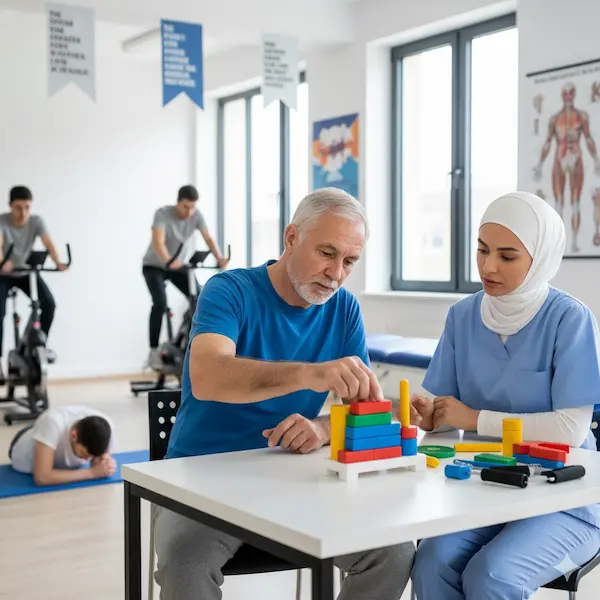
Stroke rehabilitation is a comprehensive journey that aims to retrain the brain and body. Through intensive physical, occupational, and speech therapy programs, we work to restore the patient’s ability to move, communicate, and perform activities of daily living, to enable the patient to regain his self-confidence and engage again in his life.
Rehabilitation after stroke
Rehabilitation programs for stroke patients constitute an essential focus in restoring physical, mental and psychological abilities, and include a group of various therapeutic activities that are carried out on a regular basis to stimulate the brain to learn again. They are as follows:
- Rehabilitation programs rely on repeating exercises and activities on a regular basis to stimulate the brain to learn again.
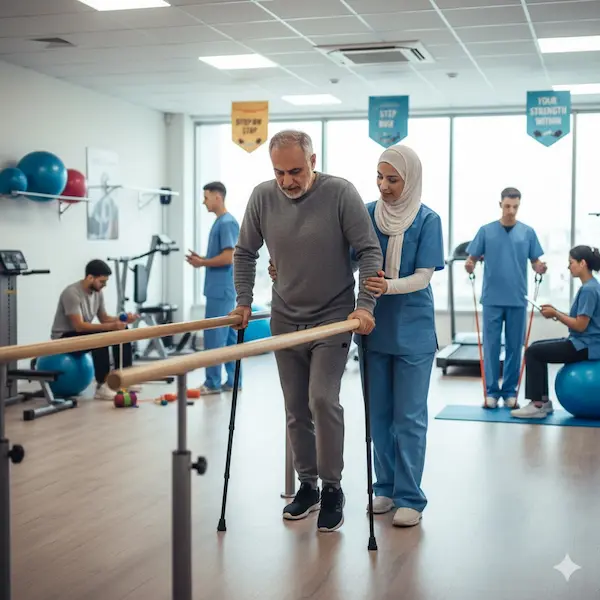
- These include movement exercises that strengthen muscles and improve balance, walking, and the ability to swallow.
- The patient is trained to use assistive devices such as a crutch, walker, or wheelchair when needed.
- Ankle braces may be used to stabilize the foot and support the body while walking.
- An important treatment method is restraint stimulation, where the healthy limb is restrained to encourage use of the affected limb.
- Range of motion exercises help reduce muscle stiffness and spasms and restore normal flexibility.
- Electrical stimulation can be used to gradually move and strengthen weak muscles.
- Robotic devices help affected limbs perform repetitive movements to restore strength and function.
- Some wireless devices are used to track activity and encourage the patient to increase daily movement.
- Virtual reality technologies can be used to stimulate the brain through interactive digital environments and training games.
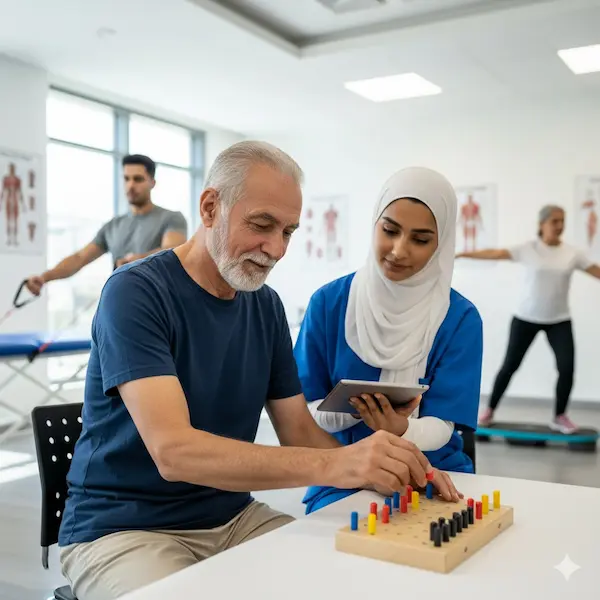
- Occupational therapy contributes to improving mental abilities such as concentration, memory, and problem solving.
- Speech therapy helps restore communication skills such as speaking, listening and writing.
- Psychological support is important to help the patient adapt to changes after a stroke, whether through counseling sessions or support groups.
- The doctor may recommend medications that help improve mood or increase attention and activity.
- One of the newer treatments being studied is magnetic stimulation of the brain to improve movement.
- Biological treatments such as stem cells are still under research and are only used in clinical trials.
- Some patients may benefit from complementary medicine such as massage or acupuncture, but a doctor should be consulted first.
- The success of rehabilitation depends on the patient's commitment to treatment, family support, and patient encouragement to continue.
Read also: When is a stroke fatal?
Causes of stroke
1- Ischemic (obstructive) stroke
It occurs when one of the blood vessels that feed the brain is blocked, and this prevents the delivery of blood and oxygen. The most prominent reasons are the following:
- arteriosclerosis: Fat accumulation within the walls of the arteries.
- Atrial fibrillation: Heart arrhythmia, which may be associated with sleep apnea.
- Blood clotting disorders: It makes the body more susceptible to clot formation.
- Congenital heart defects: Like an opening between the chambers of the heart.
- Poor perfusion: In the microvasculature, it affects blood flow in small capillaries within the brain.
2- Hemorrhagic stroke
It occurs when a blood vessel inside the brain bursts or ruptures, leading to bleeding. Common reasons include:
- Aneurysm is a weakness in the wall of a blood vessel that causes it to swell and burst.
- Brain tumors may affect vessels and cause bleeding.
- Chronic or acute high blood pressure weakens the walls of blood vessels.
- Genetic or rare diseases such as conditions that weaken the structure of blood vessels, including Moyamoya disease.
3- Transient ischemic attack
Known as a mini-stroke, it causes symptoms similar to a stroke but is temporary. It is considered an early warning of the possibility of a real stroke, and requires urgent medical intervention.
Where does stroke rehabilitation take place?
There are multiple options available to rehabilitate stroke patients, including inpatient and outpatient units, specialized nursing facilities, and home programs, and the most appropriate ones are determined in coordination with the medical team and the family. The most important places are the following:
Rehabilitation options are available
- Internal rehabilitation units
You stay there for a short period of two to three weeks and undergo an intensive programme. These units are usually part of a hospital or specialized centre.
- External rehabilitation units
You visit the center for a few hours a week, and are a convenient option if you are able to move around.
- Specialized nursing facilities
They provide varying care depending on the type of facility, some focusing on rehabilitation, others providing less intensive support.
- Home programs
It provides great flexibility and can be implemented in your home, but it may lack specialized equipment, and its insurance coverage varies from one case to another.
It is important to discuss these options with your medical team and family to choose what is most appropriate for you. If you are looking for a reliable medical authority, you can contact Almoosa Specialist Hospital to obtain advice about the rehabilitation programs available to them.
Read also: How long do stroke symptoms last?
The effect of stroke on humans
Recovering from a stroke involves dealing with a range of physical, psychological, and cognitive changes that may last a long time. Here are the most prominent of these effects as follows:
Physical effects
- Muscle weakness It often affects one side of the body and affects the ability to move.
- Partial or complete paralysis In severe cases, muscle weakness may lead to loss of the ability to move an arm or leg.
- Foot drop Difficulty raising the toes while walking, which leads to the foot stumbling.
- Decreased staminaFeeling tired quickly when exerting effort, which makes it difficult to control the body.
- Muscle spasm Stiffness and tightness in the muscles make movement painful or limited.
- imbalance It may cause dizziness or unsteadiness, making mobility more difficult.
Psychological and emotional changes
- Depression and anxiety They are common after a stroke, especially in the first year, and may be a normal reaction to physical changes.
- difficulty communicating, Stroke sometimes affects the ability to understand or express words.
- Impulsivity or aggression, may exhibit surprising or socially inappropriate behaviors.
- Apathy or loss of motivation, A feeling of lack of interest or enthusiasm for daily activities.
- Fear of becoming a burden, This anxiety may lead to isolation and loneliness.
Cognitive and perceptual problems
- Poor concentration and attention, Difficulty following tasks or conversations.
- Problems remembering Like forgetting what you were doing or what was said to you moments ago.
- Difficulty organizing information Like watching a TV show or reading a book.
- Disorientation in familiar places Such as forgetting the usual route or feeling lost.
Symptoms of stroke
Stroke is a race against time to save brain cells, so early recognition of symptoms is the first step towards effective treatment. The most prominent symptoms that require immediate intervention are the following:
- Sudden weakness or paralysis In the face, arm, or leg, especially on one side of the body.
- Sudden disturbance in The ability to speak Or difficulty understanding.
- Sudden loss of Balance Or coordination of movement.
- Visual disturbances Sudden, such as double vision or partial loss of vision.
- headache Severe and sudden, unusual in severity.
- Numbness Or transient weakness in the face or limbs.
- Temporary disturbance in Vision.
- Short-term difficulty in Pronunciation or understanding.
- dizziness Or loss of balance that disappears within a short time.
The best stroke rehabilitation center
progress Almoosa Specialist Hospital Integrated services in the field of rehabilitation of stroke patients, through a multidisciplinary team that works to meet the patient’s physical, psychological and cognitive needs, لEnsure an inclusive and sustainable recovery as follows:
- doctors, This includes your primary care doctor, neurologists, and physical and rehabilitation medicine doctors, who oversee your health, help prevent complications, and provide guidance for a healthy lifestyle that reduces the risk of reoccurring stroke.
- Rehabilitation nursing staff Provides daily support to help you integrate learned skills into your routine, and helps manage issues such as bowel and bladder control.
- Physiotherapist They work to help you regain mobility, such as walking and balance, and improve physical strength.
- Occupational therapist They help you regain your independence in daily activities such as dressing, bathing, housework, and even returning to work command They also support you in improving swallowing skills and cognitive abilities necessary for daily life and work.
- Speech and language specialist They focus on improving communication and language skills, as well as treating swallowing problems, and offer strategies for dealing with memory and thinking difficulties.
- Social workers They provide support with social and financial aspects, and help plan the next phase of recovery, including living arrangements and connection to community resources.
- Psychologists They evaluate your psychological and cognitive state, and help you deal with the emotional changes and psychological stress that may follow a stroke.
- Therapeutic Recreation Specialist They work to reintegrate you into the activities and hobbies you enjoyed before your injury, which enhances your quality of life and community participation.
- Professional advisors They provide support if returning to work is one of your goals, and help you navigate professional challenges after recovery.
Read also: Discover the most important steps in the effective physical therapy rehabilitation process
Duration of physical therapy after stroke
The duration of rehabilitation for stroke patients varies from one case to another, depending on the severity of the injury and associated factors such as age, general health condition, and the speed of starting treatment after the stroke. In most cases, the rehabilitation period extends from a few weeks to several months, and may be longer in some cases that require additional support.
The important thing is that the duration of treatment is not measured in days only, but rather is considered a treatment journey specifically designed for each patient, and is carried out under the supervision of a specialized medical team to ensure achieving the best possible results in recovery and restoring quality of life.
FAQs
Is a stroke a stroke?
Yes, stroke is often the result of a blood clot that blocks blood flow to part of the brain, so the two terms are sometimes used interchangeably, but ischemic stroke is the more comprehensive term, and also includes cases of cerebral hemorrhage and not just clots.
When does a stroke patient die?
The death of a stroke patient depends on many factors, such as the severity of the injury, the speed of medical intervention, and the general health condition, but in the end, lives remain in the hands of God alone, and no one can be certain of a date or outcome.
Will a stroke patient return to what he was?
It is possible for a stroke patient to return to his normal state, but it depends on several factors such as the severity of the injury, the speed of therapeutic intervention, and the extent of the patient’s commitment to the rehabilitation program. Some patients significantly regain their functions, while others need continuous support and gradual improvement.
In conclusion, we talk about rehabilitation of stroke patientsIt is important to emphasize that the speed of intervention is what makes the difference. Choosing a specialized center is a crucial step on the road to recovery. Contacting Almoosa Specialist Hospital It offers integrated rehabilitation programs under the supervision of an elite group of specialists, and provides an advanced therapeutic environment that combines experience and innovation.
