
If you've ever felt a burning pain that extends from your lower back to the back of your thigh, or leg, you may have sciatica, which prevents you from performing even the simplest movements and keeps you from enjoying your day.
Sciatica is not a disease, but rather a symptom of a health problem that affects the sciatic nerve (which is the longest and largest nerve in the human body).
So if you want to know what causes this pain, and how can it be treated?
What is sciatica?
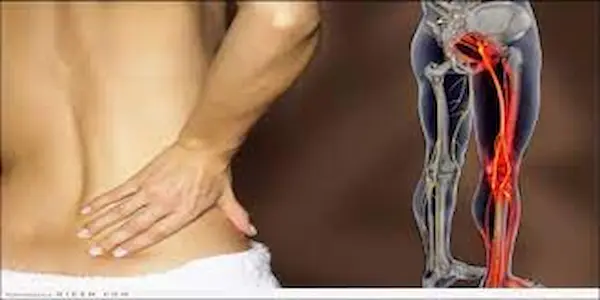
Sciatica, also known as lumbar radiculopathy, is nerve pain resulting from injury or irritation to the sciatic nerve (it is the main nerve in the leg, and the largest nerve in the entire body, measuring up to two centimeters in width).
The sciatic nerve is not just one nerve, but rather a bundle of nerves that come from five nerve roots branching off from the spinal cord.
This nerve extends from the back of the pelvis to the back of the thigh until it reaches just below the knee, then it divides into other nerves that connect to more distant parts, such as the foot and toes.
Lumbar radiculopathy may affect the following: –
- Lower back.
- الساقين.
- الوركين.
- الأرداف.
- Symptoms may extend to the feet and toes, depending on the affected nerve.
Causes of sciatica
Sciatica may occur due to conditions that affect the following: –
- Sciatic nerve.
- Spinal nerves combine to form the sciatic nerve.
Conditions that may cause lumbar radiculopathy include the following: –
- Herniated disc: –
He promises Herniated disc The main cause of most cases of sciatica, and its incidence increases with age.
- Spinal stenosis: –
Narrowing of the spinal canal in the lower back through which the nerves and spinal cord pass.
- Spondylolisthesis: –
It occurs when one vertebra of the spine slides forward over the other.
- Back injury: –
You may suffer from lumbar radiculopathy as a result of a spinal fracture.
- Bone spurs that the elderly may suffer from.
- Degenerative disc disease: –
It occurs when the soft discs between the bones of the spine collapse.
- Piriformis Syndrome: –
It is a pear-like muscle located in the buttocks. It is known as the false sciatica, as it presses on the sciatic nerve when it is stretched.
There are also other causes that may lead to lumbar radiculopathy, such as: –
- Tumors.
- Incorrect sitting position.
- السمنة.
- clot.
- Abscess.
- Any neurological disorders.
- Muscle spasm in the back or buttocks.
- الحمل.
- arthritis.
- Cauda equina syndrome.
- Conus medullaris syndrome.
Methods of diagnosing sciatica
Sciatica may be diagnosed by the following: –
First, your doctor will review your medical history, then ask you about how the pain starts and travels, and what exactly your symptoms are.
Secondly, you will undergo a physical examination, which includes the following: –
Walking: –
Lumbar radiculopathy may cause visible changes in the way you walk.
Straight leg raise test:-
This test helps determine the cause of sciatica, and is performed by the following: –
- Lie on the examination table with your legs straight.
- The doctor will begin to lift your legs up slowly, one at a time.
- The doctor will ask you when you start feeling pain?
Squat and rise.
Thirdly, the doctor will advise you to undergo some tests that contribute to diagnosing sciatica and ruling out similar conditions, such as: –
X-rays: –
Used to image the spine;
Computed tomography: –
It contributes to obtaining a clearer picture of the spinal cord and spinal nerves.
MRI: –
Helps create images of the inside of your body;
Electromyography: –
It measures how quickly nerve signals travel through your muscles, and is used to find out whether a herniated disc is putting pressure on the nerves that control your muscles.
Nerve conduction study: –
To help pinpoint the exact location of your injury.
Myelography.
Book your consultation now at مركز صحة المرأة At Al Mousa Specialist Hospital.
Sciatica symptoms
If you suffer from lumbar radiculopathy, you may feel the following symptoms: –
- Pain occurs as a result of pressure on the nerve.
This pain may extend down the leg on the affected side, and may usually occur when sneezing, coughing, bending the legs, or raising them higher when lying on the back.
You may feel pain as follows: -
- Lower back.
- Hip.
- Buttock or leg, which gets worse when sitting.
- Buttocks.
- Foot.
- Tingling or numbness.
- Muscle weakness.
- Numbness, which occurs as a result of loss of sensation in the affected areas of your back or leg, due to nerve signals not reaching the brain.
- Urinary or fecal incontinence.
Methods of treating sciatica
There are many therapeutic methods that contribute to relieving the pain of lumbar radiculopathy and increasing mobility, including the following: –
Medicines: –
Your doctor may advise you to take anti-inflammatory medications, such as ibuprofen or naproxen sodium.
- Muscle relaxants.
- Anti-inflammatories.
- Antiepileptic drugs.
- Pain relievers.
- Antagonists Depression.
Physiotherapy: –
The doctor may prescribe some exercises for you, for the following: –
- Improve your body posture.
- Relieve pressure on the sciatic nerve.
- Increase your flexibility.
- Strengthen your muscles to support your back.
The exercises include the following: –
- Stretching exercises.
- Walking.
- Swimming.
- Water aerobics.
Steroid injections: –
Your doctor may advise you to take steroid injections (such as cortisone injections) to help treat the inflammation surrounding the nerve and relieve pain.
Alternative treatments: –
These treatments are becoming increasingly popular because they provide alternative options to traditional medical treatments and medications.
Alternative treatments include the following: –
- Yoga.
- Acupuncture.
- Biofeedback, to manage pain and relieve stress.
- massage;
- Adjusting the position of the spine.
Surgical treatment: –
Your doctor may advise you to undergo surgical treatment if your pain persists for three months without improvement after trying non-surgical treatment.
Types of sciatica surgeries include the following: –
- Discectomy surgery:-
The doctor removes small parts of the herniated disc that are pressing on a nerve.
- Laminectomy: –
Removal of part of the lamina (found on the side of the vertebra just below the skin of the back), which is pressing on the spinal nerves.
- Home remedies: –
- Apply cold compresses wrapped in a piece of cloth to the lower back for 20 minutes several times daily.
- Use warm compresses.
- Doing stretching exercises.
How can sciatica be prevented?
You can prevent sciatica by the following: –
- Make sure you have good sitting and standing posture.
- Sit properly when using the computer.
- Lose weight, if you suffer from obesity.
- Exercise regularly.
- Use safe technique when lifting heavy objects.
- Stop using tobacco products.
- Protect yourself from falling.
Risk factors for sciatica
The following factors may increase the risk of lumbar radiculopathy, including: –
- Previous injury to the spine or lower back.
- Natural wear and tear due to aging.
- Age-related health problems, such as هشاشة العظام.
- Overweight or obesity.
- Weak trunk muscle strength.
- Jobs that require sitting for long periods without proper back support.
- Jobs that require lifting heavy objects, bending a lot, or working in uncomfortable positions may increase the risk of lower back problems.
- داء السكري من النوع الثاني.
- Not exercising.
- التدخين.
When do you visit a doctor to treat sciatica?
You should contact your doctor and seek emergency medical care if you experience the following: –
- Muscle weakness.
- Loss of bladder or bowel control.
- Severe pain that prevents you from performing your daily activities, and lasts for several hours.
- Loss of feeling in your affected leg.
- Return of pain after successful treatment of lumbar radiculopathy.
- Feeling numbness or tingling.
Frequently asked questions about sciatica
If you suffer from lumbar radiculopathy, you may have many questions in mind, such as: –
Is sciatica in the right or left leg?
Yes, lumbar radiculopathy is nerve pain resulting from injury or irritation of the sciatic nerve.
Where does sciatica pain start?
Lumbar radiculopathy pain begins in the lower back, extending through the hips and buttocks and down the leg.
Does walking increase sciatica pain?
No, walking may help relieve the pain of lumbar radiculopathy.
The correct way to sleep for someone who suffers from sciatica?
The doctor may advise you to sleep on your back with a pillow under your head, and a large, firm pillow under your knees.
In conclusion, I now realize, dear reader, what is sciatica?
I also learned how to treat this painful symptom, and how it can be prevented.
Therefore, if you are suffering from this symptom, you must go to Al Mousa Specialist Hospital, so that the best doctors can help you determine the underlying cause of this pain, and determine the appropriate treatment for your condition.
Sources
Sciatica – clevelandclinic
Sciatica – nhs
