
Symptoms of a benign brain tumor may pass by the patient without causing concern at first, and often appear in the form of recurring headaches or a slight disturbance in balance or vision, but they may indicate the presence of a tumor that requires follow-up and early diagnosis. From here, it can be said that the benign tumor, although it is not cancerous, its pressure on the nerve areas may cause gradual symptoms, so early diagnosis is necessary to prevent complications.
In this context, this article provides a comprehensive overview of the signs and possible causes of this disease, explaining the diagnostic and treatment methods available for each case.
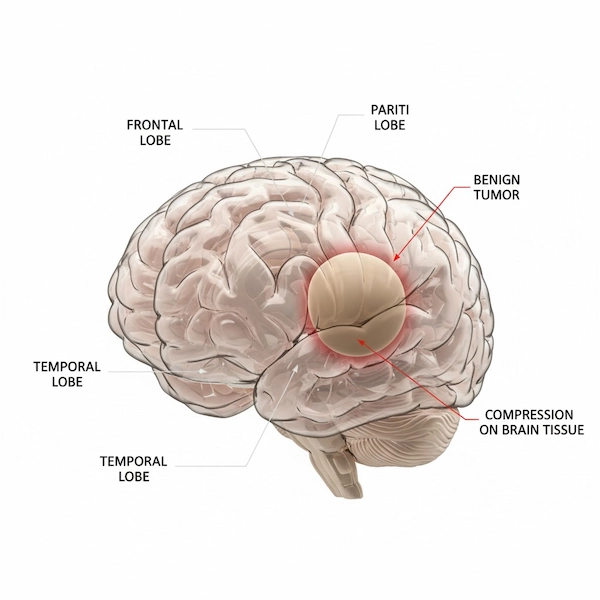
Symptoms of a benign brain tumor
Symptoms vary between patients depending on the size and location of the tumor. Perhaps the question that many ask is: What are the symptoms of a benign brain tumor? As shown below:
First: General symptoms resulting from increased intracranial pressure
This type of symptom occurs when the tumor begins to put pressure on the brain tissue, interfering with its normal functioning. The most common signs are:
- Frequent headaches that become more severe in the morning or when bending over and coughing.
- Nausea or desire to vomit for no apparent reason.
- Blurred or double vision, which may be accompanied by temporary loss of part of the visual field.
- Convulsive seizures similar to epileptic seizures, and may involve the entire body or a specific area of it.
- A tendency to sleep excessively or constantly feel lethargic.
Second: Symptoms related to the location of the tumor within the brain
Each part of the brain is responsible for a specific function, Therefore, symptoms vary depending on the location of the tumor:
1- Frontal lobe
Controls behavior, memory and language, Symptoms may appear as:
- Changes in personality or behavior.
- Weakness or numbness on one side of the body.
- Speech disorders or difficulty finding words.
- Loss of sense of smell or poor memory.
- Repeated convulsive seizures.
2- Parietal lobe
Associated with sensation and coordination of movements, Symptoms include:
- Numbness or weakness on one side of the body.
- Loss of ability to perform simple tasks.
- Language disorders such as difficulty understanding or expressing.
3- Occipital lobe
responsible for the vision, The most important symptoms of his infection:
- Partial or complete loss of vision on one side of the visual field.
4- Motor coordination center in the brain (cerebellum)
Participates in controlling balance and fine movements, The most important symptoms resulting from the tumor in this area are:
- Loss of balance or difficulty walking.
- Constant dizziness.
- Unexplained vomiting or blinking in the eyes.
5- جذع الدماغ (Brainstem)
It coordinates the brain and spinal cord, and is responsible for automatic movements. Possible symptoms include:
- Difficulty speaking or swallowing.
- Weakness of facial muscles.
- Double vision.
- Loss of coordination while walking or standing.
It is worth noting that the slow growth of the tumor does not mean that it is harmless, as its continuation may, over time, negatively affect neurological functions. Therefore, it is recommended to consult a doctor immediately if you notice the symptoms of the benign brain tumor that we mentioned previously.

About benign brain tumor
A benign brain tumor is a tumor that arises due to irregular growth in brain cells. It is usually characterized by slow development and does not spread outside the brain. However, its presence inside the skull may cause gradual pressure on the surrounding nervous tissue. As a result of this pressure, some brain functions may malfunction and symptoms may appear that affect the patient’s life and neurological functions.
اقرأ أيضاً: Types of tumors: A comprehensive guide to understanding benign and malignant tumors
Types of benign brain tumors
There are many types of benign brain tumors, depending on the tissue from which they originate inside the skull. The following are the most common types:
- Meningioma:
It originates from the membranes surrounding the brain and spinal cord, and is considered one of the most common tumors, especially among women over the age of forty.
- Schwannoma:
It is a benign growth that arises from the cells that surround nerves. Acoustic neuroma is the most common type, as it directly affects hearing and balance.
- Pilocytic astrocytoma:
It affects the supporting cells in the brain, and appears mainly in children and adolescents, especially in the cerebellum or brainstem.
- Pituitary adenoma:
It develops in the pituitary gland, which is responsible for regulating the body’s hormones, and may cause a hormonal imbalance, leading to physical or functional changes.
- Clinoepithelioma:
It is a rare benign tumor that usually appears in childhood or adolescence. It grows near the pituitary gland, which leads to an imbalance in the secretion of hormones. It may also cause vision impairment as a result of its pressure on the surrounding nerves.
- Hemangioblastoma:
It grows slowly in the cerebellum or spinal cord, and is sometimes associated with the genetic disorder known as von Hippel-Lindau syndrome.
- Choroid plexus tumor:
It forms in the area responsible for producing cerebral fluid, and mostly affects children.
- Skin and epidermoid cysts:
They are benign cysts that contain fatty or skin tissue, and may cause pressure on the brain or spinal cord when they increase in size.
Causes of benign brain tumor
There is no specific reason for the formation of benign brain tumors, but research indicates that several factors may contribute to their appearance or increase their risk, These factors include the following:
- Genetic factors may contribute to the formation of benign brain tumors, especially in people with a family history or rare syndromes such as neurofibromatosis and tuberous sclerosis.
- Some benign brain tumors occur as a result of mutations in the DNA that cause a defect in the division of healthy cells. This leads to irregular growth that may result from random or environmental factors.
- Excessive radiation increases the risk of benign brain tumors, due to its harmful effect on the DNA of nerve cells and surrounding tissues.
- Environmental and chemical factors are possible causes of the emergence of benign tumors, as toxic substances, such as pesticides and solvents, can lead to cellular disorders, even if their connection has not been definitively proven scientifically.
- Repeated brain injuries may cause abnormalities in brain tissue, which stimulates the growth of abnormal cells over time. Although this factor is rare, a possible association has been found in some cases.
- The risk of benign tumors increases with age due to normal changes in cells and their functions.

Diagnosis of benign brain tumor
The process of diagnosing a benign brain tumor is an essential step that depends on careful evaluation and specialized examinations to accurately determine the type, location, and size of the tumor. It includes several main stages, the most important of which are:
- The clinical examination is the first step in diagnosis, as the doctor evaluates the symptoms to form an initial perception of the condition and direct appropriate examinations.
- Magnetic resonance imaging (MRI) is one of the most accurate diagnostic methods, as it accurately determines the size and shape of the tumor, and dye is sometimes used to increase the clarity of the image.
- Computed tomography (CT) scan, used to quickly detect tumors or bleeding within the brain.
- Neurological and brain tests that include electroencephalography (EEG) and cognitive tests that evaluate memory, concentration, and nervous system response.
- Biopsy is performed when the diagnosis is not clear, where a sample of the tumor is taken and examined in a laboratory to accurately determine its type and choose the appropriate treatment.
- Blood tests and hormone tests are performed when tumors in the pituitary gland are suspected, and help evaluate their impact on hormone balance and body functions.
اكتشف المزيد عن: What is the most dangerous type of brain cancer?
Treatment of benign brain tumor
With the development of modern medicine, the chances of recovery from benign brain tumors have increased thanks to advances in surgical and treatment techniques. The most appropriate plan is determined for each patient according to his condition. The following are the most important treatment methods:
1- Periodic monitoring
This method is followed when the tumor is small and does not cause obvious symptoms, as the patient is followed up periodically through examinations and imaging, and in the event of an increase in size or the appearance of symptoms, therapeutic measures are taken such as surgery or radiation.
2- Microscopic surgery
Surgical resection using a microscope is considered the most efficient solution in treating benign brain tumors, especially when they cause symptoms or put pressure on sensitive areas. This technology is characterized by the following:
- A small surgical incision, no more than a few centimeters.
- Reduce loss Blood During the operation.
- Accurate tissue viewing thanks to advanced magnification and illumination.
- Faster recovery and fewer complications compared to traditional surgery.
3- Radiation therapy
This type of treatment is used when it is difficult to completely remove the tumor or parts of it remain. Stereotactic radiation is applied with high precision to destroy the remaining cells without harming healthy tissue.
4- Drug treatment and symptom control
In some cases, medications are used to reduce symptoms such as seizures or hormonal disturbances, or to keep the condition stable until surgical or radiation intervention is performed.
5- Hormonal treatment
When the pituitary gland or hormonal control centers are affected, the patient may need regulatory treatment or hormone replacement to restore the natural balance in the body.
At the conclusion of this articleWe discussed the symptoms of benign brain tumor, its causes, and methods of diagnosis, explaining the importance of early diagnosis in preventing complications and improving the chances of recovery.
Therefore, we invite you to Book your consultation In the oncology center through Al Mousa Specialist Hospital To obtain precise care under the supervision of a group of specialized doctors.
تعرف أيضاً على: Types of brain cancer: Your guide to understanding the difference between them
Frequently asked questions
After treating a benign brain tumor.. Will it come back?
The tumor may return if it is not completely removed, but careful follow-up and comprehensive treatment greatly reduce the possibility of recurrence.
How long does a benign brain tumor patient live?
When a benign brain tumor is treated in a timely manner, the patient lives a normal life, but delaying treatment may cause disturbances in brain functions.
How is the difference between a benign and malignant brain tumor?
It is not possible to differentiate between a benign and malignant tumor based on symptoms alone. Rather, the diagnosis depends on accurate examinations, including MRI or sample analysis, as benign tumors are characterized by slow growth, while malignant tumors grow and spread quickly.
Is a benign tumor painful when touched?
A tumor inside the brain does not cause pain to the touch, but it may lead to a headache or internal pressure due to its effect on surrounding nerves or tissue.
Can a brain tumor cause frequent urination?
This may only occur when the tumor affects the pituitary gland, which is responsible for regulating hormones and fluids in the body, and it is a rare condition that requires careful hormonal examinations.
How do you differentiate between a headache and a tumor?
Headaches resulting from the tumor are continuous and increase in the morning or with coughing and bending over, and are often accompanied by other symptoms such as nausea or blurred vision, unlike normal headaches that go away with rest or painkillers.
