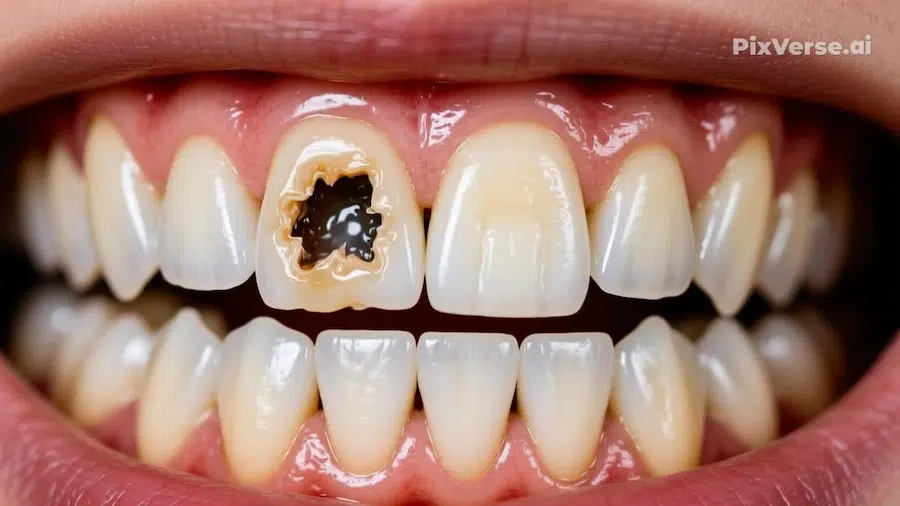
Did you know that there are more than 2 billion adults worldwide who suffer from permanent tooth decay?

What is tooth decay?
The medical definition of dental caries indicates that it is a chronic bacterial disease that occurs due to the interaction between bacteria and fermentable substances such as carbohydrates and sugars.
This reaction produces acids that accumulate on the hard tissue of the tooth and cause erosion of the metal components in it. Because of this continuous erosion, the hard tissue dissolves and cavities appear that grow deeper with time until they reach the pulp of the tooth, and then cause the inflammation and severe pain for which tooth decay is famous.
Stages of tooth decay
Tooth decay does not happen overnight. Rather, there are many stages that the interaction that occurs between bacteria and fermentable substances goes through until the tooth becomes brittle and hollow. These stages come as follows:
Demineralization
It is also known as the stage of initial changes. When you eat sugars or carbohydrates, some small pieces of them remain on the teeth, activating the bacteria that feed on them, and then acid production begins, which causes the erosion of minerals in the hard tissue known as tooth enamel.
At this stage, you may notice the appearance of white or somewhat transparent spots on the surface of the tooth, and this indicates the beginning of its erosion. If medical intervention is not done and the teeth are maintained clean, the matter can get worse, but when caries are taken care of, the decay can be stopped.
Enamel caries (Superficial Caries)
We reach this stage if we neglect dental treatment and do not pay attention to its hygiene, as the acid continues to attack the tooth enamel and begins to create a gap in the enamel layer. The tooth then loses its external appearance and begins to gradually discolour until it turns brown, which indicates the occurrence of decay.
This stage is characterized by the absence of pain except in some minor cases, and it is possible to perform medical cleaning of the teeth and treat cavities easily before the problem worsens.
Dentin Caries
This stage means that the enamel layer has been completely compromised, and the infection then reaches the dentin area, which is a weak tissue characterized by high porosity, so this stage does not take a long time to worsen.
Acids and bacteria move to the core of the tooth from the inside, and you begin to complain of pain, especially when eating hot or cold foods or sweets.
Pulp Damage
When a specialist doctor is not consulted to treat the problem, the infection reaches the pulp of the tooth after passing the dentin layer, and here the infection directly affects the nerves and blood vessels, so the patient suffers from severe and continuous pain, especially when pressing on the tooth or during sleep.
Abscess Formation
Abscesses appear due to untreated periradicular infection, where a pocket of pus forms around the root of the tooth or in its surrounding tissue, leading to swelling and pulsating pain that prevents the patient from performing his daily activities. If treatment is not done properly, the infection can spread to nearby tissues and bones.
Tooth loss (Extraction)
This is the last stage that the patient reaches due to neglecting tooth decay and not treating it, as the affected tooth is lost after it is extracted. Losing a tooth is not an easy matter, because it causes difficulty in chewing food properly, increases pressure on adjacent teeth, and may affect speech pronunciation, and the entire jaw structure may change in some cases after tooth extraction.
Symptoms of tooth decay and erosion
It is necessary to take care of dental hygiene and health as directed by doctors, and if you notice any of the following symptoms, you should go to the specialist immediately: The most important of these symptoms are the following:
- The appearance of white spots on the enamel. These spots are characterized by their chalk-like appearance, and they are an important sign of the beginning of the attack on the tooth enamel layer.
- Teeth change to yellow or brown, or part of them changes color.
- Suffering from tooth sensitivity and pain, especially if this pain occurs when eating cold or hot food or when eating sweets.
- The appearance of tooth pain that is not related to eating, or pain that increases in intensity when biting or applying pressure on the tooth.
- Notice the presence of a hole in the tooth.
- The appearance of bad breath or a feeling of a bad taste in the mouth.
- An abscess occurs in the tooth or a swelling and swelling is observed around it.

Causes and risk factors of tooth decay
Eating sugars without brushing your teeth is the most prominent and common cause of tooth decay, because it provides a suitable environment for the growth of bacteria that secrete acids that dissolve the layers of teeth. There are other reasons including:
- Neglecting oral and dental hygiene, and not using toothbrushes and floss.
- Eating food without removing food residue stuck between the teeth.
- Fluoride is one of the most important elements that strengthens the enamel layer, and its deficiency is one of the most important risk factors for tooth decay.
- Dry mouth and lack of saliva secretion, as it helps in neutralizing acidity and remineralizing the teeth, so its deficiency causes increased chances of tooth decay.
- Teeth that are not cleaned easily are more likely to collect bacteria, especially molars and teeth with fissures.
- Some people develop tooth decay due to genetic factors, such as poor enamel thickness and the inability of the teeth to resist wear for a long time.
Read also: Tooth decay in children
Types of tooth decay
Types of tooth decay vary depending on location and depth. These types can be explained as follows:
By location:
It depends on the location of the caries, Here it appears as follows:
- Caries, pits and cracks in the surface of the back teeth or ridges in the front teeth.
- Caries of the smooth surface on the sides of the teeth.
- Caries near the gums.
- Root decay.
- Caries of the incisal surface that appears at the edges of the teeth.
Depending on the depth of damage:
- Initial cariesIt appears in the enamel layer.
- Moderate cariesIt reaches the borders of enamel and dentin.
- Deep cariesIt goes beyond the dentin layer and approaches the pulp.
- Caries in the tooth pulpIt indicates the presence of infection and inflammation, and requires root canal treatment or tooth extraction.
Depending on the speed of progress:
- Severe cariesIt often appears in children.
- Caries progresses slowlyIt takes many years before the pain begins.
- Frequent cariesIt occurs after filling a tooth due to repeated infection.

Treatment of tooth decay
There is more than one treatment procedure that can be used to treat tooth decay, and this depends on the stage the tooth has reached. The most important therapeutic procedures are the following:
- Use a fluoride toothpaste twice daily.
- Pay attention to oral hygiene and reduce sugar intake.
- Getting rid of decayed parts of enamel and dentin.
- Using restorative fillings according to the condition and location of the tooth.
- Covering the tooth if it needs it, in addition to root canal treatment.
- In some cases, tooth extraction may be required as a final step after all treatment attempts have failed.
Find out more about: Tips for children to maintain teeth and enhance their health from a young age
How to prevent tooth decay
Providing daily oral care is one of the most important methods that you can follow to protect your teeth from decay. Added to this is attention to reducing the factors that provide a suitable environment for increasing acids in the mouth. The most important measures taken to prevent the problem of decayed teeth are the following:
- Reduce intake of sugars and carbohydrates.
- Brush your teeth at least twice a day using a fluoride-containing toothpaste.
- Use dental floss to remove plankton between the teeth.
- Pay attention to regular check-ups with the dentist.
- Eat foods that are beneficial for oral and dental health.
- Drink water healthily.
Can cavities be prevented permanently?
Paying attention to dental hygiene and visiting the dentist to check on their health is sufficient to prevent cavities, but preventing cavities completely is not possible, because it does not always occur as a result of factors that you can control. There are some biological or genetic factors that cause cavities, and some negative eating habits increase the possibility of it occurring.
At a stage Childhood The chances of exposure to cavities increase, especially with the lack of early care and excessive consumption of sugars. Therefore, cavities may occur and progress without being discovered until after feeling pain.
Therefore, it is possible to prevent tooth decay and erosion to a very large extent, but preventing it permanently is not guaranteed in all cases.
FAQs
Learn more about tooth decay with the answers to frequently asked questions below:
Can cavities return after treatment?
Yes, this can happen. It is known as secondary caries. It may be caused by gaps around the filling, the use of materials that do not release fluoride or do not form a good seal, or for other reasons such as poor habits after filling.
Does every cavity cause pain?
No, caries in its primitive stages does not cause pain. Rather, pain appears after it reaches the deeper layers.
How do I make mites go away from my teeth?
You can do this depending on the stage you have reached, so you need to go to the doctor to determine the extent of the damage and how to treat it. However, cleaning your teeth with a suitable toothpaste is always an excellent method.
Also learn about: Decay of baby teeth
In conclusion Tooth decay is a big problem if left untreated, but it is simple with immediate intervention and constant attention to dental hygiene and health, so you should visit us at . To ensure the safety of your teeth and treat them immediately if any decay is found.