
Congenital spinal malformations are disorders that occur to the spine, and the development of these disorders begins in the fetus before birth, and in this type of spinal malformations, the correct formation of the fetal spinal vertebrae does not occur at a very early stage of fetal development, and this leaves structural issues in both the spine and the spinal cord, and it is mentioned that these malformations range from mild to severe malformations.
What are congenital spinal deformities?
Congenital spinal malformations are malformations that affect fetuses in the womb, and we can describe them as congenital spinal curvature disorders, and this occurs at the stage of fetal formation, and here the fetus is exposed to structural issues regarding the formation of the spinal cord and the formation of the spine, where the vertebrae of the spine are formed abnormally due to the disturbances in the spine.
In the beginning, the malformations are mild and then become severe if neglected in receiving appropriate treatment, and it was revealed that congenital vertebral malformations include a group of malformations that affect the spine, and most of these malformations, 85% of the malformations, are not clinically important, but it should be clarified that they affect the spinal cord through compression because they lead to distortion of the vertebral canal, and cause imbalance, as these abnormalities appear in the mother's womb.
Here, changes are observed in the shape and number of vertebrae of the spine, and there are children who suffer from simple congenital malformations that affect one of the vertebrae of the spine, and there are those who suffer from malformations that do not exceed centimeters in size, but cause an imbalance in the shape of the child's entire body, and from this we can say that spinal malformations are one of the most harmful types of congenital malformations in children.
Causes of congenital spinal deformities
Congenital spinal deformities are those that are caused by birth defects in the fetus, but they are categorized as the least common spinal deformities, and there are many reasons that lead to this, which are as follows:
- The expectant mother taking medications during her pregnancy, having unsafe X-rays, and having viral or other diseases.
- A deformity occurs when some vertebrae are underdeveloped, some vertebrae are underdeveloped, or a number of vertebrae are not fully developed.
- As a result of underdeveloped vertebrae, the spine has an anterior or posterior hemivertebra, fusion between the vertebrae, or a bony column between the vertebrae.
- The process of detecting spinal deformity in children is done by a pediatrician, and there are cases where this issue is found when imaging is done for other reasons.
Therefore, the child should be examined by a specialized orthopedic and spine doctor, because he can detect congenital defects in the spine early, and it is necessary to show the child periodic scans and compare the scans to ensure the progress of the child's condition.
تعرف على كيفية Rehabilitation of spinal cord injury patients
Symptoms of congenital spinal deformities
Symptoms of congenital spinal deformities depend on the child's condition, and are generally characterized by the following:
- Pain in the lower back and upper back, and even more intense when moving or sitting for a long time.
- Tingling sensation and also issues when taking a bath, such as constipation or urinary incontinence.
- The child has an infection.
- Lack of shoulder height asymmetry and a difference in leg length.
- Abnormal curvature in scoliosis, where the patient bends to one side, and in kyphosis, excessive curvature of the upper back.
- The muscles of the legs or feet are weakened, and the child finds it difficult to walk or stand.
- Numbness and tingling in the arms or legs.
- Difficulty sitting up.
- Vertebral deformities, where there is great difficulty in movement, including the inability to bend or twist easily.
- A herniated disc or spinal stenosis where the patient feels pain in the area of the legs or feet.
- In severe kyphosis or scoliosis, the shape of the body is altered, and even the shape of the back is visibly distorted.
- The child has trouble breathing as a result of being bent over, which puts pressure on the lungs and causes a feeling of suffocation.
- Experiencing sharp pain while coughing or vice versa in the case of a herniated disc or spinal stenosis.
- If the condition is severe, there are changes in bowel and bladder motility.
- Pain when bending over or lifting heavy weights, as this puts pressure on the nerves and vertebrae.
Book your consultation now at Orthopedic center At Al Mousa Specialist Hospital.
Treatment of congenital spinal deformities at Almoosa Hospital
The treatment of spinal deformities is different and the appropriate treatment is determined by the specialized doctor within Almoosa Hospital, depending on the type of deformity, its severity and the reasons that led to its appearance, in addition to surgical and natural treatment:
Physical therapy
- Helps Physical therapy for spinal deformities strengthens the muscles in the back and even improves the flexibility of the spine.
- They rely on equipment or braces that correct the curvature and even prevent further deformation.
- Take pain-relieving medications to relieve pain.
- Exercise on a regular basis, including muscle strengthening and stretching exercises, as they give the spine strength and flexibility.
- Applying warm or cold compresses can help relieve the pain of a herniated disc.
العلاج الجراحي
- There are cases that require surgical intervention in severe cases, or if physical therapy fails.
- Surgery to correct scoliosis is done in cases of severe scoliosis and helps stabilize the vertebrae through metal plates or brackets.
- A herniated disc resection, in which the slipped disc or part of it is removed in order to relieve pressure on the nerves.
- Surgery to treat spinal stenosis widens the spinal canal, which ensures normal nerve passage.
- Corrective kyphosis surgery, which is done in the case of severe kyphosis, is a correction of the spine through metal braces or spinal fusion.
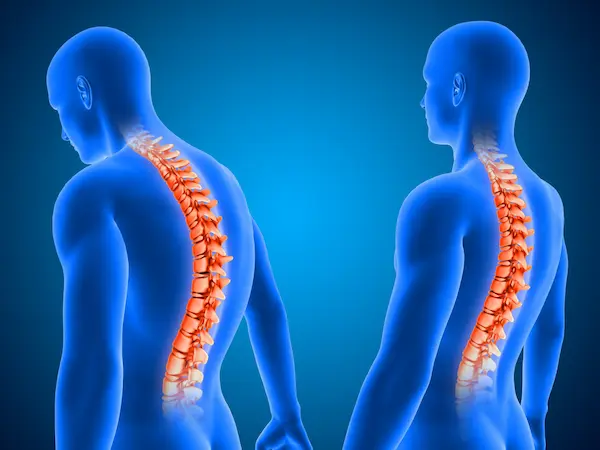
Treatment methods for congenital spinal deformities
Treatment of congenital spinal deformities is through follow-up and physiotherapy, and if the case is severe, it is treated with surgery early because it harms the respiratory system, and among the surgeries are the installation of columns that work on the growth of the spine, and through stabilizing part of the vertebrae, and there is a process called complete resection of the vertebra that is the cause of the deformity and this is done by making a posterior surgical incision only.
The deformity can be corrected, pain can be reduced, and normal spinal function can be restored through braces, which strengthen the spine, and there is a surgery known as spinal stabilization.
Frequently asked questions
Is there a cure for spinal deformity?
Spinal deformities vary and there is a difference in symptoms and causes, which makes the treatment methods varied, and the most common cases are those who suffer from spinal curvature, where drug treatment is available, which is provided in mild and moderate cases, and there is sports treatment and belt treatment, and it was revealed that there is surgical treatment, including cartilage removal and stabilization of the vertebrae.
Can a deformed spine be repaired?
It is possible to repair the deformed spine and there is a trial period to work on pain management and non-surgical physical therapy, this is for pain caused by facet arthritis, and if the curvature is severe, complex spine surgeries are resorted to.
Does scoliosis affect marriage?
One study revealed the relationship between scoliosis and marriage and its impact on sexual relations, as it indicated that one third of women with scoliosis suffer from suffering and issues in sexual life, as there is a sense of embarrassment regarding appearance, on the other hand, the inability to participate in activities that require physical effort from the woman, and from this, body image and sexual activity are affected by cultural differences and national differences as well.
What are fetal spinal abnormalities?
It is a deformity that affects the spine and is during the embryonic stage while the child is in the mother's womb, these deformities are caused by disorders in the development of the vertebrae of the spine, where disorders appear in the formation of the vertebrae or in the distribution of the vertebrae of the spine of the fetus, and here we see the deformation of the vertebrae and from there the development of kyphosis occurs.
Finally, there are many types of congenital spinal deformities that affect children, including spina bifida, slipped vertebrae, spinal cord deformities and scoliosis, and the orthopedic doctor has an ideal role in determining the type of deformity and good diagnosis, in addition to determining the appropriate type of treatment, whether it is physical therapy or surgical treatment, we within Almoosa Hospital have the best, most important and largest doctors specialized in diagnosis and treatment in addition to the best medical devices for physical therapy.
Sources
Congenital Spine Deformities – physio-pedia
