
Experiencing a headache is one of the most common and annoying experiences that humans ever face. There is hardly a person who has not felt the pain of a headache at some point in their life, whether the sensation is mild or severe pain that affects their daily life. Understanding the locations of headaches and their possible causes is the key to determining the type of headache you suffer from, and thus choosing the most appropriate treatment. Each type of headache has its distinctive characteristics, in terms of the location of the pain, its intensity, and the symptoms accompanying it. Follow with us this article presented by Al-Mousa Specialist Hospital. We will explore in depth the different places that can cause it.
Types of headaches
A headache is a pain or sensation after rest in the head, scalp, or neck. The nature of the pain varies depending on the location and cause of the headache, i.e. the type of headache. It is the signal that your body sends indicating the presence of a problem in your body.
The different types of headaches fall into two main categories:
- Primary headache
These types occur on their own, meaning they are not a symptom of another disease, as they are often associated with a defect in the electrical activity of the brain, blood vessels, or nerves surrounding the head.
Common types of primary headaches include:
- Tension headache: It is the common type associated with tension, stress, and psychological anxiety. It is characterized by mild to moderate pressure or pulling around the head, as if there is a belt pressing on the forehead or sides and back of the head, and the pain may extend to the neck and shoulders.
- Migraine: It has no specific cause, but it has triggers and is believed to be hereditary. It is characterized by severe, pulsating pain in one side of the head, but it can affect both sides.
- Cluster headaches: They do not have a specific cause, but they are believed to be linked to a defect in the hypothalamus part of the brain. They are characterized by severe and very painful pain, usually concentrated around or behind one of the eyes or in the temple on one side of the head.
- Secondary headache
These are types of headaches that are a symptom of another medical condition, and include:
- Sinus headache: which accompanies sinusitis and is pain in the face, forehead, and cheeks that gets worse when bending over.
- Caffeine headache: resulting from excessive caffeine intake and then sudden cessation of it.
- Post-traumatic headache: is a headache that occurs after a head injury, and may last for weeks or months.
- Medication overuse headache: It is called rebound headache, and it is chronic and occurs as a result of excessive use of pain relievers to treat the headache itself.
- High blood pressure headache: It is acute and severe.
- Sudden thunder headache: It reaches peak pain in less than a minute, and indicates serious conditions such as a cerebral hemorrhage.
- Headaches associated with serious conditions: such as brain tumors, stroke, and meningitis, are often accompanied by other serious symptoms.
Learn about: Left eye headache Common causes and effective treatment methods
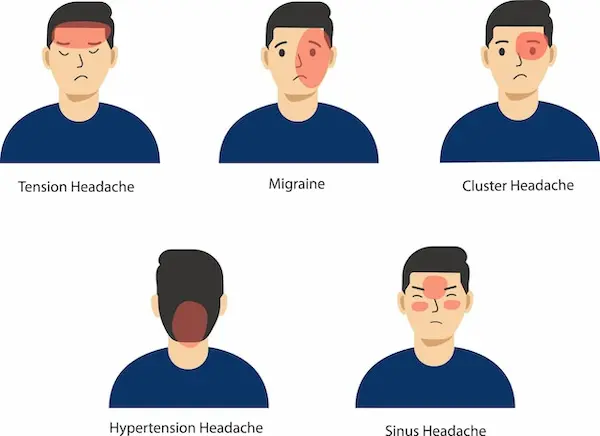
Headache locations and causes
Headache pain is distributed in different places in the head, and each location often indicates a specific type of headache and its possible cause. Understanding the locations of headaches and their causes helps determine the nature of the headache and deal with it better, and includes the following:
- Headaches in the front of the head, or forehead, are a common location for headaches, and are often associated with tension headaches, sinus headaches, or eye strain.
- Side headache: Pain may be on one or both sides, and often indicates a migraine, or a tension headache in some cases, or a result of temporomandibular joint disorders.
- A headache in the back of the head or neck, often associated with tension headaches, cervicogenic headaches, or high blood pressure headaches in cases of very severe high blood pressure.
- A headache around or behind the eye is a strong indicator of some severe types of headaches, such as cluster headaches or migraines.
- Whole-head or generalized headaches. These may be due to severe tension headaches, rebound headaches, meningitis or other serious health conditions.
Book your consultation now at مركز العلوم العصبیة At Al Mousa Specialist Hospital.
Frequently asked questions
How do I know if a headache is normal?
After explaining the locations and causes of headaches, some may wonder about the signs that headaches are normal and not a cause for concern?
- The intensity of headache pain is mild to moderate, and daily activities can be continued despite the pain.
- Headaches respond to common over-the-counter painkillers and will either go away or be significantly reduced.
- There are no serious symptoms accompanying the headache, such as high fever, stiffness in the neck, and any other serious symptoms, but only a feeling of a little fatigue or tension, which are common factors that cause headaches.
- Headache triggers are clear, and the cause can be identified, such as stress, anxiety, and lack of sleep.
- Infrequent headaches, meaning they do not occur every day or several times a week.
- A headache with a consistent and well-known pattern, such as an episodic tension headache, without any sudden change in severity, nature, or frequency.
How do I know that a headache is from pressure?
After knowing most of the locations of headaches and their common causes, including pressure headaches, it is necessary to understand that high blood pressure is called the silent killer because in many cases it does not cause any obvious symptoms. Therefore, you cannot rely on headaches alone to know whether your blood pressure is high or not.
However, when high blood pressure causes a headache, it is usually in cases of severe and very sudden high blood pressure, that is, in which readings exceed 180/120 mmHg or higher. In these cases, the headache may exhibit certain characteristics and be accompanied by other disturbing symptoms, including:
- A very severe headache, described as the worst headache you have ever felt in your life, as it reaches its peak intensity in less than a minute, and may be pulsating or throbbing.
- The pain is often on both sides of the head or includes the entire head, and may be concentrated in the back of the head, especially in certain cases.
- The accompanying symptoms are the key to distinguishing, as severe high-pressure headaches are often accompanied by other serious symptoms, such as blurred or double vision, nausea and vomiting, a feeling of dizziness or severe vertigo, with shortness or difficulty breathing, chest pain, or weakness in the arms, legs, or face.
- Nosebleeds in cases of very high altitude, with ringing in the ears.
- The headache pattern is characterized by being worse in the morning upon waking up, and getting worse with physical activity, coughing, sneezing, or stress.
Where are high pressure headaches located?
When a headache is caused by very severe high blood pressure, the patient often feels pain in the back of the head and may sometimes extend to the neck, which is the common location, but in some cases the pain may appear on both sides of the head or the entire head.
How do you differentiate between headaches?
Knowing the locations of headaches and their causes helps you quickly distinguish between types of headaches, and you can also note the severity of the headache and the accompanying symptoms to distinguish between the different types, as is the case in:
- Tension headache, which is characterized by general pain like a band around the head, is mild to moderate, and there is no nausea or vomiting, and it increases with tension or fatigue.
- Migraines are usually felt on one side. The pain is moderate to severe. It is characterized by being pulsating and throbbing, accompanied by nausea or vomiting, and sensitivity to light or sound. It may be preceded by a visual aura of flashes and numbness.
- Cluster headache is described as a sharp pain around one eye or temple, which is very severe and described as knife-like, and is accompanied by symptoms such as tears, eye redness, and nasal congestion on the same side.
- Sinus headache, which occurs in the forehead of the face and around the eyes or cheeks. It is moderate pain, similar to pressure, and is accompanied by nasal congestion and discharge, and increases when bending forward.
- Analgesic overuse headache is a general, daily or recurrent headache.
- The headache of a brain hemorrhage, brain stroke, or meningitis is a sudden and severe headache, with recurrent vomiting, blurred vision, loss of consciousness, or weakness in the extremities. In this case, you must resort to the nearest emergency hospital.
In conclusion, headaches remain a common and multifaceted experience, and require precise understanding and knowledge of the locations and causes of headaches, with the aim of distinguishing the differences between different types of headaches, to help doctors diagnose the condition and develop an effective treatment plan.
The Center for Neuroscience and Headache Treatment at Al Mousa Specialist Hospital is an integrated neuroscience center that focuses on providing specialized and comprehensive care for patients suffering from neurological disorders, including chronic and recurrent headaches, based on the latest diagnostic techniques and individual treatment plans.
لا تتردد في زيارتنا للحصول على الاستشارة والعلاج الأمثل، ويمكنك الاتصال بنا على ارقامنا المدونة على الموقع للمزيد من التفاصيل والحجز والاستفسار.
Sources
14 Types of Headaches and How to Treat Them – healthline
What is a headache? – healthdirect
