
Treating hallux deviation without surgery is the ideal solution sought by many who suffer from a change in the shape of the foot without wanting to undergo surgery. This common condition may begin with a slight discomfort when wearing shoes, but it develops over time if not treated properly. In this article, we review with you the causes of hallux deviation, diagnostic methods, and how it can be dealt with by non-surgical means, in addition to several directions that we provide to you from the medical team at Al Mousa Specialist Hospital, which helps you prevent and reduce symptoms.
What is hallux deviation?
Hallux valgus, also known as hallux valgus, is a foot condition in which the hallux, which is the big toe, deviates toward the other toes, causing a bone to protrude on the side of the foot at the base of the thumb. This deviation is often accompanied by pain, swelling, or redness in the affected area.
Reasons Hallux deviation
- Genetic factors such as a family history of the condition.
- Wearing inappropriate shoes, such as tight or high-heeled shoes.
- Structural problems such as flat feet or weak ligaments.
- Joint diseases such as rheumatoid arthritis.
Symptoms of hallux deviation
- Pain or discomfort when walking or wearing shoes.
- A bony prominence or bump on the side of the foot.
- Thumb deviation towards other fingers.
- Difficulty finding comfortable shoes
- Redness or swelling in the joint.
- The shape of the foot gradually changes.
- In some cases, a feeling of numbness or tingling occurs.
Methods for diagnosing hallux deviation
Diagnosis of hallux deviation is often made easily through a clinical examination, but to determine the extent of the deviation and a plan for treating hallux deviation without surgery;
Medical history
The doctor asks about:
- Family history of the condition.
- Quality of shoes used.
- Any previous injuries or diseases such as rheumatoid arthritis;
الفحص السريري
- The doctor visually examines the foot to notice the deviation of the thumb towards the other toes, and the protrusion of the bone or bump at the base of the thumb.
- The doctor asks about pain, swelling, difficulty walking, or the effect of the condition on wearing shoes.
- The extent or range of motion of the thumb joint is checked, along with any restriction or pain during movement.
- The doctor examines the entire foot, looking at the shape of the foot such as flat feet or any other deformities.
- The doctor may ask the patient to walk;
Radiography (X-rays)
X-rays of the foot are used to confirm the diagnosis and measure the degree of deviation. The x-rays are usually taken in the weight-bearing position, i.e. standing.
- Hallux valgus angle.
- Intermetatarsal angle.
- The presence of any changes in the joint, such as arthritis or cartilage erosion.
Additional tests (in rare cases)
- Magnetic resonance imaging (MRI): May be used if there is suspicion of soft tissue, ligament, or periarticular injury.
- CT scan: used in complex cases;
Learn about natural treatment for osteoporosis
How to treat bunion deviation without surgery
Non-surgical treatment of hallux valgus is focused on relieving symptoms, improving foot function, and preventing the condition from worsening. Non-surgical options are particularly suitable for mild to moderate cases. Below are the main methods for treating hallux valgus without surgery.
1. Wear appropriate shoes
- Choose shoes that are wide in the toe;
- Avoid high-heeled shoes or tight shoes.
- Wear shoes with good arch support;
2. Use braces or splints
- Wear a night splint to hold the thumb in the correct position;
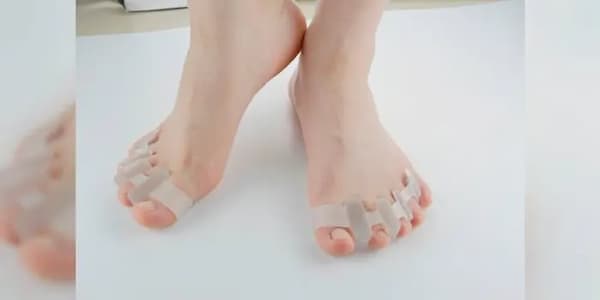
- Use finger separators, which are devices placed between the thumb and the adjacent finger to maintain alignment.
- Use silicone or cloth protection pads;
3. Use medical insoles
- Customized insoles support the arch and help correct foot mechanics, reducing pressure on the hallux.
- A specialist in foot orthotics can be consulted;
4. Physical therapy and foot exercises
- Strengthening exercises for the muscles of the foot and fingers, such as trying to lift a small towel with your toes.
- Thumb stretching exercises;
- Foot massage to relieve stress and improve blood circulation.
- The small ball exercise is rolling a small ball or water bottle under the foot.
5. Relieve pain and inflammation
- Apply cold compresses or ice for 10 to 15 minutes;
- Use non-steroidal anti-inflammatory drugs such as ibuprofen by prescription;
- applying topical creams;
6. Injection therapy (in some cases)
- Corticosteroid injections may be used to relieve severe inflammation, but must be under medical supervision.
7. Lifestyle modification
- Reduce activities that increase pressure on the foot, such as standing for long periods.
- Maintain a healthy weight;
- Avoid activities that increase pain, such as running on hard surfaces.
However, we note that treating bunion deviation without surgery does not lead to the bone shape returning to its normal position, but it reduces pain and slows down the progression of the deviation. Therefore, you must consult an orthopedic doctor or foot specialist.
When is surgery resorted to?
Surgery is used to treat bunion deviation when treating bunion deviation without surgery does not succeed in alleviating the symptoms, or when the condition is severe and greatly affects the quality of life. The following are cases that may require surgical intervention:
- Chronic and severe pain: If the pain is persistent and severe, even with proper shoes, braces, or other treatments, and affects daily activities such as walking or standing.
- Worsening deviation: When the deviation of the thumb increases significantly, leading to a visible deformity or overlapping of the fingers such as the thumb pressing on the adjacent finger.
- Difficulty wearing shoes: If it becomes impossible or painful to wear normal shoes;
- Additional complications: the development of chronic inflammation in the joints such as bursitis, the development of arthritis such as degenerative arthritis, the effect of the condition on other fingers such as hammertoe.
- Restriction of movement: If the deviation leads to joint stiffness or loss of range of motion in the hallux, which hinders the normal function of the foot.
- Impact on quality of life: If the condition restricts daily activities, work, or exercise, or affects mental health due to pain or appearance.
Ways to prevent hallux deviation
Preventing bunion deviation depends on reducing the factors that contribute to the worsening of the condition, especially if you are susceptible to it due to family history or the shape of the foot. Here are the most important methods of prevention:
- Wear shoes with a wide toe to give the toes enough room to move.
- Avoid high-heeled shoes or tight shoes that put pressure on the thumb.
- Choose shoes with comfortable inner lining and good arch support.
- Excess weight increases pressure on the feet, which may contribute to misalignment of the hallux, so maintain a healthy weight.
- Do foot muscle strengthening exercises;
- Use orthopedic insoles with arch support if you suffer from flat feet or high arches.
- Consult a podiatrist or orthopedist;
- Reduce standing for long periods of time, or doing activities that increase pressure on the ball of the foot.
- Check your feet regularly to notice any early changes, such as the beginning of a bony prominence or slight deviation.
- Avoid sitting in positions that put pressure on the toes, such as flexing the foot for long periods.
Frequently asked questions about treating bunion deviation without surgery
What is the cause of toe curvature?
It occurs as a result of factors such as wearing tight or high-heeled shoes, weakness in the muscles and ligaments of the foot, genetic factors, or joint diseases such as rheumatoid arthritis, which causes the thumb to deviate inward and the bone to protrude from the side.
What are the risks of bunion correction surgery?
Although the procedure is often safe, its risks include: infection, long-term swelling, joint stiffness, bone failure to heal properly, recurrence of the misalignment, or damage to nearby nerves.
How long does the bunion surgery take?
The operation usually takes between 45 minutes and an hour and a half, and the time depends on the degree of deviation and the type of surgical technique used.
What are the steps in the process of correcting hallux curvature?
Anesthesia, making a surgical incision in the skin at the joint, removing or modifying the bony prominence, reorienting the bones and then fixing them with screws or plates, then the wound is sutured and the foot is fixed with a bandage or splint, and then the recovery period begins gradually.
short; Musculoskeletal Rehabilitation Centre At Al Mousa Specialist Hospital, where our specialized team provides a comprehensive plan for treating hallux valgus without surgery to improve your condition, book your consultation now with the center and enjoy better health.
المصادر:
Hallux Valgus – orthobullets
Bunions (Hallux Valgus) – my.clevelandclinic
Hallux Valgus Symptoms – physio-pedia
