
Ankle surgery is a critical option for restoring movement and eliminating pain resulting from chronic injuries or deformities for which conservative treatments are unsuccessful.
At Al Mousa Specialist Hospital, ankle surgeries are performed with the latest technologies and by an elite group of specialized orthopedists, while providing comprehensive rehabilitation care to ensure full recovery and restore quality of life.
What is ankle surgery?
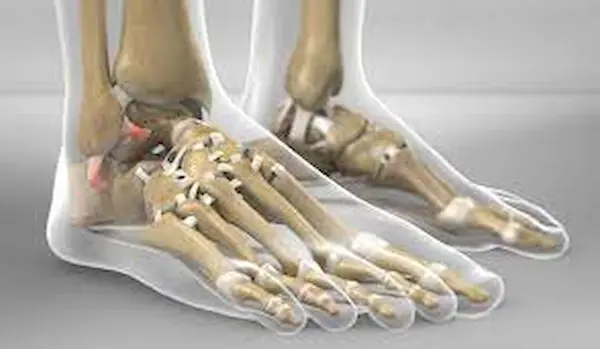
It is a surgical intervention performed on the ankle joint that aims to repair bone damage or defect or replace damaged tissue or bone in the ankle joint, in order to restore the normal function of the joint and relieve pain resulting from injury or wear.
This type of surgery is performed using precise techniques, and the procedure may be traditional or laparoscopic depending on the case.
What conditions does ankle surgery treat?
This procedure treats several conditions that affect the ankle joint and impede movement or cause chronic pain, including:
-
Severe or non-healing fractures
When the ankle joint is severely fractured or the bone is broken down into small pieces, surgical intervention is necessary to reattach the bones in their normal place using metal plates and screws. Surgery is also performed if the ankle joint does not heal properly after non-surgical treatment, causing deformity or lack of movement.
-
Chronic ligament or tendon rupture
In some injuries, especially in athletes or those with repeated ankle sprains, the ligaments or tendons of the ankle may be torn in a way that does not heal on its own.
-
Roughness or wear and tear of the ankle joint (arthritis)
Erosion of the cartilage covering the ankle joint occurs as a result of chronic arthritis such as osteoarthritis or rheumatoid arthritis.
-
Ankle deformities or joint deviation
Some deformities are caused by old injuries that were not treated well, or by genetic or congenital diseases that affect the structure of the foot and ankle, such as flat feet or arthrogryposis.
-
Bone or cartilage bodies within the joint
Small bone or cartilage fragments may form inside the ankle joint as a result of injuries or wear and tear, causing chronic pain, clicking, or difficulty moving.
-
Chronic ankle instability
Some patients experience a persistent feeling of ankle instability, especially after repeated foot sprains.
-
Tumors or bone infections
In some rare cases, benign or malignant tumors, or chronic infection in the ankle bones, can cause joint damage.
Learn about: Your comprehensive guide Treating protrusion of the foot bone without surgery Effective, safe and proven methods
When is ankle surgery recommended?
Doctors recommend surgical intervention if:
-
Persistence of chronic pain despite conservative treatment:
If the patient does not improve after a sufficient period of medication, physical therapy, or splints, and the pain continues to affect daily activity and quality of life.
-
Effect of injury on the ability to walk or work:
When an ankle injury affects a patient's functional ability, such as difficulty walking, lack of balance, or a constant need for support or crutches.
-
When a deformity or misalignment of the joint appears:
If there are clear deviations in the joint or changes in the shape of the foot that affect the stability of the body and are difficult to correct without surgical intervention.
-
When there are complications affecting the adjacent joint:
Such as the transfer of abnormal pressure to the foot or knee as a result of a defect in the ankle, which increases the risk of problems in other joints.
-
After confirming the diagnosis through images and careful examinations
If X-rays or MRI show clear damage that cannot be repaired with conservative treatment, the doctor recommends surgical intervention.
What are the different types of ankle surgery?
Their types vary depending on the nature of the injury, the degree of damage, and the goals of treatment (repair, stabilization, or replacement), and include:
-
Ankle arthroscopy
It is a minor intervention using a camera and fine tools inserted through small incisions, to remove small bony objects, clean the joint, and treat tendon infections or ligament tears.
-
Ankle Fusion - Arthrodesis
It is a fusion of the ankle bones together to permanently stabilize the joint. It is used in cases of severe arthritis or cartilage erosion that causes chronic pain.
-
Ankle joint replacement (Arthroplasty)
It is the process of replacing the natural joint with an artificial joint, for advanced cases of arthritis or ankle osteoarthritis while maintaining some movement.
-
Ligament Repair or Reconstruction
It is to rebuild or strengthen damaged ligaments, to treat chronic instability or recurrent ankle sprains.
-
Bone grafting or deformity modification (osteotomy)
In which the bone is cut and reshaped to correct alignment or relieve pressure.
Book your consultation now at Surgery center At Al Mousa Specialist Hospital.
What are the different ankle surgery procedures?
The process goes through basic steps, whether simple or complex.
First: Preparation before the operation
- A comprehensive evaluation, including blood tests, x-rays, and MRI, is performed to evaluate the condition and determine the procedure to be followed.
- The doctor asks you to stop certain medications such as blood thinners.
- The patient must fast 6 to 8 hours before the operation.
- The specialist doctor and anesthesiologist will discuss the appropriate anesthesia plan for your condition (full or hemi).
Second: Procedures during the operation
Procedures vary depending on the type of operation itself, in the case of:
- Ankle arthroscopy:
The surgeon inserts a tiny camera and tools through small incisions to clean the joint, remove free radicals, or repair damaged tissue.
- Ankle fixation:
The damaged cartilage between the bones is removed and the joint is stabilized using screws or plates.
- Ankle joint replacement:
The doctor removes the entire damaged joint and installs an artificial joint made of modifiers and polyethylene, in order to maintain joint movement and reduce pain.
- Ligament or tendon repair:
The doctor sews and patches the ligaments using autologous or synthetic tissue, and temporarily stabilizes the joint until it heals.
- Bone modification:
Here, part of the bone is cut to change the alignment, and then the bone is reattached after the adjustment.
ثالثًا: الرعاية بعد العملية
After completing the operation, the doctor recommends several procedures for the patient to follow:
- Staying in the hospital ranges from one to several days, depending on the type of operation.
- Use a splint, medical shoe, or crutches.
- Painkillers and anti-inflammatories.
- Begin physical therapy gradually to improve movement and strength.
- Periodic follow-up with imaging and x-rays to ensure joint healing or stability of the prosthetic limb.
Learn: Why it matters Orthopedics؟ وما الحالات التي تُعالجها؟
What are the risks of ankle surgery?
Like any surgical procedure, this procedure may be accompanied by some potential complications, but they are rare in most cases, and the medical team takes every precaution to avoid them.
- Infection: It can occur after surgery, but is usually superficial and is treated quickly with appropriate antibiotics.
- Blood clotting: It is a known complication in operations involving the lower extremities, but the use of preventive methods such as medications and compression stockings greatly reduces its possibility.
- Delayed bone or tissue healing: The recovery time may be long for some patients, especially if there are chronic diseases such as diabetes, but regular follow-up helps to overcome this.
- Joint stiffness or limited mobility: This condition is often temporary, and can be significantly improved by adherence to physical therapy after surgery.
- Temporary pain or numbness: Some patients may feel a change in sensation or minor pain during the recovery period, which often goes away over time.
It is important to emphasize that these risks do not necessarily mean that they will occur, but rather they are general possibilities that are clarified to ensure transparency with the patient and enable him to make the decision with confidence and awareness. Choosing a qualified surgeon and following post-operative instructions play a major role in reducing these risks and accelerating recovery.
الاسئلة الشائعة:
Is ankle surgery painful?
During the surgery, the patient will not feel pain due to anesthesia.
What are the benefits of ankle surgery?
Its benefits lie in relieving chronic pain resulting from injuries or wear and tear, improving joint mobility and restoring the ability to walk normally, correcting deformities or instability in the ankle, and improving the quality of life to enable the patient to return to daily and sporting activities.
How long does it take to recover from ankle surgery?
Recovery from surgery usually takes 6 to 12 weeks, depending on the type of surgery and the patient's condition.
In the end, ankle surgery may be a necessary step to improve the quality of life, as it helps relieve pain and restore movement, and although there are some risks, its positive results outweigh the challenges when adhering to the doctor’s instructions and the recovery plan.
Sources
NIH- Ankle Arthroplasty
MedlinePlus– Ankle replacement
Cleveland Clinic- Ankle Surgery
