
Muscle separation is one of the common health problems that women can face after pregnancy and childbirth. Some men can also suffer from it as a result of incorrect exercise or exposure to repeated physical stress. It is a separation of the rectus abdominis muscles, which leads to the appearance of bloating in the abdominal area and weakness in supporting the torso. In the current period, methods of treating muscle separation have become available with increased health awareness. These methods contribute to maintaining the health of the body and improving the physical appearance. They vary between therapeutic exercises and physical therapy, and surgical intervention in some cases to restore muscle balance. Continue reading with Al Mousa Hospital.
What is muscle separation?
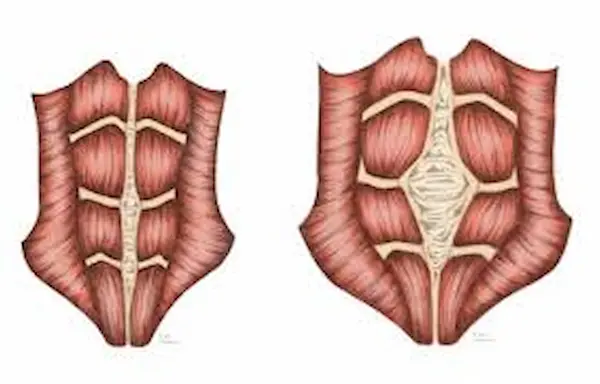
Diastasis recti is a condition in which there is separation between the two rectus abdominis muscles as a result of weakness in the connective tissue that connects them. It usually appears in the form of a protrusion or bulge in the middle of the abdomen, especially when performing an effort such as coughing or sitting. It is more common in women after pregnancy due to the expansion of the abdominal wall, but it may also affect men and athletes as a result of stress or incorrect exercises. This condition may affect trunk strength, posture, and cause lower back pain. Therefore, the patient needs a customized program of muscle separation treatment to restore balance.
Causes of muscle separation
We know very well that the shape of the abdomen is annoying to you when a bulge-like bulge appears in it, and there are some reasons that lead to muscle separation, and these reasons are as follows:
- Pregnancy and childbirth, the expansion of the abdominal wall as the fetus grows, especially in the last months, is the most common cause in women.
- Obesity or overweight, the accumulation of fat in the abdominal area puts pressure on the abdominal muscles and gradually separates them.
- Lifting heavy weights frequently, whether during exercise or physical work, may lead to weak connective tissue.
- Doing exercises incorrectly, such as traditional abdominal exercises, crunches or planks, incorrectly.
- Genetic factors: Some people have a natural weakness in connective tissue that makes them more susceptible to infection.
- Aging may cause muscles and supporting tissues to weaken over time.
Symptoms and how to recognize it
If you want to know whether what you have is weight gain or muscle separation, there are some symptoms that indicate diastasis recti, which are:
- A protrusion or bulge in the middle of the abdomen, especially when coughing, laughing, or getting up from a lying position.
- Weakness in the abdominal muscles and difficulty performing some movements.
- Lower back pain due to loss of muscle support.
- Sagging abdomen despite exercising or losing weight.
- Postural problems and difficulty with balance.
- In some cases, it may be accompanied by a feeling of discomfort in the pelvic area.
To identify it, you can perform a simple test at home, which consists of lying on your back and bending your knees, with your head raised slightly forward, as if you were going to do an abdominal exercise. Then, place your fingers on the middle of the abdomen, at the navel, and move them slightly up and down. If you feel a gap or gap between the rectus abdominis muscles that allows two or more fingers to enter, this is a sign of muscle separation.
Learn about: هل الحثل العضلي خطير؟
Methods of diagnosing muscle separation
There are a number of ways in which muscle separation is diagnosed, and these methods are as follows:
- The doctor or physical therapist manually examines the abdominal area while the patient lies down and raises the head slightly forward. The distance between the two rectus abdominis muscles is measured. If the distance is more than 2 cm or the width of two fingers, this indicates the presence of muscle separation.
- The patient himself can perform a simple examination, as I mentioned previously, by lying on his back, raising his head slightly, then feeling the space in the middle of the abdomen at the navel.
- Ultrasound imaging is considered the most accurate way to determine the extent and depth of the separation, as it clearly shows the distance between the muscles and the condition of the connective tissue.
- CT scan or MRI is used in complex cases or when there is a need for a comprehensive evaluation of the abdomen and surrounding tissues.
Effective exercises to treat muscle separation
Below we explain a group of effective exercises in treating muscle separation, but before starting any exercise we remind you that it is preferable to consult a doctor or physical therapist to ensure its suitability for your condition, and these exercises are:
Deep breathing exercise
- Sit or lie down comfortably.
- Inhale deeply, expanding the ribs, then exhale slowly, pulling the navel in toward the spine.
- Repeat 10 times.
Pelvic tilt exercise
- Lie on your back, bend your knees, and place your feet on the floor.
- Pull your navel in and gently push your lower back toward the floor.
- Hold for 5 seconds then relax.
- Repeat the exercise 10 to 15 times.
Light side press exercise
- Lie on your back and bend your knees.
- As you exhale, pull your navel inward and slowly extend one leg forward and then bring it back.
- Switch feet 10 times.
Partial head raise exercise
- Lie on your back, bend your knees, and place your hands on your stomach.
- Inhale, then as you exhale raise your head slightly while pulling your abdomen inward.
- Go back slowly and repeat 10 times.
Internal push-up exercise with a towel
- Lie on your back, then bend your knees.
- Then place a towel wrapped around the abdomen and hold both ends with your hands.
- As you exhale, pull your navel inward while gently pulling the towel to bring the muscles together.
- Repeat the exercise 10 to 15 times.
Treating muscle separation with massage
Of course, you would like to know the various details about muscle separation through massage, as massage is considered an auxiliary treatment to the muscle separation treatment program, but it is not sufficient alone to close the gap between the abdominal muscles, and its main role is to improve blood flow, increase tissue elasticity, and relieve tension around the abdominal and back area. The benefits of massage in cases of muscle separation are as follows:
- Stimulating blood circulation, which helps nourish tissues and support the healing process.
- Relieve pain and tension in the lower back and muscles surrounding the abdomen.
- Increasing the elasticity of the connective tissue surrounding the abdominal muscles, which makes therapeutic exercises more effective.
- Reducing bloating and muscle tension resulting from trunk weakness.
Types of massage used
It should be noted that the best types of massage come as follows:
- Deep manual massage that focuses on deep tissues to relieve stiffness.
- Lymphatic massage to reduce swelling and improve lymphatic drainage.
- Massage with natural oils such as lavender oil or coconut oil to support muscle relaxation.
Arthroscopic treatment of muscle separation
It is one of the modern options in treating muscle separation, especially in advanced cases that do not respond to exercises or physical therapy.
- The surgery is done through very small incisions in the abdomen instead of open surgery.
- The surgeon inserts a camera and tiny instruments to re-approximate and tighten the rectus abdominis muscles and connect them together with special threads.
- The surgeon may use a supportive mesh in some cases to prevent recurrence of the separation.
The advantages of laparoscopic treatment are that it is less invasive compared to traditional operations, in addition to the appearance of small, unnoticeable scars because the incisions are limited. In addition, there is a faster recovery period that is less than the usual weeks in open surgery, in addition to reducing the risk of infection or complications due to the small size of the incisions.
Book your consultation now at مركز أمراض الجهاز الهضمي At Al Mousa Specialist Hospital.
Surgical treatment of muscle separation
Surgical intervention is considered the final and most effective solution in cases of severe diastasis, especially when exercises and physical therapy fail to return the abdominal muscles to their normal position. This surgery is known as Abdominoplasty with Muscle Repair. The steps of surgery are as follows:
- General anesthesia to ensure patient comfort.
- Making a surgical incision in the lower abdomen, usually at the cesarean section line in women.
- Expose the rectus abdominis muscles and determine the location of the separation.
- The muscle is re-approximated and sutured with strong insoluble sutures to hold it in place.
- Removal of excess skin and fat if there is associated sagging.
- Closing the wound cosmetically to reduce the appearance of the scar.
The advantages of surgical treatment are as follows:
- Closing the gap permanently and effectively.
- Improve trunk strength and spine support.
- Restore the appearance of a firm and flat abdomen.
- Treating functional problems such as lower back pain or pelvic weakness.
It should be noted that surgery is recommended in some cases, including if the muscle separation exceeds 5 or 6 cm, or if there is sagging skin or an accompanying abdominal hernia, or when exercises and physical therapy do not achieve the desired results after several months. The patient usually needs 4 to 6 weeks to return to light activities, and it is recommended to wear an abdominal compression belt to stabilize the muscles and reduce swelling. Lifting weights or doing strenuous exercises should also be avoided for a period of up to 3 months.
Duration of treatment for muscle separation
The duration of treatment for muscle separation varies according to the types of treatments used. In physical therapy and exercises for mild to moderate cases, results may begin to appear after 8 to 12 weeks of commitment to deep muscle strengthening exercises and therapeutic breathing. Some may need 3 to 6 months to reach a noticeable improvement and reduce the gap significantly. The most important factor is regularity and follow-up with a physical therapist to avoid wrong exercises that may increase the problem. In the case of massage therapy and additional support, it is considered an auxiliary method alongside exercises, and helps improve flexibility and blood circulation, and its results are gradual.
Preventing muscle separation during and after pregnancy
During pregnancy, it is important to prevent muscle separation by following the following points:
- Maintain correct posture by standing and sitting with slight tension in the abdominal muscles and avoiding exaggerated back bending.
- Practice deep breathing exercises and exercises to strengthen the deep abdominal muscles, such as diaphragmatic breathing and pelvic floor exercises, while avoiding traditional abdominal exercises such as crunches.
- Wearing a pregnancy support belt helps reduce pressure on the abdominal wall and support the lower back.
- Maintaining a healthy and appropriate weight during pregnancy reduces pressure on the abdomen.
- Avoid lifting heavy objects as it increases pressure on the abdominal muscles and widens the separation.
After pregnancy, it is important to protect yourself from muscle separation by doing the following:
- Gradually start with gentle exercises such as breathing exercises and Kegel exercises before moving on to more advanced abdominal exercises.
- Avoid movements that increase separation, such as sitting suddenly or getting up straight from the bed. It is preferable to get up using the “roll on the side first” method.
- Use a postpartum tummy tuck belt to provide additional support to your abdominal muscles in the first weeks.
- Good nutrition by eating foods rich in protein and vitamins to promote tissue healing.
- Follow up with a physiotherapist specializing in women’s health to monitor recovery and ensure that the problem does not worsen.
If you suffer from muscle separation after pregnancy or notice an annoying protrusion in the abdomen that affects your appearance and health, do not hesitate to consult the experts at Al Mousa Specialist Hospital. We provide you with the latest diagnostic methods and integrated treatment plans, starting with therapeutic exercises under the supervision of specialists all the way to surgical intervention when needed, to help you regain your muscle strength and self-confidence. Book your appointment today with our specialized medical team and begin your journey towards a tight abdomen and better health.
Frequently asked questions
Does the corset treat muscle separation?
The corset does not treat muscle separation radically, but it is used as a temporary aid to support the abdominal wall and reduce pressure on the muscles, which gives a feeling of comfort and improves posture, especially after childbirth. However, effective treatment depends mainly on therapeutic exercises directed at strengthening the deep muscles, and in some cases the patient may need surgical intervention if the separation is severe, so it is recommended to use the corset in addition to an appropriate treatment program and not as a sole solution.
Does walking help treat muscle separation?
Walking is a safe and beneficial activity after birth and helps indirectly in treating muscle separation, as it contributes to stimulating blood circulation, improving general fitness, and stimulating the work of the deep muscles of the abdomen and back in a gentle way without increasing pressure on the abdominal wall, but it is not enough alone to close the gap between the muscles. Rather, it must be combined with exercises dedicated to strengthening the transverse abdominal muscles and therapeutic breathing exercises to achieve effective results in treating muscle separation.
Is muscle separation a hernia?
Muscle separation is not a hernia. They are two different conditions despite the similarity in some of the symptoms. Muscle separation occurs when the rectus abdominis muscle stretches and releases from the midline due to weak connective tissue, causing protrusion in the middle of the abdomen, especially when exerting effort. As for a hernia, it is the exit of part of the intestine or tissue through an opening or weakness in the abdominal wall, and is considered more serious because it may cause complications that require urgent surgical intervention, while muscle separation can often be treated with exercises or plastic surgical intervention when necessary.
Does muscle separation cause abdominal cramps?
Yes, muscle separation may cause what is known as a paunch or protrusion of the abdomen, where the widening of the distance between the two rectus abdominis muscles leads to a weakness in supporting the abdominal wall, which makes the abdomen push forward and appear flabby even with a normal weight. This protrusion is not always a result of fat, but rather due to a loss of muscle cohesion, so some women or even men may notice the presence of a paunch despite exercising or following a diet, and the solution is through therapeutic exercises targeting the deep muscles or surgical intervention in severe cases.
Medical sources
phyxphysio – Abdominal Separation
the clinics – What is Diastasis Recti
