
The moment of childbirth is a unique and pivotal experience in the life of every woman, and therefore many questions arise about how to make this moment as comfortable and safe as possible, and in light of thinking about options for relieving pain, the spinal needle for childbirth stands out as one of the most common and effective methods, and you may still have lingering questions about exactly what it is, when to use it, and whether it is the ideal choice for you, so follow this article with us, it will be your comprehensive guide to understanding the spinal needle for childbirth, and we will discuss everything you need to know about its work, its benefits, and the potential risks and side effects that may
What is a back needle for childbirth?
Epidural anesthesia, also called epidural anesthesia, is a method of pain relief widely used during labor and natural or cesarean section delivery.
A mixture of local anesthetics and strong pain relievers such as opioids are injected continuously or in intermittent doses, as needed and according to the medical protocol. These medications numb the nerves that transmit pain signals from the lower part of the body to the brain.
Benefits of back needle for childbirth
The back needle for childbirth offers many important benefits that make it a popular and preferred option for many women during labor and childbirth. The most prominent of these benefits include the following:
- Effective and comprehensive pain relief;
- Maintaining awareness, staying awake and being able to participate, especially in the case of a natural birth.
- Reducing physical and psychological stress resulting from severe labor pain.
- The possibility of adjusting the dose and controlling pain, through the catheter that remains in the mother’s back.
- Its benefit is in emergency caesarean section, where the anesthetist can simply increase the concentration of the drug through the same catheter to provide sufficient anesthesia for the caesarean section, without the need for additional general anesthesia.
Learn about: Low back pain causes, treatment and when it is serious
When is a dorsal injection taken for childbirth?
Determining the timing of administering a dorsal injection for labor depends on several factors, including the progress of labor and the judgment of the medical team to ensure maximum safety and effectiveness, but the general guidelines that doctors follow include the following:
- In the stage of active labor, that is, the cervix has begun to dilate significantly and the contractions have become regular and strong, as the dilation of the cervix at this stage is between 4 to 5 centimeters.
- If direct delivery is not imminent, there must be enough time for the anesthesiologist to safely place the needle and catheter, and for the medications to begin working.
- In the case of a caesarean section, a dorsal epidural is usually the preferred option for sedating the mother, allowing her to remain awake during the procedure, and can be given just before surgery begins.
What is the effect of a back needle for childbirth in the long term?
In general, spinal labor is very safe, and serious or long-term side effects are extremely rare. However, it is important to understand the possibilities, even if small, which include:
- Chronic back pain:
Some women feel pain or sensitivity at the site of the needle injection for a few days or weeks after giving birth, and this usually goes away on its own, but there is no conclusive evidence linking back needles to chronic back pain in the long term.
- Permanent nerve damage
It is very rare and occurs if the nerve is directly pricked with a needle or catheter, or in rare cases due to blood collection or infection pressing on the nerves.
- Severe headache
In rare cases, about 1% of cases, an accidental puncture of the membrane surrounding the spinal cord may occur during the procedure, leaking cerebrospinal fluid and causing a severe headache that gets worse when standing and improves when lying down.
- Breathing problems
In very rare cases, if the anesthetic spreads excessively up the spinal cord, affecting the breathing muscles.
- Infection at the injection site or around the spinal cord, which is extremely rare thanks to the sterile techniques used.
- Effects on the child
The amount of medication that reaches the fetus from the back needle during childbirth is very small compared to medications given intravenously, and is usually considered safe for the child. There is no conclusive evidence that the back needle causes any long-term negative effects on the child’s development or health.
Book your consultation now at مركز صحة المرأة At Al Mousa Specialist Hospital.
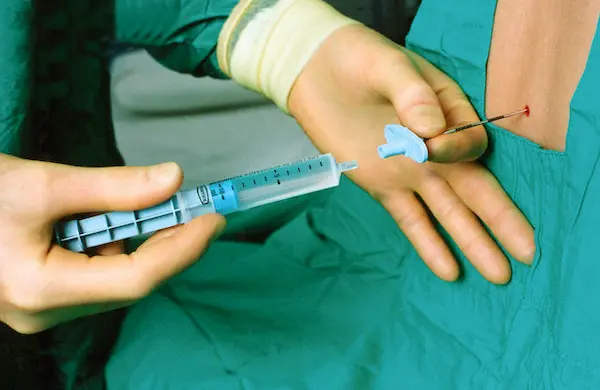
What is the difference between spinal needles for childbirth and spinal anesthesia, and which is better?
In fact, the terms epidural and spinal anesthesia are often used interchangeably in the context of childbirth, which causes some confusion, but in precise medical terms there is a difference between them, and they both fall under the umbrella of regional anesthesia, which numbs part of the body while the patient remains conscious.
The difference between a back needle for childbirth (epidural) and spinal anesthesia (spinal anesthesia) for childbirth is, in brief, as follows:
- Location and size: The back needle is injected into the epidural space around the spinal cord, and a small catheter is used to deliver the drug in continuous doses. As for spinal anesthesia, it is injected into the cerebrospinal fluid with a thinner needle, and a single dose is fast-acting.
- Speed and duration. The effect of spinal anesthesia begins within minutes and lasts approximately two hours, while the effect of the spinal needle begins after 15-20 minutes, but it is adjustable and continues throughout the birth.
- Controlling movement. A back needle relieves pain while maintaining some movement, such as walking sometimes, while spinal anesthesia temporarily paralyzes all movement.
Therefore, it cannot be said that one type is absolutely better than the other, as each has its own uses and advantages. The dorsal needle is preferred for natural birth because it provides continuous pain relief whose dose can be controlled over the long hours of labor, while allowing the mother to maintain a degree of movement and feel the pressure necessary to push during the birth stage.
While for a planned caesarean section, spinal anesthesia is preferred because it provides rapid and complete anesthesia sufficient to perform the surgery in a short time, while allowing the mother to remain awake and see her child immediately after his birth.
In the case of rapid conversion to an emergency cesarean section during labor, if the mother has already received a dorsal needle, the anesthesiologist can usually quickly increase the dose of medication through the same catheter to provide sufficient anesthesia for an emergency cesarean section, saving time and avoiding the need for general anesthesia.
What are the alternatives to the back needle?
Back injection is a common and effective option for relieving labor pain, but it is not the only option. There are several alternatives to relieve pain, including:
- Opiate analgesics such as morphine and fentanyl, administered intravenously or intramuscularly.
- Nitrous oxide, a gas inhaled through a mask or mouthpiece, is usually mixed with oxygen for pain relief and relaxation.
Spinal anesthesia or spinal anesthesia is not used in natural childbirth.
Learn about: Back strain: causes, treatment and effective prevention methods
What are the contraindications for using a back needle?
The back needle is considered safe and effective for the vast majority of women during childbirth, but there are some cases that may prevent its use or require extreme caution, including:
- The mother suffers from bleeding disorders such as hemophilia or severe platelet deficiency.
- The mother's use of blood thinners such as heparin and warfarin.
- If the mother suffers from a widespread infection in the blood or body or from an infection at the injection site.
- Severe low blood pressure in the mother.
- The mother suffers from some nerve and central nervous system diseases, such as multiple sclerosis, hemiplegia or quadriplegia, or some spinal tumors.
- The presence of a severe deformity in the mother’s spine.
- The mother has had previous back surgery that affects the epidural space.
- Allergy to anesthetic components.
- Emergencies and lack of sufficient time.
Frequently asked questions
When is a spinal injection given for natural birth?
It is preferable to give the dorsal injection when the mother is in the active stage of labor, that is, when the labor is regular, strong, and painful, and the cervix has dilated by at least 4 to 5 centimeters.
Because giving it too early may slow down the progress of labor for some women, while giving it too late may not leave enough time for it to take effect before giving birth, or the mother may be very tired and unable to cooperate during the procedure.
Do I feel the shot with the back needle?
No, you will probably not feel vaginal pain after taking a back needle, as it works to numb the nerves that transmit pain signals from the uterus and birth canal to your brain, which means it reduces or eliminates the sensation of acute pain.
But you may feel a feeling of intense pressure in the pelvic area or lower abdomen during contractions, especially as labor progresses and the pushing stage approaches.
Is a back injection given before artificial labor?
Doctors often give a spinal injection after the start of artificial labor, and not immediately before it, because artificial labor causes uterine contractions that are more intense and painful than natural contractions, so the mother feels the need to relieve the pain, and here comes the role of the spinal needle.
Is a back needle for cesarean section painful?
No, the back needle itself does not cause severe pain. Rather, you may feel some pressure or a slight tingling during local anesthesia before the spinal anesthesia needle is inserted.
In conclusion, the decision to use a spinal needle for childbirth is a personal step that requires a deep understanding of all its aspects. We have reviewed together the details of this technique and its benefits in relieving pain to help you make your decision.
Al Mousa Specialist Hospital provides comprehensive and integrated care for mother and child, with a qualified medical team and extensive experience in managing births, including providing the option of a safe and effective dorsal needle. We are proud to provide a supportive environment equipped with the latest technology to ensure a comfortable and reassuring birth experience for you and your family. Do not hesitate to visit us and you can contact us on our numbers listed on the website for more details, reservations and inquiries.
Sources
Epidural – Everything You Should Know About It – americanpregnancy
Should I Use an Epidural for Pain Relief During Labor? – healthline
