
Benign stomach cancer is considered one of the rare conditions that may not be noticed at the beginning, due to the similarity between its symptoms and daily digestive problems. However, early detection of the symptoms of benign stomach cancer has a major and important role in treatment and prevention of the development of the condition. In the following lines, we will explain with you at Al Mousa Specialist Hospital the most prominent signs that need attention and going to the doctor for reassurance.
What is stomach adenocarcinoma?
This type of cancer is a non-cancerous growth that occurs in the lining or wall of the stomach. It is characterized by the fact that it does not invade neighboring tissues and does not spread to other parts of the body, unlike malignant tumors. This type of tumor is often slow-growing, and does not pose a direct threat to life if discovered and treated early. Common examples of this type include smooth muscle tumors and benign adenomas, and they are usually treated with surgery or through periodic follow-up, depending on the size of the tumor and its symptoms.
Causes of benign stomach cancer
The causes of benign stomach cancer are not completely clear, but there are a group of factors that are believed to be the cause of its occurrence, which are as follows:
- Genetic factors play a major role in some cases, as they can increase the chances of developing benign tumors.
- Those who suffer from chronic stomach inflammation, such as gastritis caused by Helicobacter pylori bacteria, are more susceptible to the disease.
- A diet high in saturated fats, salty foods, or smoked foods contributes to an increased risk of stomach problems, including polyps.
- Those exposed to toxic chemicals or polluting materials, such as some materials used in the food industry, are among the most vulnerable groups.
- With age, the possibility of changes in stomach cells that may lead to the appearance of benign tumors increases.
- Some studies indicate that hormonal changes play a major role in the development of some benign stomach tumors.
It should be noted that the exact causes are uncertain, and these factors contribute to an increase in the probability of the occurrence of benign tumors in the stomach.
Symptoms of benign stomach cancer
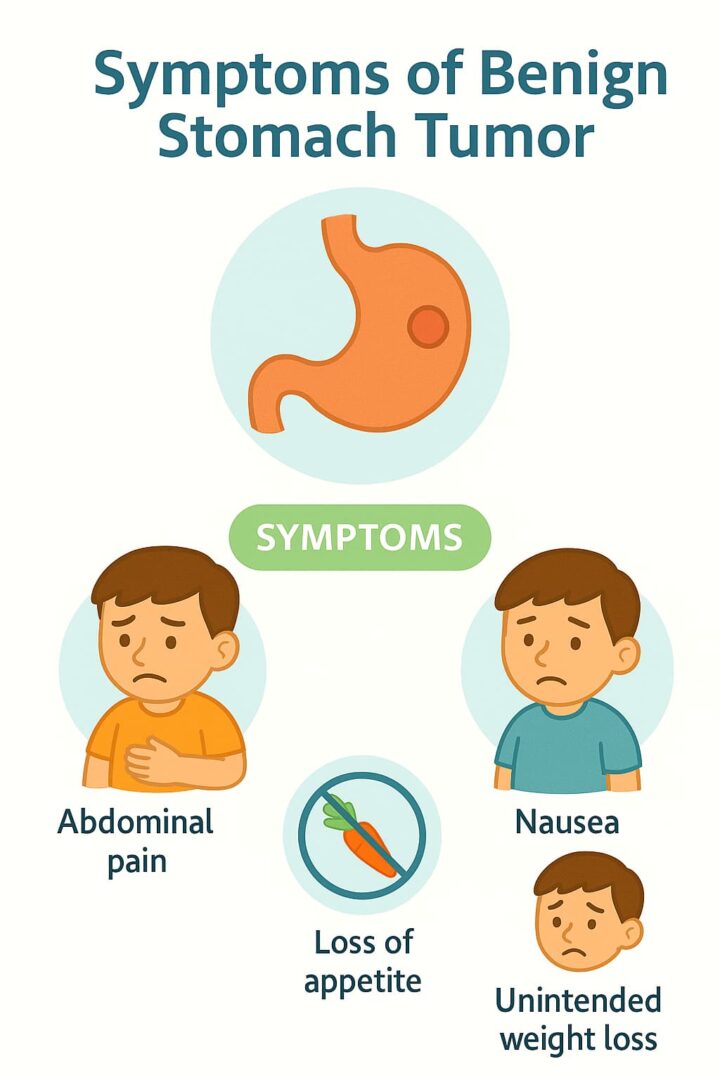
The signs may be mild or similar to the symptoms of other stomach disorders, but in some cases some clear symptoms may appear, including:
- Stomach pain and a feeling of discomfort or pain in the stomach area, which may increase after eating.
- Feeling bloated or gassy, and difficulty digesting after eating.
- Feeling nauseous or vomiting, especially after eating.
- Decreased desire to eat, which leads to unexplained weight loss.
- Even with small amounts of food, a person may feel full quickly.
- Irritation or burning in the stomach, as a result of a tumor in the stomach wall.
- Unexplained weight loss in some cases due to loss of appetite or difficulty eating.
Detecting stomach polyps early is key to preventing them from turning into more serious stages. Oncology center We have you and rest assured of your health.
Types of benign stomach cancer
Benign stomach cancer includes many non-cancerous types that grow in the stomach lining. These types differ in terms of shape and location in the stomach. The most prominent types are the following:
- Benign adenomas are rare tumors that arise from the cells lining the stomach. They appear in the form of small growths, but in some cases they may turn into malignant tumors if they are not treated.
- Smooth muscle tumors are benign tumors that arise from the smooth muscles of the stomach wall. They often do not cause obvious symptoms, but they can lead to partial obstruction of the stomach if they are large.
- FibroidsIt consists of fibrous or connective tissue, and is generally considered benign. It may grow slowly but may not be accompanied by noticeable symptoms.
- Hemangiomas, which are benign tumors resulting from the abnormal formation of blood vessels in the stomach wall, rarely cause any symptoms and are usually discovered during examinations by chance.
- Neuroblastomas, which consist of nerve cells, are considered benign and usually appear as masses in the stomach wall.
Diagnosis of stomach adenocarcinoma
Diagnosis depends on a set of medical tests and procedures that help determine the type of tumor and determine the extent of its impact on human health. The most prominent diagnostic methods are as follows:
- Clinical examination, in which the doctor begins by evaluating the patient's clinical symptoms, such as pain, bloating, or weight loss, in addition to reviewing the patient's medical history.
- Gastroscopy: This is done by inserting a thin tube equipped with a camera through the mouth into the stomach, so that the walls of the stomach are examined directly and through it, benign tumors and tissue changes can be seen.
- X-rays: In this examination, a barium substance is taken orally to cover the stomach, which allows the X-rays to show tumors or changes in the structure of the stomach.
- Using CT scans, this technique is used to obtain a detailed image of the stomach and surrounding organs, thus determining the size and location of the tumor.
- Taking a biopsy during endoscopy, where the doctor takes a sample of the tumor for examination in the laboratory under a microscope, can help determine whether the tumor is benign or contains cells that may turn into cancer cells.
- Magnetic resonance imaging, which is used to provide more detailed images of the stomach, especially in cases where it is difficult to obtain accurate details through other examinations.
- Blood tests, which can detect signs of inflammation, infection or other stomach problems, but are not sufficient to accurately diagnose adenocarcinoma.
Get to know Symptoms of stomach cancer؟ وكيف يمكن تشخيصه؟
Treatment of gastric benign cancer
Treatment depends on the type of tumor, its size, and the symptoms it causes. In many cases, if the tumor is small and does not cause symptoms, the doctor may suffice with periodic monitoring without direct therapeutic intervention. If the tumor is large or causes disturbing symptoms such as stomach obstruction or bleeding, there may be a need for surgical intervention to remove it. Most often, the tumor is removed using endoscopy without the need for open surgery, but in more complex cases, traditional surgery may be required. Drug treatments are rarely used in treating tumors.
How to prevent stomach benign cancer
Disease prevention mainly focuses on maintaining stomach health and reducing factors that contribute to the growth of tumors. The most prominent methods of prevention are the following:
- Follow a healthy diet rich in vegetables, fruits and fibre, with the importance of reducing the consumption of salted, smoked or high-fat foods.
- Maintain a healthy weight. Obesity increases the risk of stomach problems.
- Quit smoking. Smoking negatively affects the stomach lining, and in turn increases the possibility of the formation of benign and malignant tumors.
- Treating stomach infections early helps reduce the risk of developing tumors.
- Exercise regularly. Regular physical activity plays a major role in improving the digestive process and reducing the risk of digestive problems.
- Avoid drinking alcohol, as alcohol is harmful to the stomach wall and increases the possibility of developing tumors.
- The importance of periodic medical follow-up, especially for those with a family history of stomach diseases, as periodic examinations help in early detection of any abnormal changes.
Frequently asked questions
Can stomach cancer be benign?
Yes, stomach cancer can be benign, as some tumors grow inside the stomach without turning into malignant cancer cells, or spreading to other parts of the body. These tumors are known as benign tumors, such as smooth muscle tumors or adenocarcinomas. They are usually slow-growing and are not considered a major danger if they are discovered, monitored, and treated in a timely manner.
Can stomach adenocarcinoma be cured?
Yes, benign stomach cancer can be completely cured in most cases, especially if it is detected early and treated appropriately. The benign tumor is usually removed through endoscopy or simple surgery without the need for complex treatments such as chemotherapy or radiation. The tumor rarely returns after complete removal, which is why it is important for periodic medical follow-up to ensure that no new changes appear in the stomach.
What are the early signs of stomach cancer?
The signs are often mild or non-specific, which makes detecting the disease in its early stages difficult. The most prominent of these signs are a persistent feeling of indigestion, loss of appetite, mild stomach pain, nausea, and a feeling of fullness, even after eating a small amount of food, in addition to unexplained weight loss. Some other signs may also appear, such as heartburn or general fatigue, which calls for attention and early medical examinations if these symptoms persist.
Are there any cases of stomach cancer that have been cured?
Yes, there are many cases of stomach cancer that have been cured, especially when the disease is discovered in its early stages and appropriate treatment is started quickly. The chances of recovery also vary according to the stage of the cancer at the time of diagnosis, as recovery rates are high if the tumor is confined to the stomach and has not spread.
Thanks to its experienced and competent doctors, Al Mousa Specialist Hospital was able to treat many cases of benign stomach cancer. Rest assured and book an appointment now for diagnosis and to begin the treatment journey.
Medical references
Stomach cancer – mayoclinic
What is stomach cancer (gastric cancer) – clevelandclinic
