
Cutaneous leishmaniasis is one of the parasitic diseases that may seem simple at its beginning, but it may leave a permanent effect on the skin if not treated properly. This infection is transmitted by the bite of a sand fly and spreads in some hot and dry areas. It usually begins with the appearance of a small ulcer that quickly expands and inflames, causing obvious skin deformities, which makes early detection and rapid treatment extremely important. In the following lines with Al Mousa Specialist Hospital, we will shed light on the details of cutaneous leishmaniasis in terms of causes, symptoms and treatment methods.
What is cutaneous leishmaniasis?
Cutaneous leishmaniasis is a parasitic infection that affects the skin and occurs as a result of exposure to the bite of a sand fly infected with the Leishmania parasite. It is the most common form of the disease and is spread in tropical and subtropical regions and some rural areas. The infection begins with the appearance of blisters or ulcers on the skin, often in exposed areas of the body such as the face or hands. These ulcers may turn into painful wounds and may leave permanent scars if not treated properly. The severity of symptoms varies depending on the type of parasite and the state of the patient’s immune system, and treatment often depends on antibiotic medications.
Causes of cutaneous leishmaniasis
Cutaneous leishmaniasis occurs as a result of exposure to the Leishmania parasite, which is transmitted to the human body through the bite of an infected female sand fly. There are several causes and factors that increase the possibility of infection, the most prominent of which are:
- Living or being in endemic areas, as cutaneous leishmaniasis is widespread in certain regions of the world, such as parts of the Middle East, South America, India, and North Africa, so people residing or traveling to those areas are at greater risk of infection.
- Living in unclean or densely populated places, or near places where garbage and stagnant water accumulate, contributes to the spread of sand flies and increases the chances of infection.
- People with a weak immune system are more susceptible to infection and worsening symptoms of the disease, as the body cannot effectively fight the parasite.
- Not using mosquito nets or insect repellents and not wearing clothing that adequately covers the body while in infested areas increases the possibility of being bitten by a sand fly.
- Some animals, especially dogs and rodents, may be carriers of the Leishmania parasite, and their presence near human habitation increases the chances of transmitting the disease.
Symptoms of cutaneous leishmaniasis
Symptoms of cutaneous leishmaniasis usually appear weeks or months after the bite of an infected sand fly, and the symptoms gradually develop to cause visible changes in the skin. The most prominent of these symptoms are:
- The disease usually begins with the appearance of a small, painless bump or bump at the site of the bite, initially resembling a mosquito bite, then gradually turning into an open sore with a rough lining and raised edges.
- The appearance of ulcers may be preceded or accompanied by obvious redness and swelling in the affected area as a result of local inflammation.
- Over time, crusts or scabs form on the surface of the ulcers. The ulcers often take several weeks to heal, and may leave permanent scars on the skin.
- In some cases, especially in people with weak immunity, multiple ulcers can appear on different areas of the body.
- Although the ulcers are initially painless, some patients may experience itching or slight pain as they develop.
- In some cases, the spread of the parasite causes lymph nodes near the infected area to swell as a result of the body's immune response.
تعرف على: ما هي Dermatofibrosarcoma tuberosus؟ الأعراض وطرق التشخيص والعلاج
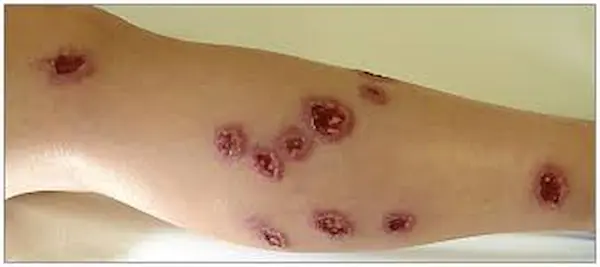
What are the types of cutaneous leishmaniasis?
Types of cutaneous leishmaniasis are divided into several clinical forms that differ in the severity and duration of symptoms. The type depends on the strain of the parasite and the type of immunity of the patient. Accurately determining the type helps in choosing the appropriate treatment and predicting the course of recovery. Therefore, it is always recommended to consult a specialist doctor when suspicious skin symptoms appear after traveling or being in infected areas. The most prominent types are the following:
الليشمانيا الجلدية الموضعية
This is the most common form. The infection begins with a small bump or pimple at the site of the bite that gradually turns into an open sore. The sores are localized in the skin without spreading internally. They often appear on the face, hands, or legs. They usually heal on their own within months but may leave a permanent scar.
Disseminated cutaneous leishmaniasis
It is a rare form and is considered more severe. The ulcers spread over large areas of the body in a manner similar to leprosy. This type usually occurs in people who suffer from weak immunity. Also, the response to treatment is weak and requires long treatment periods.
Mucocutaneous leishmaniasis
It is caused by certain types of Leishmania parasites in South America. The infection begins with skin ulcers and then spreads to the mucous membranes such as the nose, mouth, and throat. It may lead to serious deformities and tissue destruction if not treated early. This type is also less common in the Arab world.
Recurrent cutaneous leishmaniasis
It occurs when skin ulcers return after they have completely healed, and often appear around the area of old scarring. It is characterized by small, slow-growing sores that are resistant to treatment in some cases.
Complications of cutaneous leishmaniasis
Complications of cutaneous leishmaniasis vary depending on the type of infection and the extent of delayed treatment. Neglecting the disease or mishandling it may lead to long-term effects that affect the patient psychologically and physically. Prevention and early treatment are the best way to avoid complications of cutaneous leishmaniasis. Therefore, a doctor must be consulted immediately upon the appearance of any unexplained skin ulcers, especially after traveling or being in infected areas. The following are the most prominent of these complications:
Permanent skin scars
Even after skin ulcers caused by Leishmania heal, they often leave behind visible and permanent scars. In some cases, these scars are deep and cause disfigurement in visible areas such as the face or limbs. Scars also affect a person's self-confidence and may require cosmetic treatment later.
Secondary bacterial infection
As a result of skin ulcers that have been open for long periods, bacteria may enter the body and cause local infections. This infection may sometimes develop into severe infections that require antibiotics, and in rare cases the infection can extend to deeper tissues.
Abnormalities in the mucous membranes
In cases of mucocutaneous leishmaniasis, the infection spreads from the skin to the mucous membranes such as the nose, mouth, and throat. This condition leads to tissue erosion and severe deformities that may affect breathing, speech, and swallowing. Complications may be permanent even after recovery from the parasite.
Widespread cutaneous spread in weak immune conditions
In people with weak immunity, such as AIDS patients or those taking immunosuppressive medications, the infection may spread to large areas of skin, and treatment becomes more difficult and the chances of recurrence or failure to fully recover increase.
Psychological and social impact
Ulcers and scars resulting from Leishmania may affect the affected person psychologically, especially in children and women
Fear of societal perception or social isolation as a result of deformities may lead to anxiety or depression
Book your consultation now at مركز الجلدية والتجميل At Al Mousa Specialist Hospital.
How to diagnose cutaneous leishmaniasis
Cutaneous leishmaniasis is diagnosed through several precise steps based on clinical examination and laboratory tests that aim to confirm the presence of the parasite causing the disease and accurately determine its type. The following are the most prominent diagnostic methods used:
- The doctor begins by examining the skin ulcers and noting their characteristics, such as shape, location, size, and duration of appearance. He asks the patient about the history of travel or residence in areas known for the spread of leishmaniasis. This examination helps direct the doctor to suspect the disease, but it is not sufficient for a final diagnosis.
- A sample is taken from the skin ulcers, either by scraping the skin or taking a small skin biopsy, and the sample is examined under a microscope to look for Leishmania parasites (amastigotes) inside the infected cells. This examination is also considered one of the quickest and most widely used methods, especially in areas with experience in diagnosing the disease.
- The sample taken from the patient is placed in a special culture medium to multiply the parasite. This test is used if the direct sample is unclear or insufficient. Culture also takes several days but gives accurate results to confirm the presence of the parasite.
- PCR technology is considered one of the most accurate methods for determining the type of Leishmania. It depends on detecting the parasite’s DNA in the sample. This method is used in advanced medical centers, and is necessary to determine the exact type and choose the appropriate treatment.
- It is used to detect antibodies to the parasite in the blood, and its usefulness is limited in cutaneous leishmaniasis compared to visceral types, but it may be useful in some cases.
Early and accurate diagnosis is a crucial step in treating cutaneous leishmaniasis and avoiding its complications. Therefore, you must consult a dermatologist or infectious disease doctor immediately after the appearance of any unexplained skin ulcers after being in infected environments.
What is the treatment for cutaneous leishmaniasis?
Treatment of cutaneous leishmaniasis depends on several factors, such as the type of parasite, the number of lesions, their location in the body, and the patient’s age and general health condition. Treatment includes a combination of topical or systemic treatments via mouth or injection. Below is a breakdown of the most prominent treatment options used:
- Topical treatment is used in simple cases in which the ulcers are small and few in number. Treatment is as follows:
- Paromomycin ointment, which is used twice daily on the affected skin for up to 20 days, has proven effective in improving lesions and reducing the duration of the disease.
- Cryotherapy, in which the lesion is frozen using liquid nitrogen, and the treatment is repeated every two weeks until complete recovery. It is also usually used in localized and uncomplicated cases.
- Local heat, where the affected skin is exposed to high heat in a controlled manner to kill parasites, is considered a good option in some species without the need for systemic treatment.
- Systemic treatment, which is used in severe cases or if the ulcers are widespread or in sensitive places such as the face or joints. This treatment is as follows:
- Pentavalent antimonials, such as Glucantime meglumine or sodium stibogluconate (Pentostam), are given by intramuscular or intravenous injection for 20 days or more, and are among the traditional and most widely used treatments, despite the presence of side effects.
- Amphotericin B: It is used in resistant cases or if the patient cannot tolerate other medications. It is effective but requires careful monitoring due to its potential impact on the kidneys.
- Meclofenamide (Miltefosine) is an oral medication that is effective against some types of cutaneous leishmaniasis. It requires taking it under medical supervision because it may cause nausea and digestive problems.
- Antibiotics or topical cortisone, which are not used to treat the parasite itself, but are sometimes added if a secondary bacterial infection occurs in the ulcers.
- Surgery or removal of the lesion is rarely used and is limited to special cases such as skin tumors resulting from chronic leishmaniasis or if the lesion does not respond to any type of treatment.
Read also: Learn about the types of skin allergies in children
How to prevent cutaneous leishmaniasis
Prevention of cutaneous leishmaniasis consists of avoiding the bites of the sand fly that transmits the parasite that causes the disease. Personal and environmental protection are among the most effective methods. Preventive measures include the following:
Personal prevention of sand fly bites
- Wear long, loose clothing that covers the arms and legs, especially when in infested areas during periods of fly activity from dusk until dawn.
- Use insecticide-treated mosquito nets while sleeping, especially in places where sand flies are common.
- Apply insect repellents such as those containing DEET or picaridin to exposed skin and clothing.
- Avoid sleeping in the open or open places in rural or desert areas without proper protection.
Improving the surrounding environment
- Remove organic waste and animal waste from around homes, as they are an attractive environment for sand flies to breed.
- Fill cracks and holes in walls and floors to prevent insects from entering.
- Spraying insecticides in places where flies gather, especially around animal pens and farms.
- Get rid of infected rodents or wild dogs that could be natural reservoirs for the parasite.
Health awareness and community prevention
- Spreading awareness among local residents about infection and prevention methods
- Training health sector workers to detect cases early and treat them.
- Supporting national prevention campaigns in affected areas.
Immunization and future research
There is not yet an effective vaccine against cutaneous leishmaniasis, but research is continuing to develop future vaccines to prevent infection.
Leishmaniasis prevention depends largely on preventing exposure to the vector fly and improving environmental and living conditions, especially in rural or poor areas that lack health infrastructure. Adherence to these measures reduces the spread of the disease and protects individuals from exposure to skin complications and permanent disfigurements.
Frequently asked questions
Does cutaneous leishmaniasis heal without treatment?
In some cases, cutaneous leishmaniasis may heal spontaneously within several months to a year, especially if the infection is limited and mild, but self-healing often leaves permanent scars and skin deformities, so it is preferable to receive appropriate treatment to reduce the duration of the infection and avoid aesthetic and health complications.
Is leishmaniasis transmitted by touch?
No, cutaneous leishmaniasis is not transmitted from one person to another through touch. Rather, it is transmitted only through the bites of a sand fly infected with the parasite. Therefore, contact with or touching the wounds of an infected person does not lead to transmission of the disease, which makes it not directly contagious between humans.
هل يصاب الشخص باللشمانيا مرتين؟
Yes, a person can be infected with cutaneous leishmaniasis more than once, as the immunity that the body acquires after infection is not permanent or complete against all types of parasites that cause the disease, and there are different types of leishmaniasis that may infect a person later, even after recovering from a specific type.
If you suffer from symptoms of cutaneous leishmaniasis or would like early diagnosis and treatment to avoid complications, do not hesitate to visit Al Mousa Specialist Hospital, book your appointment now.
المصادر:
Leishmaniasis – dermnetnz
Cutaneous leishmaniasis – wikipedia
