
Dermatofibrosarcoma is classified as a rare type of cancer, in which the cancer begins in the connective tissues under the skin. Most often, the sarcoma takes the form of a solid plaque with slow growth on the skin. It usually occupies the trunk area or is on the limbs close to it. This mass takes on a purple, red, or blue color. At the beginning of its infection, the patient does not feel any kind of pain. It is the result of a gene mutation or is hereditary. Al Moosa Health Hospital offers the best techniques used to treat this type of disease.
What is dermatofibrosarcoma tuberosity?
Dermatofibrosarcoma is classified as an extremely rare type of cancerous tumor. The tumor may originate in the dermis layer of the skin. It is reported that this tumor affects one person out of a million people every year, but its spread is slow in the patient’s body. Therefore, it has been revealed that the chances of recovery and survival from the tumor are great. The tumor does not spread to various parts of the body, but it spreads only in its primary place. Its damage is the destruction of the soft tissue under the skin, and it can turn into an aggressive type that spreads quickly throughout the body.
Is dermatofibrosarcoma benign or malignant?
Dermatofibrosarcoma is a rare cancerous malignant tumor, but it grows slowly with local recurrence, and it is rare for it to spread to other areas of the body. Because it is a malignant type, the tumor has the ability to grow and even infiltrate the surrounding tissues, and in special cases it spreads to other parts of the body (metastases). Because cutaneous sarcoma is rare, we can say that it is not common, but it is considered a malignant skin tumor. It is said to be slow-growing, yet it recurs in the same area after it is removed.
In most affected cases, the tumor does not spread to distant areas of the body. It is noteworthy that DFSP is rare, but this does not negate the fact that it does not spread at all. It is possible for this to happen. Important periodic monitoring is required even after the condition is treated.
Learn about: Soft tissue sarcoma Symptoms causes and treatment options
What are the causes of tuberous dermatofibrosarcoma?
The exact cause of cutaneous fibrosarcoma has not been identified for most affected cases, but it is indicated that there is a belief that genetic changes in tumor cells may have a major role in the development of cutaneous fibrosarcoma, but they are not considered hereditary genes. The following are the possible causes or contributing factors:
- First, genetic changes: DFSP is often linked to a genetic transfer that occurs between chromosome 17 and chromosome 22, which results in a genetic fusion between COL1A1 and PDGFB. This may produce a protein that has a role in promoting tumor growth by working to increase the production of platelet-derived growth factor (PDGF).
- Secondly, previous skin injuries: There are some cases in which there is a connection between DFSP and previous skin injuries, including burns, wounds, or surgical operations.
- Third, genetic factors: From a general perspective, DFSP is not hereditary, but there are rare cases in which there is a genetic predisposition.
- Fourth, radiation exposure: Some studies have revealed that radiation exposure increases the risk of developing DFSP, but that study is still under research.
Who are the people most at risk of infection?
People most at risk of contracting the disease
Dermatofibrosarcoma tuberose is adults between the ages of 20 and 50 years, and men are the most susceptible to infection, while few women are affected by it. In addition, it is more common in black-skinned women, and the risk factors also include the presence of previous skin injuries such as burns, scars, or radiation treatment.
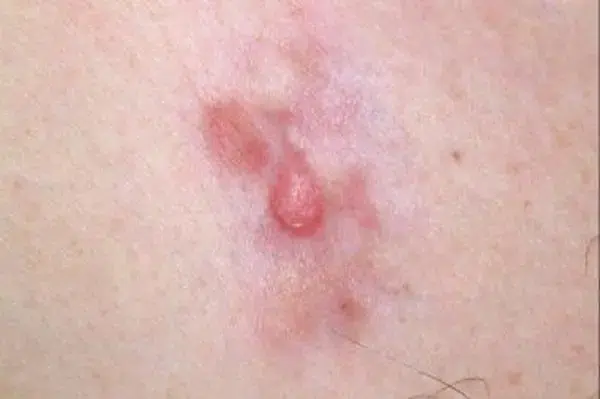
Symptoms of dermatofibrosarcoma tuberosity
Dermatofibrosarcoma is a slow-growing, malignant cancerous skin disease. Its initial symptoms are a hard spot or mass that does not cause pain and has a rubbery or hard texture. Below are details of the symptoms:
- It appears as a solid spot or mass that is skin-colored or brown and may be red.
- The spot is slow-growing and growth occurs over months or years.
- The solid mass is a soft mass in texture that appears reddish or purple in color, or the basic color of the skin.
- The lump does not cause any type of pain, especially in the early stage of the disease, but this does not negate the presence of pain or sensitivity, but only in some special cases.
- There are rare cases in which the affected area bleeds.
- It is similar to some other benign skin conditions, including cellular dermatofibromas.
Book your consultation now at مركز الجلدية والتجميل At Al Mousa Specialist Hospital.
How is dermatofibrosarcoma diagnosed?
Dermatofibrosarcoma is diagnosed through several methods, but it is difficult to make the diagnosis at first, but it is most often made after the tumor appears clearly and is large. We discuss the diagnostic methods as follows:
- Physical Examination and History: The doctor performs a skin examination to carefully check the symptoms and also begins a review of the patient's medical and medical history.
- Skin biopsy: This is done by taking a biopsy of the suspicious tumor and examining it through a microscope. This method helps in detecting the presence of cancer cells or not.
- Imaging studies: These include several tests required by the senior specialist, including an MRI in order to evaluate the size and depth of the tumor, and from these the extent of the tumor’s spread and its reach into the surrounding tissues is determined.
- Genetic Testing: There are cases where genetic testing is required in order to identify the specific mutations that are associated with DFSP.
Treatment options for tuberous dermatofibrosarcoma
There are multiple treatment options available for tuberous dermatofibrosarcoma, the main treatment being surgery, in addition to targeted therapy and radiation therapy. Details of the treatment are as follows:
- Firstly, surgical treatment: Surgical excision is classified as one of the basic treatments for tuberous dermatofibrosarcoma, in which the tumor is completely removed along with the removal of part of the healthy tissue surrounding the tumor, thus reducing the risk of the tumor returning. There is a type of surgery called Mohs surgery in which thin layers of skin that contain the cancer are removed, and then each layer is examined with a microscope to show any cancer cells.
- Secondly, radiotherapy: The specialist doctor resorts to radiotherapy if the cancerous tumor is unable to be completely removed, or if there is a possibility of exposure to an increased risk of the tumor returning. Radiotherapy may also be done at other times before surgery in order to reduce the size of the tumor.
- Third, targeted therapy: This type of treatment is an option in advanced or recurrent cases of dermatofibrosarcoma, and is represented by medications that target specific chemicals in cancer cells.
Frequently asked questions
Is sarcoma dangerous?
Indeed, cutaneous fibrosarcoma is classified as a serious disease because it is a type of cancer that affects bones and soft tissues, including blood vessels, as well as nerves, tendons, fat, and muscles as well. Sarcoma may be a malignant cancerous disease, and this makes it capable of growing and spreading to other parts of the body, as it can spread to reach the lungs or bones, which makes the process of treating it extremely difficult.
The cure rate for sarcoma cancer?
The cure rate for sarcoma varies depending on various factors, including the type of sarcoma, its location, and the stage of discovery of the sarcoma. The cure rate also varies depending on the extent of the sarcoma’s response to treatment, but in general, the cure rate for people with sarcoma is 80% if it is discovered and treated early. If osteosarcoma spreads to other areas of the body, such as the lungs, the rate of recovery and survival decreases to about 30 to 40%.
How long does sarcoma spread?
Determining the duration of the spread of sarcoma cannot be accurate because its survival depends on many factors, but there is an estimate of the average time it takes to spread, which depends on the type, size, and location. The reason for the variation in the duration of spread is due to the type of sarcoma, the size of the tumor as well as the location of the tumor, as some tumors are located near the blood vessels or the lymphatic system.
Dermatofibrosarcoma is a malignant tumor that requires consultation from a specialist doctor who can choose an appropriate treatment method according to the patient’s condition. People with this type of tumor should also be subject to close follow-up within Al-Mousa Health Hospital, which provides advanced medical care within a medical team specialized in skin diseases of various types, as this tumor is likely to recur after treatment.
Sources
Dermatofibrosarcoma: a comprehensive guide – apollohospitals
