
Arrhythmia means there is a defect in the heart rate and its regularity, as the heart works according to electrical signals that help regulate the pulses, but in some cases a defect occurs in these signals, which leads to a state of cardiac arrhythmia that causes problems with the heart rhythm, and through Al Mousa Specialist Hospital we provide you with more information about this condition, how to diagnose it, and whether it can be treated or not.

What is meant by arrhythmia?
It is an abnormal rhythm of the heartbeat;
There is a complex electrical system that regulates the heartbeat, and when a malfunction occurs in this system, the heart works in an irregular rhythm, and this causes many health problems resulting from poor blood circulation in the body.
Symptoms of irregular heartbeat
If you suffer from this condition, you will experience different symptoms, تتضمن ما يلي:
- Fluttering or palpitations that occur intermittently or continuously.
- Rapid heartbeat for no apparent reason, or slow heartbeats other than during sleep and rest.
- Feeling pain in the chest, this pain feels like pressure.
- Fainting or feeling dizzy.
- Exhaustion and inability to carry out daily activities due to fatigue.
- Sweating for no apparent reason, such as air temperature or the like.
- Feeling short of breath suddenly or simultaneously with a change in the heartbeat rhythm.
Types of heart rhythm disturbances
There are different types of arrhythmia, The most prominent and common cases are the following:
- Supraventricular tachycardia: It is a condition that causes rapid and abnormal heartbeats in the atria, and appears for no reason, such as exertion or the like.
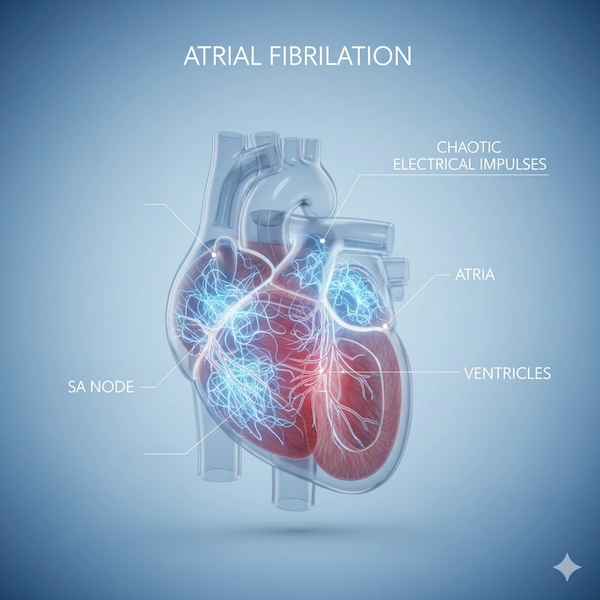
- Atrial fibrillation: It is a state of rapid heartbeat, but it occurs irregularly, temporarily or continuously.
- Ventricular tachycardia: It is a heart rhythm disturbance caused by abnormal electrical signals that affect the lower chambers of the heart, causing these chambers to not fill with blood and poor blood circulation.
- Ventricular fibrillation: A problem that occurs when the heart contracts, and appears due to the acceleration and disturbance of the electrical charges that give the heart the pulse signal.
- Heart block: It means that the heart beats abnormally slowly, due to a defect in the electrical system that causes the atria and ventricles to not work in harmony.
- Bradycardia: It refers to a lower than normal heart rate due to sick sinus node syndrome, which leads to the heart being slow or oscillating between very slow and very fast.
- Premature or extra heartbeat: It occurs once, and the patient feels as if the heart missed a beat that it did not make, but this condition is generally less serious than the previous one.

Causes of arrhythmia
The problem of irregular heartbeat occurs for many reasons, Below we present to you the most important reasons that may lead to such a defect:
- Heart disease: Such as high blood pressure, defects in the heart valves, coronary artery disease, or even heart failure.
- Having electrical problems in the heart: It causes a malfunction in the electrical system, and in this case the patient suffers from atrial fibrillation, ventricular tachycardia, or something else.
- Hormonal imbalance and salt levels in the body: Because it affects the heart's electricity and thus causes a cardiac arrhythmia.
- Thyroid disorders.
- Taking stimulant medications: Such as cold medicines.
- Consumption of caffeine, alcohol or drugs: All of them are substances that stimulate heart rhythm disorders.
- Lifestyle that causes psychological stress: Especially with sleep disorders.
- Getting older: Especially in cases with previous infections in the family history.
- Tilt Table Test: To evaluate the heart's response to changes in body position.
- Stress Test: Through which the heart's response to effort or physical activity is measured while the patient is exercising.
- Electrophysiology Study: Which is adopted to determine the source of the disturbance in the heart's electrical system.
When is a fast heartbeat dangerous?
Many cases do not suffer from any symptoms or problems even with an accelerated heartbeat. But in the following cases, you must visit a doctor immediately because the matter becomes serious:
- If your heart rate is more than 100 beats per minute at rest.
- When you feel additional symptoms with an increased heartbeat, such as chest pain, shortness of breath, or dizziness.
- If you experience cold sweats or fainting with an increased heartbeat.
- If the heart rate continues to increase during rest for a long time.
Complications of heart arrhythmia
There are very serious complications that occur if the problem persists and is not treated, The most important of these complications are:
- Stroke: Many cases of atrial fibrillation are particularly affected by it, because the irregular fibrillation of the atria causes the formation of clots that travel to the brain and cause blockage of the blood vessels, which ultimately leads to a stroke.
- Transient Ischemic Attack (TIA): It is a treatable type of stroke that goes away within a short period, and occurs due to the inability of the heart to pump a sufficient amount of blood to the brain.
- Dementia: This disease refers to a problem that the brain faces in performing its mental and cognitive functions, and it occurs due to a lack of blood flow as a result of the heart’s inability to perform its function properly.
- Heart Failure: The continuation of the problem of irregular heartbeat for long periods eventually leads to weakness of the heart muscle, which affects its functional performance and ability to pump blood to different parts of the body, and this condition is known as heart failure.
- Sudden Cardiac Arrest: Most often caused by ventricular fibrillation, it results from the rapid, dysfunctional fibrillation of the ventricles, eventually causing the heart to completely stop pumping blood.
Medical interventions
In some cases, the doctor intervenes by using devices to regulate the heart pacemaker. The most important of these devices are:
- A device that delivers an electric shock to the heart: It helps in electrical cardiac arrhythmia.
- Catheter ablation: A vascular catheter is inserted into the heart to detect and destroy tissue causing the arrhythmia.
- Pacemaker: It is implanted in the chest, and this procedure is often done in cases of slow heartbeat.
- Defibrillator manager device: It is also one of the successful medical interventions in cases of serious tachycardia, as it performs electrical shocks to the heart to adjust its speed.
Surgical interventions
Doctors who specialize in heart surgery perform surgeries, تتضمن ما يلي:
- Heart maze: During which a pattern of scar tissue is created in certain parts of the heart, to help prevent abnormal electrical signals, which is a last resort for cases of atrial fibrillation.
- Coronary artery bypass surgery: It depends on taking a blood vessel from the body and using it to create a new passage for blood to pass through instead of narrowed arteries, to prevent heart rhythm problems.
Frequently asked questions about arrhythmia
Discover a number of questions previously asked by our customers about arrhythmia and their answers:
Can arrhythmia be cured?
Yes, there are many cases in which heart rhythm problems are completely cured, but it depends on your attention to the symptoms and the competence of doctors in diagnosing and treating the problem.
Can the heartbeat be regulated with herbs?
Although problems with heart rhythm regulation are often caused by problems in the heart itself or in its electrical system, herbs may be useful in cases affected by a stressful lifestyle. Therefore, valerian can be taken to improve sleep, as well as beet juice to lower blood pressure, but consult a doctor before using them.
What is the difference between arrhythmia and atrial fibrillation?
The difference is that arrhythmia is a general problem that includes atrial fibrillation as one of its types.
ختامًا Arrhythmia is due to many causes, and its treatment is related to identifying those causes. Contact us in Al Mousa Specialist Hospital To diagnose the causes of the problem with the latest tools and techniques, at the hands of the most qualified doctors, and achieve complete recovery.
