
In the world of modern beauty, laser for the face has become one of the most important modern revolutionary technologies that has changed the scales of skin care, and your dream of having smooth skin is no longer just a dream. By using laser it has become possible to obtain flawless and radiant skin, and thanks to it, pigmentation, dark spots, etc. can be removed. With Al Mousa Specialist Hospital, we will follow up with you in the following lines to learn more details.
What is laser for the face?
Facial laser is considered a non-surgical cosmetic technique that is used to improve the appearance of the skin and treat various problems such as wrinkles, pigmentation, scars, and acne. It is a technology that relies on directing high-precision light rays to specific layers of the skin, which stimulates collagen production and promotes cell regeneration. The types of lasers used also vary according to the case, including exfoliative facial lasers and non-peeling facial lasers, and each type is used for specific purposes. In general, laser is considered an effective option for those looking for smooth and radiant skin without the need for intervention.
Types of laser techniques used for the face
There are many laser techniques used for the face, each of which has different uses and benefits. Below we explain the most prominent types:
Carbon dioxide laser
It is used to treat deep wrinkles and fine lines. It is also effective in removing scars resulting from acne, wounds, or burns, treating the effects of melasma and dark spots, and unifying skin tone. It also helps in tightening sagging skin and improving its texture, in addition to removing skin tumors such as warts.
This type of laser is effective in treating deep skin problems and has long-term results. It also has the disadvantage that the recovery period is relatively longer.
Fractional laser
It helps improve the appearance of scars and acne effects and treats wrinkles and fine lines. It also rejuvenates the skin, stimulates collagen production, and works to lighten dark spots and unify skin tone.
One of its most prominent advantages is that it does not affect the outer layer of the skin and its recovery period is shorter compared to carbon dioxide laser. Its disadvantage is that it requires many sessions to obtain the desired results.
Nd:YAG laser
It has many uses. It is used to remove hair from various skin types, including dark skin. It can be used to treat vascular lesions such as spider veins. It helps rejuvenate the skin and improve its color and texture. It removes tattoos and treats melasma and dark spots.
One of its most prominent features is that it is relatively safe for dark skin and has many uses. Its drawback is that it requires several sessions to completely remove hair, and it is less effective with very light hair.
Alexandrite laser
Its uses include removing hair, especially on light skin types with dark hair, removing black, blue, or green tattoos, treating pigment lesions such as freckles and sun spots, and rejuvenating the skin.
It is characterized by being fast and effective for getting rid of hair on suitable skin types, but it is not suitable for dark skin due to the risk of skin discolouration.
Pulsed dye laser
Pulsed dye laser is used to treat vascular lesions such as birthmarks. It is used to reduce the redness of scars and prevent them from increasing in size. This type of laser for the face is also effective in treating vascular problems, but it has the disadvantage of causing temporary bruising.
Carbon laser
The carbon laser is used to deeply cleanse the skin and remove impurities and excess oils. It works to lighten the skin and unify its color. It works to reduce the appearance of blackheads and acne and stimulates collagen production and tightens the skin. This type is characterized by being gentle on the skin and its recovery period is very short. This type requires many sessions to get the best results.
Get to know Laser facelift procedure The best technology to restore your youth
Facial laser working conditions
The conditions for using a facial laser vary based on the type of facial laser used, the purpose of treatment, and the condition of the skin. There are a number of conditions that apply to most types of facial lasers, and they are explained as follows:
- It is necessary to consult a specialist dermatologist to evaluate the skin and determine the type of laser for the face that is most appropriate for the condition and problem you wish to treat so that the doctor can explain to you the procedure and the potential risks as well as the expected results.
- It is important to stop removing hair by waxing, threading, or any of the traditional methods for at least four weeks before the session, as the facial laser targets the hair follicles, but shaving or cutting hair is allowed one day before the session.
- You should stop using strong chemical or physical exfoliants at least a week before the session to avoid skin irritation.
- It is necessary to avoid direct exposure to sunlight or use of tanning beds at least two weeks before the session, as dark skin is more likely to absorb laser energy significantly, thus increasing the risk of complications such as burns or pigmentation.
- Your doctor should be aware of the medications you are taking, especially if they are blood thinners or photosensitivity medications.
- The skin must be cleaned and free of any cosmetics or creams on the day of the session.
- Any skin infections or acne must be treated before the facial laser procedure in order to avoid worsening the condition.
How to prepare for a laser facial session
Preparing for your facial laser session is crucial to ensuring the best results and avoiding any potential complications. Below are the most important detailed steps on how to prepare:
- First and foremost, you must book an appointment with the treating dermatologist who specializes in laser treatment. Discuss the problem and the goal of the treatment. Tell the doctor about your medical history and the medications you are taking. Then inform the doctor about any previous skin treatments you have done. Ask the doctor about the type of laser used, the expected number of sessions, the possible results, and possible side effects.
- Avoid direct exposure to sunlight for 2 to 4 weeks before your session, and use sunscreen with SPF 30 or higher daily.
- Stop using certain skin care products, such as chemical exfoliants, strong physical exfoliants, and products containing retinoids, for at least one week before the session.
- Avoid hair removal by methods that rely on extracting the roots, such as wax, thread, or hair removal machines, for at least 4 weeks before the session.
- The skin must be cleaned on the day of the session and make sure the skin is free of any makeup, creams, oils or perfumes. Make sure to wash your face and dry the skin gently.
- If any skin changes such as pimples, inflammation, or rashes appear on the face before the session, you must inform the doctor immediately.
- Keep the skin well moisturized in the days leading up to your session using a gentle, non-irritating moisturizer.
- Make sure to wear comfortable, easy-to-remove clothing in the face and neck area, if the treatment includes these areas.
Book your consultation now at مركز الجلدية والتجميل At Al Mousa Specialist Hospital.
Steps to perform a laser facial session
The steps for performing a facial laser session vary slightly depending on the type of laser used and the purpose of the treatment and the condition of the skin. There are some steps that are followed in most cases, and they are explained as follows:
- You must follow the doctor's instructions before the session, such as avoiding the sun, stopping some skin care products, and getting rid of hair in appropriate ways.
- The doctor asks the patient about the medical history and ensures that there are no new contraindications to treatment.
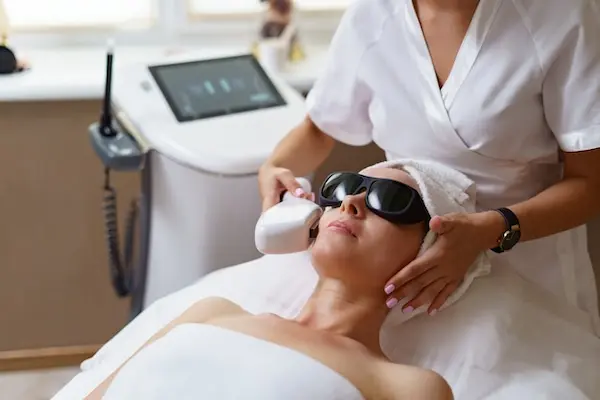
- The skin is cleaned well to get rid of any traces of makeup, oils or dirt, and then the patient is provided with protective glasses to protect the eyes from laser rays.
- During the session, a gel is applied to the skin, when using some types of lasers. It is a cold, transparent gel that is placed on the area to be treated. This gel helps cool the skin, facilitates the movement of the laser device, and delivers laser energy effectively.
- The hand of the laser device is passed over the surface of the skin in the targeted area and the device emits short light pulses from the laser.
- The patient may feel a slight tingling sensation or a stinging sensation as the laser passes, and this depends on the type of laser, the sensitivity of the patient’s skin, and the treated area.
- Some lasers have a built-in cooling system that blows cool air to reduce the feeling of heat and protect the skin.
- After completing the session, the skin is cleaned and a soothing agent is applied by applying a cream or ointment.
How many sessions are required to get the best results?
The number of sessions required to obtain the best results depends on a group of factors, which we summarize as follows:
- Purpose of treatment.
- Type of laser used.
- Skin condition.
- Hair density and color in the case of hair removal, as thick, dark hair responds better and faster compared to light and thin hair.
- Depth and severity of the skin problem. Deeper and more severe problems may require a larger number of sessions.
- The laser device used.
In general, the number of sessions required for common facial conditions can be estimated as follows:
- Hair removal requires between 6 to 12 sessions to obtain satisfactory results.
- Skin rejuvenation, treatment of fine wrinkles, and improvement of texture and color require between 3 to 6 sessions or more.
- Treating the effects of acne and scars requires between 3 to 6 sessions.
- Pigmentation treatment requires between one and 6 sessions.
- Vascular treatment requires between one and three sessions.
Check out Benefits of carbon laser for the face And damages and complications
When do laser results appear on the face?
The speed at which laser results appear on the face varies greatly depending on the purpose of treatment, the type of laser used, and the condition of the skin. In the following context, we explain to you in detail the time when laser results appear on the face for some common cases, as follows:
Laser hair removal
A decrease in hair growth can be observed after the first or second session, and more noticeable results appear after 3 to 4 sessions. To obtain the best results, you need between 6 to 12 sessions.
Laser skin rejuvenation
You notice a slight improvement in the softness and elasticity of the skin immediately after the first session, and the most visible results begin to appear within weeks to months. To achieve the desired results, you need between 3 to 6 sessions. As for the final results, they appear after the sessions are completed.
Treating acne scars and scars with laser
A slight improvement in the appearance of scars and redness appears after the first session, and the results may take longer to appear. Usually, the results appear after several sessions, starting from 3 sessions to 6 or more, and the improvement in appearance continues for several months after the sessions end.
Laser pigmentation treatment
A slight lightening of the color of the pigmentation can be observed after the first session. For noticeable results, it takes one to 6 sessions or more to see the difference in the color of the pigmentation. The appearance of results depends on the type of pigmentation, its depth, and the skin’s response to the treatment.
Carbon laser
Cleaner and more radiant skin is noticed immediately after the session. Results begin to improve skin texture a month after the first session. The final results require a number of sessions to see the best results and usually appear after about 3 months.
اسئلة شائعة
Is laser suitable for all skin types?
Lasers are not suitable for all skin types to the same degree. The response varies according to skin color and type. Usually, light skin is easier to deal with laser techniques, especially in removing pigmentation or hair, due to the clear difference between the color of the skin and hair or spots. People with dark skin are more susceptible to complications such as excessive pigmentation or hypersensitivity, so they need specialized types of lasers. In general, it is important to consult a specialist doctor to evaluate the skin type and choose the most appropriate type of laser to achieve the best results and avoid expected damage.
Does laser remove facial hair permanently?
Lasers cannot completely and permanently remove facial hair, but they work to reduce their growth in significant, long-term ways. Lasers in general target hair follicles and destroy them with heat, which leads to their weakening and delaying the growth of new hair. In many cases, it leads to the cessation of hair growth for long periods, but some light or weak hairs can appear over time due to hormonal changes or the nature of the body. This is why most individuals need periodic sessions every several months to maintain the results.
Does laser remove deep pigmentation?
Yes, lasers can remove deep pigmentation, but it depends on the type of pigmentation, its depth, and the type of skin. Various advanced laser techniques are used to penetrate the layers of the skin and reach deep pigmentation, which helps break up accumulated melanin particles and stimulate the skin to renew itself. However, deep pigmentation may require many sessions to obtain satisfactory results, but it may disappear completely in some cases, and it is important to have the condition evaluated by a specialist doctor to determine the appropriate type of laser.
Al Mousa Specialist Hospital is proud to have a distinguished medical staff that can be relied upon to use facial lasers. It also has the latest laser technologies suitable for all cases. If you have already made your decision, book your appointment now and start diagnosis and treatment.
المصادر:
Laser resurfacing – mayoclinic
Laser Skin Resurfacing – webmd
