
The nose, with its fine details and prominent location on the face, has a large and important role in facial features and the balance of appearance. But what if the shape of the nose changes? Of course, it is very difficult. Nasal deformities are not just an aesthetic issue. They extend to affect self-confidence in addition to its basic function, which is breathing. In these lines, we learn about the causes and types of these deformities, in addition to their impact on daily life. Follow up with Al Mousa Specialist Hospital to reveal the details.
What are nasal deformities?
Nasal deformities are those abnormal changes in the shape or structure of the nose. Nasal deformities may be congenital from birth or acquired as a result of injury, previous surgery, or certain diseases. These deformities vary in severity. Nasal deformities may be simple and only affect the external appearance, or complex and affect the main function of the nose in breathing or smell. Common deformities include deviations in the nasal septum or asymmetry between the two sides of the nose, in addition to the presence of protrusions or depressions in the bones or cartilage.
Types of nasal deformities
There are many types of nasal deformities, and they can generally be classified into two categories: congenital deformities and acquired deformities, which we explain in detail below:
Congenital nasal deformities
These are deformities that a person is born with, and they occur as a result of problems with the growth of the nose during pregnancy. They include the following:
- The lack of a nose and its complete or partial absence.
- Narrowing of the pyriform nostril, which is a narrowing of the front opening of the nasal bones, which causes nasal obstruction.
- The presence of a hole in the nose, which is often accompanied by a cleft lip or what is known as a cleft mouth.
- Nasal dermoma, which is a benign cyst or tumor that contains skin tissue, hair, or sebaceous glands.
- Nasal cerebellar tumor is a protrusion of brain tissue or surrounding membranes through an opening in the skull into the nose.
- Abnormalities associated with various other syndromes such as Fraser syndrome, Alpert syndrome, or Crouzon syndrome.
- Congenital saddle nose, which is a depression in the bridge of the nose that is present from birth.
Acquired nasal deformities
- These deformities occur after birth due to many different factors, including trauma and injuries, such as nasal fractures, soft tissue injuries, such as damage to the skin and cartilage of the nose. Also, previous surgical operations may cause deformities after Rhinoplasty Or other nose operations.
- Diseases and infections such as chronic nasal and sinus infections, syphilis and leprosy, as well as autoimmune diseases such as systemic lupus erythematosus, can cause nasal deformities.
- Inhaled drug use can destroy the nasal septum and thus cause deformities.
- Tumors, whether benign or malignant, play a role in changing the shape of the nose.
- Aging sometimes causes the tip of the nose to droop or change its shape.
Types of nasal deformities according to their shape and location
The types of nasal deformities can also be divided according to shape and location as follows:
- Nasal hump, which is the presence of a protrusion or convexity on the bridge of the nose.
- A hooked or deviated nose, which is a curvature of the nose to one side.
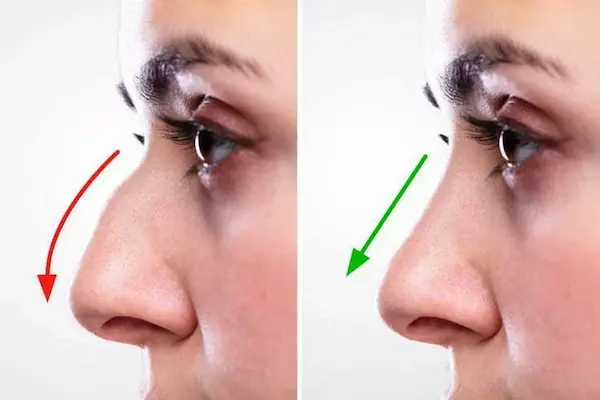
- Droopy tip of the nose, which is the tip of the nose going down.
- A bulbous or bulbous nasal tip, in which the tip of the nose is round and large.
- A constricted nasal tip, in which the tip of the nose is narrow and asymmetrical.
- A large nose that is disproportionate to the facial features.
Symptoms of Nose Deformities
Symptoms of nasal deformities vary greatly depending on the type and severity of the deformity and its location. Some people with minor deformities may not notice any symptoms, but there are others who suffer from a variety of problems. The common symptoms of nasal deformities are as follows:
Symptoms related to appearance
- Change in the shape of the nose.
- Asymmetry between the nostrils.
- Scars or skin abnormalities on the nose.
Symptoms related to function and breathing
- Difficulty breathing through the nose.
- Chronic nasal congestion.
- snoring.
- Frequent nasal dryness.
- Frequent nosebleeds.
- Difficulty smelling.
- Recurrent sinus infections.
- Headache or facial pain.
Other symptoms such as sleep issues, voice changes, psychosocial impact and lack of self-confidence may also occur.
Causes of Nose Deformities
There are a number of causes that play a role in the development of nasal deformities, including:
- Genetic factors as some nasal abnormalities may be passed down through genes from parents to children.
- Fetal developmental issues, and during pregnancy, the growth and development of the nose can be disrupted due to various factors such as the mother's exposure to certain chemicals or medications during pregnancy, lack of certain essential vitamins or minerals, or the mother contracting some viral diseases during pregnancy.
- Many genetic syndromes are associated with nasal abnormalities as one of a range of different symptoms, such as Binder's syndrome, Fraser's syndrome, and Albert's syndrome.
- Also among the causes are trauma and various injuries such as nose fractures and soft tissue injuries.
- Previous surgeries such as rhinoplasty and other nose and face surgeries.
- Chronic nasal and sinus infections.
- Various infections such as syphilis and leprosy.
- Autoimmune diseases such as Wegener's granulomatosis.
- Age-related changes.
- Acquired septal deviation.
- Tumors.
Book your consultation now at مركز الجلدية والتجميل At Al Mousa Specialist Hospital.
How can a nose deformity be diagnosed?
The diagnosis of a nasal deformity depends on a series of different procedures and tests performed by the doctor to assess the shape and function of the nose and determine the cause of the deformity:
- Medical history, where the doctor asks you about your medical history, find out when you first noticed the deformity, find out if you have had any injuries or trauma to the nose, find out if you have had any surgeries in the nose or face, and whether you have any issues with breathing or smell, the doctor also asks about family history of nasal deformities, and the doctor learns about chronic diseases you may suffer from and the medications you are taking.
- The doctor carefully examines the nose from the outside to assess shape, size and symmetry, visually inspects the nose from different angles, evaluates the structure of the bones and cartilage, and examines the inside of the nostrils with a simple nasal endoscope.
- Using a thin scope with a small camera and light inserted into the nose, a doctor can see details of the internal structures of the nose, including the nasal septum, nasal passages and sinuses, which helps identify deviated septum, tumors, infections, and various other issues that contribute to nasal deformity or interfere with nasal function.
- X-rays are used to evaluate recent nasal fractures, and CT scans provide detailed images of the bones and soft tissues of the nose and paranasal sinuses.
- Magnetic resonance imaging (MRI), which provides images of soft tissues and is used to evaluate tumors involving the soft tissues of the nose, some congenital malformations, and differentiate between different tissues in the nose and paranasal sinuses.
You can read:Symptoms of nose fractures Various diagnostic and treatment methods
Nose deformities treatment methods
Methods of treating nasal deformities depend on the type of deformity, its severity, and its accompanying symptoms, in addition to the desire for treatment, and treatment methods can be divided into two types, the first of which is surgical, and the second is non-surgical treatment, as shown below:
Non-surgical treatment
Some cases do not need treatment, if the deformity is minor and does not cause any functional or aesthetic issues, and other cases can focus on relieving the symptoms associated with the deformity without fixing the deformity itself, for example steroid nasal sprays or decongestants to relieve nasal congestion caused by a slightly deviated septum, and saline nasal rinses to clean and moisturize the nasal passages.
Cosmetic injections can be used to fill some minor deformities or asymmetry in the shape of the nose, which is a temporary procedure that needs to be repeated to maintain the results, and there are some cases of minor congenital nasal deformities in infants in which an external splint is used to guide the growth of the nose in the first months of life.
Secondly, surgical treatment
Surgery is the most common option for treating nasal deformities that cause significant functional issues such as difficulty breathing:
- Reducing or enlarging the nose.
- Changing the shape of the bridge of the nose.
- Changing the shape and size of the nasal tip.
- Change the width of the nose.
- Asymmetry correction.
- Combining rhinoplasty with septal deviation repair to optimize breathing function.
- Nasal septum repair to improve airflow through the nose, often done in conjunction with rhinoplasty.
- Rhinoplasty surgery to repair deformities resulting from severe trauma, tumor removal, or large congenital deformities.
- Surgery for congenital nasal abnormalities such as repairing a split nose or removing nasal skin or brain tumors.
اسئلة شائعة
Is a crooked nose normal?
A crooked nose is one of the most common deformities, and the crookedness may be normal if it is simple and does not cause any obvious aesthetic or functional issues, and many people have a slight deviation in the shape of the nose due to natural differences in the growth of bones or cartilage, however, if the crookedness is severe and affects breathing or causes a noticeable deformation in appearance, then it needs medical evaluation and needs surgical intervention to correct it.
Can you live with a crooked septum?
Yes, it is possible to live with a crooked nasal septum if the deviation is mild and does not cause annoying symptoms, and many people live a normal life without knowing that there is a deviation in the nasal septum, as long as it does not cause difficulty breathing, frequent headaches or chronic sinus infections, but in case the symptoms affect the individual's life, it is recommended to consult a doctor to assess the condition and consider the appropriate treatment, whether medication or surgical treatment, depending on the severity of the deviation.
How do I know if I have a deviated nose?
Nasal deviation can be suspected if you frequently experience difficulty breathing through one nostril more than the other, if you suffer from chronic nasal congestion, frequent nosebleeds, dry nose, loud snoring, or frequent sinus infections, but an accurate diagnosis of nasal deviation requires a clinical examination from a specialized doctor, who will use a nasal speculum to evaluate the shape of the nasal septum and determine the extent of the deviation and its effect on the airway.
Almoosa Specialty Hospital guarantees you experienced and competent doctors to diagnose the condition and recognize the appropriate treatment in case you suffer from nasal deformities, do not hesitate too much and book an appointment now for the doctors to diagnose you and start treatment to improve your quality of life, whether at the aesthetic level or the functional level of the nose.
المصادر:
Nasal deformity – topdoctors
