
Rehabilitating children is the basis for building their future. It is a long-term investment that aims to support the child’s development in all aspects of his life, through carefully designed programs. Our ultimate goal is to enable every child to achieve his or her fullest potential, to live an independent and happy life, and to integrate effectively and positively into their society.
Cases that require rehabilitation for children
He is careful Al Mousa Specialist Hospital To provide effective solutions and integrated rehabilitation services to help children overcome their health challenges, and enable cases to benefit from rehabilitation programs at the hospital وهي كالتالي:
- Cerebral palsy:
We provide specialized support to address motor skill problems that result from brain damage that may occur before, during or after birth.
- Spina bifida:
We support children with loss of movement and sensation resulting from this congenital spinal cord defect.
- Muscular dystrophy:
We help deal with this genetic disorder that causes progressive muscle weakness over time.
- Autism spectrum disorder:
We provide specialized support programs to enable children to develop the social and communication skills necessary for integration.
- Trauma injuries:
These conditions include musculoskeletal problems resulting from accidents or sports injuries, and we work to restore motor function.
- Speech and language delay:
We provide targeted therapy to help children improve their expression and verbal communication skills and boost their self-confidence.
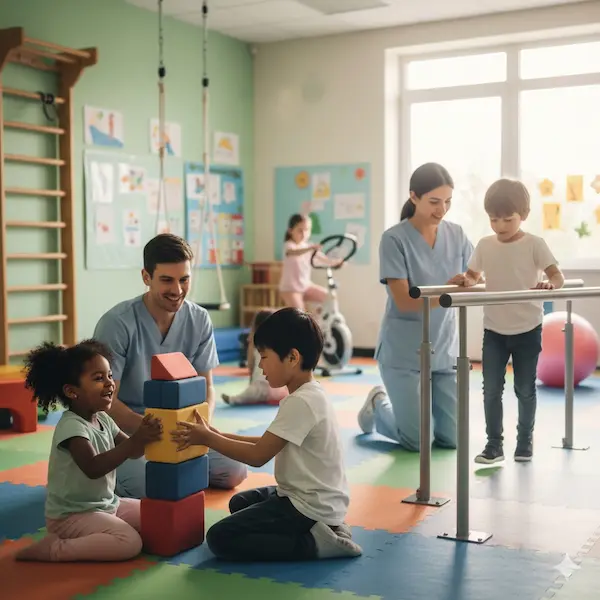
Stages of rehabilitation of children
A child’s rehabilitation journey is an organized and supportive process, based on his individual needs to ensure the best results, and this journey passes through major stages. They are as follows:
Comprehensive evaluation stage
The journey begins with an accurate understanding of the child’s condition, as the specialized team comprehensively assesses the child’s skills, abilities, and needs, in addition to identifying his strengths and challenges. This assessment is the foundation on which everything is built, as it sets clear and achievable therapeutic goals.
Individual plan design stage
Once the evaluation is completed, a completely customized treatment plan is designed for the child. This plan is like a road map that includes appropriate exercises, various therapeutic sessions (such as physical, occupational, or speech therapy), the necessary assistive tools, and daily activities that contribute to his development.
Implementation and work phase
At this stage, the treatment plan begins to be implemented under the direct supervision of specialists, where the focus is on creating a safe, comfortable and stimulating environment for the child. Sessions and exercises are applied with love and patience, while ensuring that the child feels supported and encouraged at every step.
Review and follow-up stage
The child's condition is reviewed periodically and continuously to evaluate his progress towards the specified goals. If new needs emerge or a goal is achieved, the treatment plan is modified to ensure that support continues with maximum effectiveness and to meet the child's changing needs.
اقرأ ايضاً: العلاج الطبيعي للأطفال لتعزيز شفاء طفلك
Children's rehabilitation center services
At Al Mousa Specialist Hospital, a wide range of services are offered designed to treat and assist children with complex conditions, Includes:
- Neurological and motor injuries:
Such as spinal cord injuries, tethered spinal cord, and stroke that may affect children.
- Genetic and chronic disorders:
Such as muscular dystrophy and hereditary spastic paraplegia.
- Movement and walking problems:
Including gait disorders, delayed walking, and fine motor coordination disorder.
- Skeletal and bone deformities:
Such as spinal deformities (scoliosis), joint deformities, hip dysgenesis in children, and leg length discrepancy.
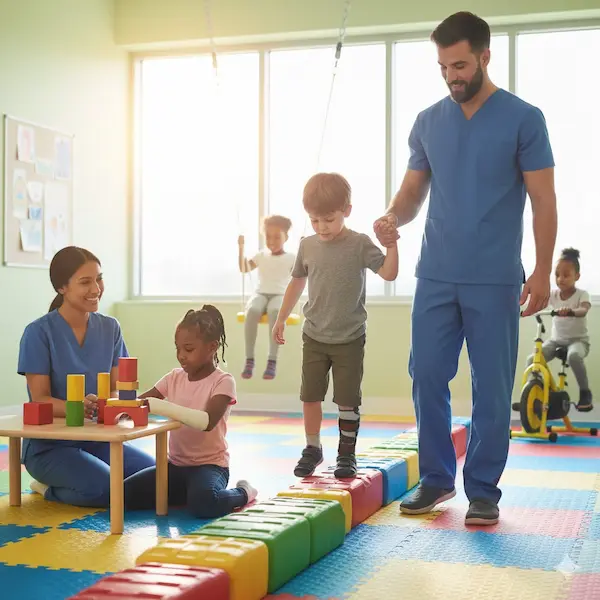
Features of the children's rehabilitation center
The ideal center is characterized by a set of characteristics that ensure that the child’s journey towards empowerment is effective, safe, and stimulating. The most important features of the specialized centers are the following:
- The presence of specialists in different fields (physical therapy, occupational therapy, speech, and psychology) working in complete coordination.
- Design fully customized programs to meet each child's unique needs and goals.
- Parent involvement and training are an essential part of the rehabilitation process to ensure continued progress at home.
- Providing modern spaces and tools designed to suit children, making learning and rehabilitation enjoyable.
- Using the latest devices and therapeutic methods supported by scientific evidence to enhance results.
- Continuously reviewing the child’s progress and adjusting the treatment plan flexibly according to the development of his condition.
- Not only the physical aspect, but also supporting social, emotional, and cognitive skills.
اقرأ ايضاً: Discover the most important steps in the effective physical therapy rehabilitation process
The importance of rehabilitating children
Investing in rehabilitation is an investment in their future, as this comprehensive process aims to support the child’s development in all aspects, and this brings him a set of profound benefits. They are as follows:
- The child's motor skills (walking and playing), cognitive abilities (learning and understanding), and social interactions such as communication and building relationships improve significantly and inspiringly.
- Children acquire new skills that increase their ability to rely on themselves in daily life activities, which gives them a feeling of freedom and facilitates their movement and interaction with their surroundings.
- Improving the child’s general health condition, increasing his self-confidence, and raising his level of happiness and satisfaction with his life.
- Children are empowered to become more adaptable and integrated into the school environment and community. This early support sets them on a path to long-term academic and social success.
- The best results are achieved because each child is treated as a unique case, and fully customized treatment plans are created that meet his or her unique needs and challenges, increasing the effectiveness of treatment.
Treatment plans for rehabilitation of children
Rehabilitation aims to enable each child to achieve his or her maximum developmental potential, as treatment plans are designed to suit individual needs. It includes a group of the following therapeutic methods:
Motor skills training:
This training aims to develop the child’s physical abilities through carefully designed activities that focus on fine and gross motor skills. By working on specialized exercises, basic aspects such as balance and coordination are enhanced, in addition to improving the vital harmony between hand and eye movement, which enables the child to deal with his surroundings more efficiently.
Physical therapy:
It is considered an essential foundation for increasing the child's physical endurance and strength. It includes a set of muscle-strengthening exercises that contribute to improving the level of energy and effort, in addition to performing flexibility and movement exercises. Advanced training in walking and balance can also be provided, and this may include the use of advanced rehabilitation devices to support movement.
Occupational therapy:
It focuses on giving the child the necessary tools to gain independence in practicing his basic daily life activities. Practical exercises and practices are implemented to help him master self-care tasks, and specialized programs are prepared to support his effective participation in school activities, playtime, and his integration into social life in a smooth and comfortable manner.
Speech and language therapy:
This aspect addresses communication challenges, as special, targeted techniques are applied to effectively develop the child’s speech and language skills, which enhances his ability to communicate and express himself. Voice, pronunciation, and verbal expression problems are also addressed, with the aim of building the child’s confidence in interacting with others.
Play therapy:
Play therapy is a dynamic approach that uses organized activities and games as a primary means to support the child’s social, emotional, and cognitive development. This approach ensures that the activities are fun and stimulating, and this makes the treatment process more effective and turns it into an interesting and enjoyable educational experience for the child.
Psychological support and family guidance:
Believing that the family is an essential partner, psychological support is provided to meet the child’s emotional and social needs and enhance his psychological resilience. At the same time, families are provided with knowledge and guidance, and taught supportive methods and exercises that they can easily apply at home, to ensure the continuity of rehabilitation results.
اقرأ ايضاً: إليك أحدث تقنيات العلاج الطبيعي وأهم فوائدها الطبية
Children's rehabilitation tools
Modern technology and innovative tools play a crucial role in enhancing the child’s development and accelerating the process of restoring his motor and cognitive functions. The most important basic tools and techniques in rehabilitating children are the following:
- Robotic rehabilitation devices:
These are advanced technologies that help retrain walking and balance, and provide a safe environment that simulates daily challenges.
- Hydrotherapy unit:
These are special therapeutic pools used Water Warm to relieve pressure on joints and muscles, allowing the child to perform strength and movement exercises with the least possible resistance.
- Micro-skills development tools:
It is a variety of devices and tools specifically designed to improve fine motor skills and hand coordination.
- Electrostimulation and laser techniques:
To strengthen muscles and prevent atrophy, laser and ultrasound therapy to relieve pain and accelerate tissue healing.
- Sensory integration modules:
Equipped rooms and tools help children with sensory disorders process sensory information better, and this supports behavioral and cognitive development.
- Walking aids and devices:
They include anti-gravity treadmills that allow exercise without complete stress on the joints, as well as various supports and other assistive devices.
Frequently asked questions
What is child rehabilitation?
It is an integrated and specialized process that aims to help children who face challenges (physical, mental, or behavioral) to develop their skills and abilities to the greatest extent possible. The primary goal is to enable the child to achieve independence, improve his quality of life, and ensure his effective and positive integration into society.
What is the difference between physical therapy and rehabilitation?
Rehabilitation is the most comprehensive concept, and is an integrated process aimed at restoring function and achieving maximum independence and quality of life after injury or illness. It includes multiple specializations (medical, psychological, social).
Physical therapy is an essential part and one of the rehabilitation specialties, focusing primarily and directly on improving movement, strength, flexibility, balance and physical function.
What are rehabilitation sessions?
Rehabilitation sessions are planned, specialized therapeutic meetings led by a team of specialists, such as physical, occupational, or speech therapists.
Its main goal is to improve the individual's abilities (physical, cognitive, social) and restore function after illness or injury, which enables him to achieve independence and effectively raise his quality of life.
How much do physical therapy fees cost?
Physiotherapy fees cannot be determined by a fixed number, as prices vary greatly and depend on basic factors such as the service provider (hospital or private center), the type of treatment provided (traditional treatment or advanced techniques), the duration of the session, in addition to the experience of the specialist, and the extent of health insurance coverage for it.
To get an accurate cost, You must contact Al Mousa Specialist Hospital directly To inquire about their pricing system.
What are the three types of rehabilitation?
The rehabilitation process is essentially divided into three interconnected types: physical rehabilitation, which focuses on restoring movement, strength, and physical function; functional rehabilitation, which aims to enable the individual to achieve independence in daily life tasks; and speech and language rehabilitation, which focuses on improving communication, pronunciation, and comprehension skills. These types work together within a comprehensive plan to restore the individual’s quality of life.
in the end, Rehabilitating children is a necessary and valuable investment in building their future. It provides the specialized support that the child needs to develop his abilities and achieve independence and balanced growth. Our ultimate goal is to enable every child to participate effectively and happily in his society, to find his natural place and achieve his maximum potential.
