
Vaccinating infants is one of the necessary and important steps to protect individuals from serious diseases. However, it is accompanied by an increase in temperature, which is a normal and common increase, but it worries parents. However, there is no need to worry. Below, with Al Mousa Specialist Hospital, we provide a comprehensive guide on treating fever in infants after vaccination, starting with ways to reduce fever at home and even cases that require consulting a doctor. Read on for more details.
Why does an infant's temperature rise after vaccination?
The infant's temperature rises after vaccination for many reasons, the most important of which are the following:
- Activating the immune system, as the vaccination contains dead or weakened germs that when they enter the infant’s body, the immune system fights them. This process triggers a natural inflammatory response and thus an increase in temperature as a sign of this response.
- Some vaccines contain adjuvants that aim to stimulate a strong immune response, and these substances work to increase temperature.
- Also, some vaccines cause a higher temperature than others. For example, the measles, mumps, and rubella vaccine causes a mild fever about one to two weeks after vaccination.
- Some vaccines are given by injection, which causes local inflammation and a slight increase in temperature.
When can an infant's temperature rise after vaccination be considered abnormal?
A sharp increase in temperature, from mild to moderate, after vaccination is considered normal and common. It is also considered an indicator that the infant’s immune system is working properly, but it is very important to monitor the infant and monitor his temperature, so that appropriate action is taken to reduce the temperature if necessary.
An infant's high temperature after vaccination can be considered a worrying and abnormal matter if the temperature rises above 38 degrees Celsius in infants less than 3 months old, and if the fever persists for more than 3 days. Likewise, when the infant suffers from various other symptoms associated with fever, such as difficulty breathing, rashes, as well as when he cries continuously, and in any of these cases it is necessary to consult a doctor immediately so that he can diagnose the infant and provide him with treatment for infant fever after the appropriate vaccination for your infant.
Get to know: Colic medications for children: when to use them and when to visit the doctor
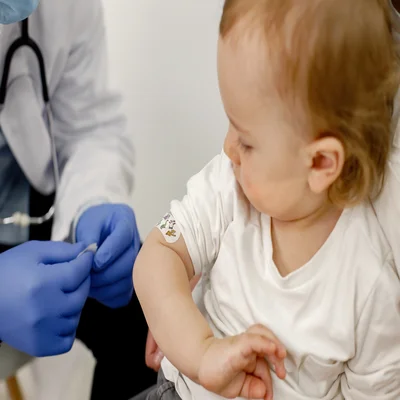
Ways to reduce an infant's temperature after vaccination
An increase in the infant’s temperature after vaccination is a widespread issue among infants, but it is important to deal with the matter in the correct manner to ensure the child’s safety and comfort. There are some effective ways to reduce the temperature after vaccination, which are as follows:
Use of fever-reducing medications
Before giving an infant any medication, it is necessary to consult a pediatrician to determine the dose that is appropriate for the child’s age and weight. There are some antipyretics available, including paracetamol and ibuprofen. It is necessary to follow the doctor’s instructions carefully to not exceed the recommended dose. Infants should not be given aspirin, as it can cause Reye’s Syndrome, which is among the serious conditions in children.
What to do
Mothers always ask themselves what they should do in this case to their child after giving treatment for fever in infants after vaccination. In fact, there are some procedures that can be followed, including using compresses with lukewarm water using a piece of soft cloth, provided that they are lukewarm and not too cold, while placing the compresses on the child’s forehead, under the armpits and between the thighs, while changing the compresses about once every quarter of an hour. It is also important to loosen the child’s clothes so that he wears light and loose clothes, while not covering the child too much so that it does not rise.
If the child is breastfed, he must continue to be breastfed frequently. Likewise, if he is dependent on formula milk, he must be given small amounts of milk frequently. For children older than 6 months, it is important to give them small amounts of lukewarm water between feedings.
Make sure to ventilate the room well so that it is not too hot, and it is necessary to monitor the child’s temperature regularly. If the fever increases for more than 3 days or the child’s temperature rises above 38 degrees Celsius in infants less than 3 months old, a doctor should be consulted immediately.
You can also benefit from: What are the ways to treat a strong cough in children?
When should we visit the doctor?
Fever after vaccination is common and normal, but there are some cases that require you to visit a doctor immediately to obtain treatment for fever in infants after vaccination immediately, and these cases are evident as follows:
- When the temperature rises to 38 degrees Celsius, and more for infants less than 3 months.
- When the temperature rises to 39 degrees Celsius, and more for infants between 3 and 6 months.
- When the infant's temperature increases to 40 degrees Celsius or more for a child older than 6 months.
- If the fever persists for more than 3 days.
- If the child suffers from some accompanying symptoms such as skin rash, difficulty breathing, difficulty waking up, continuous crying or severe irritability, refusal to breastfeed or refusal to take fluids, persistent diarrhea or vomiting, stiffness in the neck, and seizures.
Book your consultation now at Pediatric Center At Al Mousa Specialist Hospital.
How to deal with high temperatures after vaccination
An increase in temperature after vaccination must be dealt with with caution and care. There are some important tips and instructions on how to deal with an increase in temperature after vaccination, which are as follows:
- Measure the child’s temperature regularly, and it is preferable to use the rectal or armpit temperature measurement.
- Consult a pediatrician before giving the child any medicine to reduce fever. It is usually recommended to give paracetamol or ibuprofen in the appropriate dose for the child’s age and weight.
- Give the child enough rest and sleep, and avoid strenuous physical activities.
- Provide the child with the necessary fluids by encouraging him to drink plenty of fluids, such as water, diluted juice, or soup. If the child is breastfed, he must continue to breastfeed him frequently.
It should be noted that most cases of high temperature after vaccination are mild and go away without therapeutic intervention within a few days, but it is important to follow the child closely and go to the doctor if any worrying signs appear.
Frequently asked questions
When should I give my child an antipyretic after vaccination?
It is not recommended to give an infant an antipyretic after vaccination as a preventive measure. It is best to measure the child’s temperature and observe the child’s general condition. If the infant shows signs of discomfort or his temperature exceeds 38 degrees Celsius, a doctor must be consulted to give him an antipyretic appropriate for his age and weight.
How long does the fever last after two months of vaccination?
Usually, the fever lasts after the two-month vaccination for a period ranging from one to three days. It should be noted that this period varies from one child to another, and there is no specific standard for all children. There are a number of factors that affect the duration of the fever after vaccination, including the type of vaccination, the immune system, and age. Younger children may be more susceptible to an increase in temperature after vaccination.
How do I bring down a baby's temperature quickly?
In order to quickly reduce the infant's temperature, you must follow some steps, which include using a fever reducer, applying lukewarm compresses, loosening clothing, and drinking plenty of fluids, while providing comfort to the child and ventilating the place well.
Where to put compresses to quickly reduce the temperature?
To quickly reduce the temperature, lukewarm compresses are placed on specific areas of the body, including those areas where blood vessels are located near the surface of the skin, thus cooling the body faster. These areas include the forehead, neck, armpits, and thighs. In addition, lukewarm compresses can be placed on both the wrists and ankles. It is important to ensure that the compresses are lukewarm and not too cold to avoid causing the child to shiver.
When any worrying signs appear after the child’s vaccination, it is important to go to the doctor. An appointment can be made at Al-Mousa Specialist Hospital for the doctor to diagnose the child and provide treatment for fever in infants after vaccination. Your child’s health is worth it.
Medical sources
This information was based on:
