
Mothers usually suffer from the problem of infants vomiting phlegm with milk. Doctors have confirmed that this is a normal thing that usually happens to all children as long as the child does not show any symptoms that require concern, such as mucus mixing with blood or severe pain during vomiting and other abnormal matters. Here, it is necessary to consult a specialist doctor, but usually there are many natural causes for the problem of phlegm vomiting in children.
Causes of phlegm in children
There are many reasons for the problem of children coughing up phlegm, which are as follows:
- The child consumes more milk than his digestive system can absorb, which leads to phlegm being expelled with the milk. This is often due to the incompleteness of the valve that keeps the milk inside the infant’s stomach.
- If a child suffers from a cold, he will expel phlegm from the mouth as a result of swallowing a quantity of it during breastfeeding, as a result of his inability to expel it through the nose.
- The child suffers from crying spells for a period of time, which leads to the child coughing and thus vomiting milk along with some phlegm.
- The child suffers from chronic itching, which leads to the accumulation of phlegm in the chest, which is then expelled with milk because he is unable to expel it through the nose.
- The child suffers from allergies in the chest and nose, which leads to the accumulation of phlegm in the chest and its excretion with milk when vomiting.
- The presence of a viral infection in the child’s respiratory system.
- The baby suffers from gas as a result of swallowing some air while breastfeeding.
- The flow of the grain to the child is excessive, and the child is unable to swallow it to the required amount.
- The child suffers from pyloric stenosis, which is a rare disease that affects children and usually causes a narrowing of the pyloric muscle, which is located at the end of the stomach.
Clear phlegm discharge for children
When children have a cold or flu, the body secretes a clear phlegm, specifically in the trachea or bronchi, in order to combat infections that may affect the respiratory system due to the cold.
It is a transparent substance that resembles saliva, but in reality it is dead cells containing a high percentage of white blood cells, and it works to retain bacteria in order to resist them.
There are many reasons that lead to the appearance of this type in children, including the following:
- Exposure to smoke.
- Sinusitis.
- Nasal infections.
- Colds.
- Bronchitis.
The child vomits yellow phlegm
The body produces phlegm and it is transparent and white in color at first due to a respiratory disease, cold or other causes, but with time and the large number of white blood cells that fight infection, its color turns yellow or green, depending on the degree of the disease and the aggravation of the condition.
Its appearance is due to the following reasons:
- Viral infection.
- Bacterial infection.
- Lung infections.
Is phlegm beneficial for children?
Yes, it is beneficial for children to expel phlegm because its accumulation leads to many problems, which are as follows:
- Inflammation of the mucous membranes, leading to respiratory infections.
- Respiratory tract infection.
- Having difficulty breathing.
- Pneumonia.
- Respiratory infection.
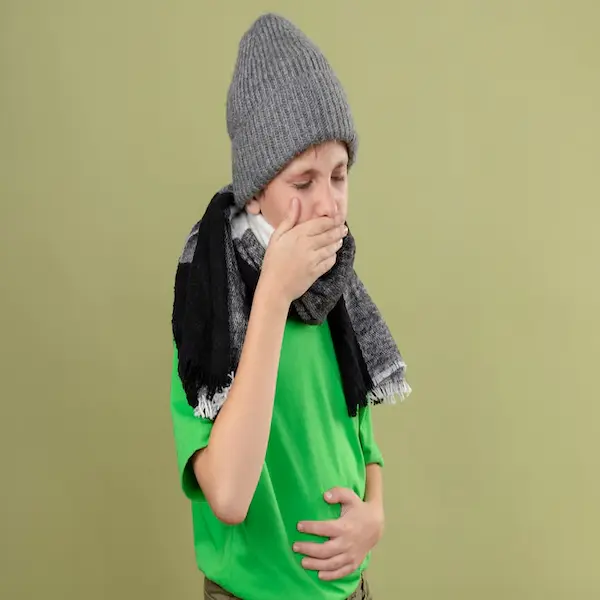
Vomiting blood with phlegm for children
There are a group of reasons that lead to children vomiting blood with phlegm, which are as follows:
- The child has a disorder in the blood clotting process.
- The child suffers from an allergy, specifically to milk.
- The presence of a defect in the child due to abnormal growth before birth.
- The child suffers from vitamin K deficiency.
- The child swallowed something.
How do you deal with phlegm vomiting in children?
There are a set of tips that must be taken into account when children cough up phlegm, which are as follows:
- Make sure that the child does not eat chocolate or milk, as they are foods that increase the rate of phlegm production in the body.
- Giving the child balanced doses of medications that dissolve phlegm at the specified times and according to the doctor’s instructions.
- Ensure that the child receives steam sessions that work to relieve andعلاج الكحة It dissolves phlegm, which leads to cleansing the chest.
- Observe the child's expressions and condition carefully, and if necessary, go to the treating physician immediately.
When should a doctor be consulted when children cough up phlegm?
You should make sure to see a doctor immediately. You can Book a consultation at a clinicPediatric Center At Al Mousa Specialist Hospital And check on your child, if some symptoms are noticed in the child, which are as follows:
- The child suffers from difficulty breathing.
- Noticing that the child’s temperature is very high and he does not respond to medications.
- It persists for a long time with no improvement even if you follow all the required instructions.
- The child suffers from clear signs of dehydration.
Factors that lead to phlegm in children
There are a group of important factors that lead to phlegm in children, which are as follows:
- The child suffers from chest or nasal allergies.
- The presence of some infections in the child’s respiratory system.
- The child suffers from a chronic cough, which leads to the accumulation of phlegm in the chest, which is then extracted to get rid of it.
- The child has the flu or a common cold.
- The child eats some foods that cause phlegm to accumulate in the chest, such as chocolate and milk.
The process of coughing up phlegm in children is a very common thing that occurs when phlegm accumulates in the child’s chest, so he resorts to this process in order to get rid of it. Some mothers usually worry about this matter, despite the fact that it is very useful for the child to get rid of phlegm, which may lead to many health problems if it accumulates. When this happens, it is necessary to resort to the treating physician for early diagnosis and to prescribe the correct treatment. In this case, it is preferable to return to Al-Mousa Specialist Hospital to receive the best amount of health care.
اسئلة شائعة
When is phlegm dangerous for a child?
If it is accompanied by high temperatures, if it lasts for long periods, if it is accompanied by shortness of breath or when it turns brown or black.
Does phlegm come out with vomiting?
Yes, there is a portion of the phlegm stuck in the stomach that comes out with vomiting, and it is usually swallowed during breastfeeding. This is in addition to the release of phlegm stuck in the throat. As for the phlegm that causes coughing, which is usually in the chest, it does not come out with vomiting.
Medical references
Baby Spitting Up Clear Liquid – healthline
My Child Coughs So Hard, They Vomit. Should I Worry – healthcare
