
Umbilical hernia is a common condition, especially in infants. It occurs when part of the intestine or fat protrudes through a weak point in the abdominal wall near the navel. It looks like a small bulge, which worries mothers or adult patients. What are its causes and how dangerous is it? This is what we will talk about in this article presented by Al Mousa Specialist Hospital. We will delve into understanding the main symptoms of umbilical hernia, and how doctors diagnose it accurately. We will also give you practical advice for living with this condition, managing it effectively, and the available treatment options.
What is an umbilical hernia?
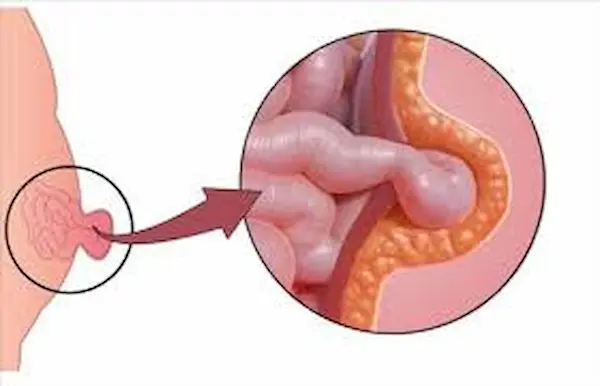
An umbilical hernia occurs when part of the intestine or fatty tissue protrudes through a weak part of the abdominal muscles, specifically near the navel, and appears as a bulge or soft swelling in the navel area.
Umbilical hernia is very common in infants and young children, but it can also affect adults.
What are the symptoms of umbilical hernia in children?
Common symptoms of umbilical hernia in children include:
- A bulge or swelling around the navel in the form of a soft lump or protrusion, and this is the most obvious sign.
- Bloating appears and becomes more noticeable when straining during defecation or when the child cries or coughs.
- The swelling disappears or decreases in size when the child is calm or lying down.
The following symptoms indicate the presence of rare and serious complications:
- The child feels pain and constant crying.
- The swelling becomes hard, swollen, or changes color to red or blue.
- The child vomits or suffers from severe constipation.
- It is not possible to re-inflate with gentle pressure.
Learn about: What are the most common diseases of the digestive system?
What are the causes of umbilical hernia?
The causes of umbilical hernia differ mainly between children and adults.
The reason for umbilical hernia in children is that in fetuses, the umbilical cord passes through a small opening in the abdominal muscles. It is normal for this opening to close immediately after birth.
An umbilical hernia occurs when these muscles do not close completely, leaving a weak point through which intestines or fatty tissue protrude.
Some factors that increase the risk of infection in children include:
- الولادة المبكرة.
- Low birth weight of the baby.
- Having a family history of umbilical hernia.
While the cause of umbilical hernia in adults is due to increased pressure on the weak abdominal wall, this weakness may be present from birth or develop over time. The most prominent factors that increase this pressure are the following:
- Repeated pregnancy, especially with twins or more.
- Excessive obesity, which increases intra-abdominal pressure.
- Chronic cough, as in the case of smokers or those suffering from some respiratory diseases.
- Lifting heavy objects frequently and with effort.
- Fluid accumulation in the abdomen, such as in patients with ascites.
- Previous abdominal surgeries, which led to weakening of the muscles in that area.
- Chronic constipation, which causes straining during defecation.
How can an umbilical hernia be diagnosed?
To determine the type and size of hernia at Al Mousa Specialist Hospital, doctors rely on several diagnostic steps, including:
- Physical examination, where the doctor examines the area and looks for any bulge or swelling around the navel, then gently presses on the bulge to try to return it to the abdominal cavity. If the bulge disappears with pressure, this often confirms the presence of a hernia.
- Strain request, where the doctor asks the patient to cough or strain himself, which increases intra-abdominal pressure and makes the hernia stand out more clearly.
- Imaging examinations. In most cases of umbilical hernia, the doctor does not need imaging examinations to confirm the diagnosis. However, he may sometimes resort to them if the diagnosis is unclear, or to determine whether there is another accompanying hernia. The most prominent of these examinations is ultrasound, known as ultrasound, to confirm the presence of the hernia and determine its intestinal or fat contents.
Book your consultation now at مركز أمراض الجهاز الهضمي At Al Mousa Specialist Hospital.
What is the treatment for umbilical hernia?
Treatment of umbilical hernia varies according to the patient's age, the size of the hernia, and the presence of any complications, and is as follows:
Treatment of umbilical hernia in children
In most cases, umbilical hernias in children heal on their own within the first two years of life. Therefore, doctors may recommend waiting and watching that it does not cause pain and does not grow significantly.
While the doctor may resort to surgical intervention to treat umbilical hernia in children in the case of:
- The hernia does not disappear when the child reaches the age of 4 or 5 years.
- The hernia is very large and increasing in size.
- The hernia causes pain to the baby.
- Strangulated hernia, a rare and serious condition that occurs when tissue gets stuck inside the hernia, cutting off blood flow.
Treatment of umbilical hernia in adults
In some simple and painless cases, the doctor may recommend wearing a hernia belt or brace, but this is not a final treatment and should be used under medical supervision to prevent the condition from getting worse.
As umbilical hernias do not tend to heal on their own in adults, but may get worse over time, therefore, surgical intervention is the most effective and common solution.
The umbilical hernia operation for adults aims to return the protruding tissue into the abdominal cavity and close the opening in the abdominal wall. The surgery can be done in one of these two ways:
- Open surgery: A small incision is made near the navel, the hernia is put back in place, then the hole is sutured. Medical mesh is often used to strengthen the abdominal wall and prevent the hernia from recurring.
- Laparoscopic surgery: It is performed through several small incisions. The surgeon uses a camera and precise tools to repair the hernia from the inside. This method is characterized by less pain and speeds up the recovery process.
Learn about: Gastroenterology diseases
الاسئلة الشائعة:
Is an umbilical hernia dangerous?
Umbilical hernias are usually not serious in most cases, especially in children, and often disappear on their own before the age of one year. However, they may be more serious in some cases, especially in adults or if left untreated, such as:
- Strangulated hernia.
- Hernias that are large or increasing in size.
- Hernia that causes chronic pain or digestive problems.
When does an umbilical hernia need an operation?
An umbilical hernia needs surgery in children in the following cases:
- If the hernia does not close spontaneously by the age of 4-5 years.
- If the hernia becomes incarcerated, that is, when the intestine or tissue becomes stuck inside the hernia and cannot be pushed back into the abdomen, this can cause severe pain and vomiting.
- If the hernia becomes strangulated, an emergency condition in which blood flow to the trapped part of the intestine is cut off, which can lead to tissue death.
While in adults, the umbilical hernia usually requires surgery because it does not heal on its own and may grow over time, especially if it increases in size or becomes painful or if suffocation or retention occurs, as in children, or in pregnant or obese women.
Is it possible to live with an umbilical hernia?
Yes, it is possible to live with an umbilical hernia in many cases, such as cases of infants and children before the age of 4-5 years, and the hernia is small, less than 1-2 cm and does not cause pain or complications. It can only be monitored.
Also, in adults, if the hernia is small, painless, and does not grow larger with time, surgery can be postponed under the supervision of a doctor, and they can live with the hernia while following prevention guidelines, such as;
- Avoid increasing pressure on the abdomen by not carrying heavy weights, avoiding constipation, and avoiding severe, chronic coughing.
- Monitor the hernia constantly. If it increases in size or becomes painful or hardened, you must see a doctor immediately.
- Wear a hernia belt with the advice of a doctor.
In conclusion, umbilical hernia is a common medical condition that can be treated effectively when diagnosed early. You should consult a doctor if you notice any swelling or pain around the navel, as accurate diagnosis is the first step towards correct treatment.
For those looking for integrated medical care, Al Mousa Specialist Hospital provides umbilical hernia diagnosis and treatment services using the latest medical technologies and a team of specialized doctors, to ensure that you get the best health results. Do not hesitate to visit us for optimal advice and treatment, and you can contact us on our numbers listed on the website for more details, reservations and inquiries.
Sources
What to know about an umbilical hernia – medicalnewstoday
